
M1 June 2018 Q4
4. A ball of mass 0.2 kg is projected vertically downwards with speed \(U\) m s\(^{-1}\) from a point \(A\) which is 2.5 m above horizontal ground. The ball hits the ground. Immediately after hitting the ground, the ball rebounds vertically with a speed of 10 m s\(^{-1}\). The ball receives an impulse of magnitude 7 N s in its impact with the ground. By modelling the ball as a particle and ignoring air resistance, find
After hitting the ground, the ball moves vertically upwards and passes through a point \(B\) which is 1 m above the ground.
| Scheme | Marks |
|---|---|
| \(V^2 = U^2 + 2g \times 2.5\) | M1A1 |
| Eliminate \(V\) and solve for \(U\) | A1 (DM1) |
| \(7 = 0.2(10 - -V)\) | M1A1 |
| \(U = 24\) | A1 |
| (6) |
Notes
First M1 for complete method, using suvat, to find equation in \(U\) and \(V\) only
First A1 for a correct equation
Second A1 – treat as third DM1, dependent on the other two M’s, for eliminating \(V\) and solving for \(U\)
Second M1 for using Impulse = Change in Momentum of ball (must have 0.2 in both terms and be using 10 as one of the velocities) (M0 if clearly adding momenta or if \(g\) is included) but condone sign errors.
Third A1 for a correct equation, 7 and 10 must have the same sign but equation may have \(V\) instead of \(-V\)
Fourth A1 for \(U = 24\) (must appear here)
N.B. If they use \(U\) instead of \(V\) in the impulse-momentum equation, can score max M1A0/6 for part (a).
N.B. If they go from \(V^2 = U^2 + 49\) to \(V = U + 7\), can score max 5/6
| Scheme | Marks |
|---|---|
| \(1 = 10t - 4.9t^2\) OR e.g. \(v^2 = 10^2 - 2 \times 9.8 \times 1\) and \(v = 10 - 9.8t\) | |
| \(1 = 10t - 4.9t^2\) to give \(\sqrt{80.4} = 10 - 9.8t\) | M1 A1 |
| \(t = \dfrac{10 \pm \sqrt{100 - 19.6}}{9.8}\) so \(t = \dfrac{10 - \sqrt{10^2 - 2 \times 9.8 \times 1}}{9.8}\) | DM1 |
| \(t = 0.11\) s or 0.105 s | A1 |
| (4) |
Notes
First M1 for complete method, using one or more suvat formulae, to produce an equation in \(t\) only using \(s = 1\) or \(-1\)
First A1 for a correct equation in \(t\) only
Second DM1, dependent on first M1, for solving their equation (this mark can be implied by a correct answer)
Second A1 for either 0.105 (s) or 0.11 (s) (must be only ONE answer)
ALTERNATIVE
| ALTERNATIVE : “the instant when the ball first passes through \(B\)” is taken to be when the ball is on the way down from \(A\). | |
| \(s = vt - \dfrac{1}{2}at^2\) OR \(v_B^2 = 24^2 + 2 \times 9.8 \times 1.5\) and \(25 = v_B + 9.8t\) | |
| \(1 = 25t - 4.9t^2\) to give \(25 = \sqrt{605.4} + 9.8t\) | M1 A1 |
| \(t = \dfrac{25 \pm \sqrt{625 - 19.6}}{9.8}\) so \(t = \dfrac{25 - \sqrt{625 - 19.6}}{9.8}\) | DM1 |
| \(t = 0.040\) (s) or 0.0403 (s) or 0.04 (s) (must only be ONE answer) | A1 |
First M1 for complete method, using one or more suvat formulae, to produce an equation in \(t\) only using \(s = 1\) or \(-1\)
First A1 for a correct equation in \(t\) only
Second DM1, dependent on first M1, for solving their equation (this mark can be implied by a correct answer)
Second A1 \(t = 0.040\) (s) or 0.0403 (s)
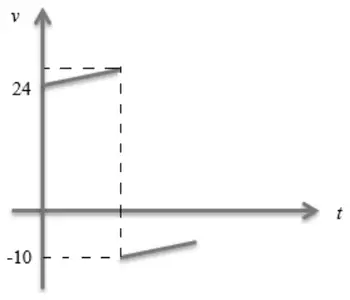
| Scheme | Marks |
|---|---|
| B1ft 1st line | |
| B1 2nd line | |
| B1 ,-10 | |
| (3) | |
| (13 marks) |
Notes
First B1ft for a straight line, with positive gradient, starting at their \(U\) value (or just at \(U\)) on the positive \(v\)-axis.
Second B1 for a parallel (approx.) line placed correctly (B0 if a continuous vertical line is included)
i.e. starting at a point where the \(t\) coordinate is equal to the \(t\) coordinate of the point where the first line stopped, and the \(v\) coordinate is negative.
Third B1 for second line, placed correctly, starting on \(v = -10\)
N.B. Whole graph could be reflected in the \(t\)-axis
SC: If second line is placed correctly but extends up to the \(t\)-axis, or beyond, lose second B1 but can score the third B1.
ALTERNATIVE
| ALTERNATIVE : again “when it first passes through \(B\)” is taken to be when the ball is on the way down from \(A\). | |
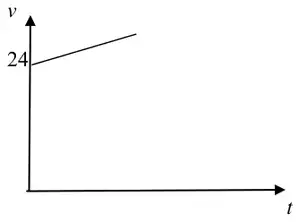 | B2 line B1ft 24 |
B2 for a straight line, with positive gradient, starting on the positive \(v\)-axis.
B1ft starting at their \(U\) value (or just at \(U\))