
M3 June 2014 Q4
4.
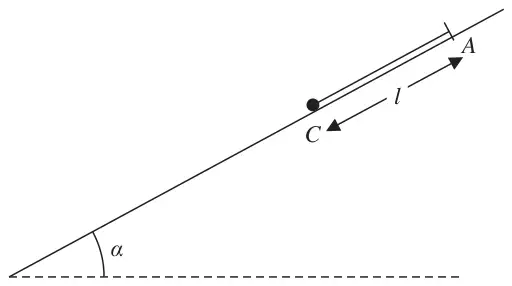
One end of a light elastic string, of natural length \(l\) and modulus of elasticity \(3mg\), is fixed to a point \(A\) on a fixed plane inclined at an angle \(\alpha\) to the horizontal, where \(\sin\alpha = \dfrac{3}{5}\)
A small ball of mass \(2m\) is attached to the free end of the string. The ball is held at a point \(C\) on the plane, where \(C\) is below \(A\) and \(AC = l\) as shown in Figure 3. The string is parallel to a line of greatest slope of the plane. The ball is released from rest. In an initial model the plane is assumed to be smooth.
In a refined model the plane is assumed to be rough. The coefficient of friction between the ball and the plane is \(\mu\). The ball first comes to instantaneous rest after moving a distance \(\dfrac{2}{5}l\).
| Scheme | Marks |
|---|---|
| \(\dfrac{3mgx^2}{2l} = 2mgx\sin\alpha\) | M1A1 B1(A1 on e-pen) |
| \(3x^2 = 4xl \times \dfrac{3}{5}\) | |
| \(5x^2 = 4xl\) | |
| \(x = \dfrac{4}{5}l\) | DM1A1 |
| (5) |
Notes
M1 for an energy equation with an EPE term of the form \(\dfrac{kmgx^2}{l}\) and a GPE term. If a KE term is included it must become 0 later.
A1 for a correct EPE term
B1 for a correct GPE term. This can be in terms of the distance moved down the plane or the vertical distance fallen
M1 dep for solving their equation to obtain the distance moved or using the vertical distance and obtaining the distance moved along the plane.
A1 for \(x = \dfrac{4}{5}l\) oe eg \(x = \dfrac{12}{15}l\)
If \(m\) used instead of \(2m\), assuming correct otherwise: (a) M1A1B0M1A0 (so 2 penalties for mis-read)
Alternative for Question 4 (a): Using NL2
| \(2ma = 2mg\sin\alpha - \dfrac{3mgx}{l}\) | |
| \(2v\dfrac{\mathrm{d}v}{\mathrm{d}x} = \dfrac{6g}{5} - \dfrac{3gx}{l}\) | M1(equation and attempt integration) |
| \(v^2 = \dfrac{6gx}{5} - \dfrac{3gx^2}{2l},\ +c\) | A1, A1 (show \(c = 0\)) |
| \(v = 0\ \ 3gx\left(\dfrac{2}{5} - \dfrac{x}{2l}\right) = 0\) | M1 (set \(v = 0\) and solve) |
| \(x = \dfrac{4l}{5}\) | A1 |
| Scheme | Marks |
|---|---|
| \(R = 2mg\cos\alpha\ \ \left(= \dfrac{8}{5}mg\right)\) | B1 |
| \(\dfrac{3mg}{2l} \times \dfrac{4}{25}l^2 = 2mg \times \dfrac{2}{5}l \times \dfrac{3}{5} -,\ \ \ \mu\dfrac{8}{5}mg \times \dfrac{2}{5}l\) | M1A1ft, B1ft (A1 on e-pen) |
| \(6 = 12 - 16\mu\) | |
| \(16\mu = 6\ \ \ \ \mu = \dfrac{3}{8}\) | DM1A1 |
| (6) | |
| (11 marks) |
Notes
B1 for resolving perpendicular to the plane to obtain \(R = 2mg\cos\alpha\). May only be seen in an equation.
M1 for an work-energy equation with an EPE term of the form \(\dfrac{kmgx^2}{l}\), a GPE term and the work done against friction. The work term must include a distance along the plane.
A1 for EPE and GPE terms correct and work subtracted from the GPE
B1 ft for the work term ft their \(R\)
M1 dep for solving to obtain a value for \(\mu\)
A1 cso for \(\mu = \dfrac{3}{8}\) oe inc 0.375 but not 0.38
If \(m\) used instead of \(2m\), assuming correct otherwise:
(b) B1 \(R = mg\cos\alpha\)
M1, A1 Equation, with EPE correct and \(mg \times \dfrac{2}{5}l \times \dfrac{3}{5}\)
B1 ft \(\mu\dfrac{4mg}{5} \times \dfrac{2}{5}l\)
DM1, A1 \(\mu = 0\)
Alternative for Question 4 (b): Using NL2
| \(R = 2mg\cos\alpha\) | B1 |
| \(2v\dfrac{\mathrm{d}v}{\mathrm{d}x} = \dfrac{6g}{5} - \dfrac{3gx}{l} - \mu\dfrac{8g}{5}\) | |
| \(v^2 = \dfrac{6gx}{5} - \dfrac{3gx^2}{2l} - \mu\dfrac{8gx}{5},\ +c\) | M1(eqn and int)A1, A1 (show \(c = 0\)) |
| \(v = 0\ \ x = \dfrac{2l}{5}\ \ \ \mu\dfrac{8}{5} = \dfrac{6}{5} - \dfrac{3}{2l} \times \dfrac{2l}{5}\) | M1 (set \(v = 0\) and solve) |
| \(\mu = \dfrac{3}{8}\) | A1 |
If SHM methods are used, SHM must be proved first.