
M1 January 2011 Q6
6.
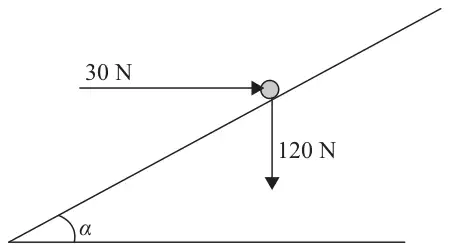
A particle of weight 120 N is placed on a fixed rough plane which is inclined at an angle \(\alpha\) to the horizontal, where \(\tan\alpha = \dfrac{3}{4}\).
The coefficient of friction between the particle and the plane is \(\dfrac{1}{2}\).
The particle is held at rest in equilibrium by a horizontal force of magnitude 30 N, which acts in the vertical plane containing the line of greatest slope of the plane through the particle, as shown in Figure 2.
(a) Show that the normal reaction between the particle and the plane has magnitude 114 N. (4)
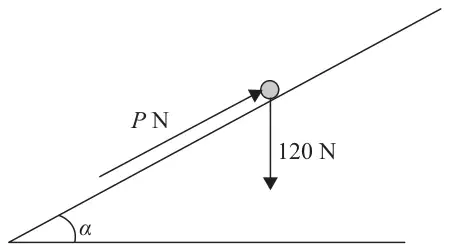
The horizontal force is removed and replaced by a force of magnitude \(P\) newtons acting up the slope along the line of greatest slope of the plane through the particle, as shown in Figure 3. The particle remains in equilibrium.
(b) Find the greatest possible value of \(P\). (8)
(c) Find the magnitude and direction of the frictional force acting on the particle when \(P = 30\). (3)
| Scheme | Marks |
|---|---|
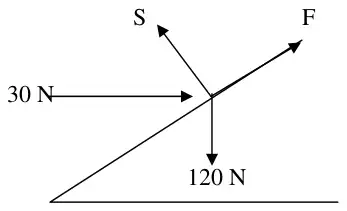
| Resolving perpendicular to the plane: | |
| \(S = 120\cos\alpha + 30\sin\alpha\) | M1 A1 A1 |
| \(= 114\) * | A1 |
| (4) |
| Scheme | Marks |
|---|---|
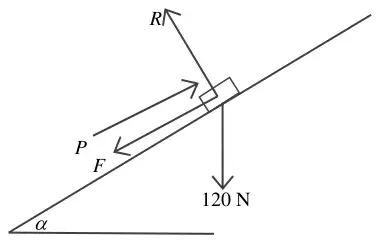
| Resolving perpendicular to the plane: | |
| \(R = 120\cos\alpha\) | M1 A1 |
| \(= 96\) | A1 |
| \(F_{\max} = \tfrac{1}{2}R\) | M1 |
| Resolving parallel to the plane: | |
| In equilibrium: \(P_{\max} = F_{\max} + 120\sin\alpha\) | M1 A(2,1,0) |
| \(= 48 + 72 = 120\) | A1 |
| (8) |
| Scheme | Marks |
|---|---|
| \(30 + F = 120\sin\alpha\) OR \(30 - F = 120\sin\alpha\) | M1 A1 |
| So \(F = 42\) N acting up the plane. | A1 |
| (3) | |
| (15 marks) |