
M2 June 2013 (R) Q6
6.
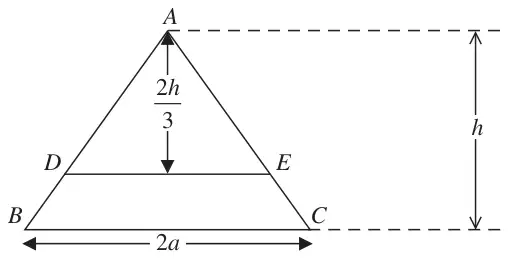
A uniform triangular lamina \(ABC\) of mass \(M\) is such that \(AB = AC\), \(BC = 2a\) and the distance of \(A\) from \(BC\) is \(h\). A line, parallel to \(BC\) and at a distance \(\dfrac{2h}{3}\) from \(A\), cuts \(AB\) at \(D\) and cuts \(AC\) at \(E\), as shown in Figure 2.
It is given that the mass of the trapezium \(BCED\) is \(\dfrac{5M}{9}\).
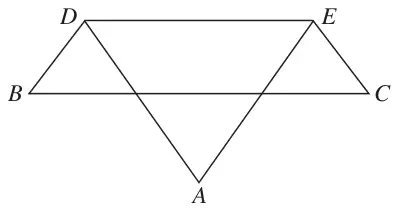
The portion \(ADE\) of the lamina is folded through 180\(^\circ\) about \(DE\) to form the folded lamina shown in Figure 3.
The folded lamina is freely suspended from \(D\) and hangs in equilibrium. The angle between \(DE\) and the downward vertical is \(\alpha\).
| Scheme | Marks | |||||||||
|---|---|---|---|---|---|---|---|---|---|---|
| B1 B1 M1 | |||||||||
| \(M\dfrac{h}{3} - \dfrac{4M}{9}\ \dfrac{5h}{9} = \dfrac{5M}{9}\bar{y}\) | A1 | |||||||||
| \(\bar{y} = \dfrac{7h}{45}\ \ \ \)*Answer Given* | A1 | |||||||||
| (5) |
Notes
B1 Correct mass ratios
B1 Correct distance ratios
M1 Moments equation. Condone sign slip
| Scheme | Marks |
|---|---|
| M1 | |
| \(\dfrac{5M}{9}\dfrac{7h}{45} + \dfrac{4M}{9}\left(\dfrac{h}{3} - \dfrac{1}{3} \times \dfrac{2h}{3}\right) = M\bar{x}\) | A1 A1 |
| \(\bar{x} = \dfrac{11h}{81}\) | A1 |
| (4) |
Notes
M1 Moments equation for the folded shape. Requires correct mass ratios, and terms of correct structure.
A1 A1 -1 each error \(\ \dfrac{h}{9}\)
| Scheme | Marks |
|---|---|
| \(\tan\alpha = \dfrac{\dfrac{h}{3} - \bar{x}}{\dfrac{2a}{3}}\) | M1 A1 ft |
| \(= \dfrac{8h}{27a}\) | DM1 A1 |
| (4) | |
| (13 marks) |
Notes
M1 Use of tan in correct triangle. Allow reciprocal.
A1 ft Correct unsimplified for their \(\bar{x}\)
DM1 Substitute and simplify