
M3 June 2013 (R) Q6
6.
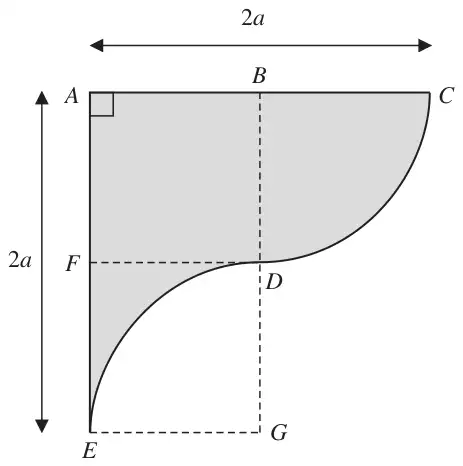
A second uniform lamina \(ABCDEFA\) is shown shaded in Figure 3. The straight sides \(AC\) and \(AE\) are perpendicular and \(AC = AE = 2a\). In the figure, the midpoint of \(AC\) is \(B\), the midpoint of \(AE\) is \(F\), and \(ABDF\) and \(DGEF\) are squares of side \(a\). \(BCD\) is a quadrant of a circle with centre \(B\). \(DGE\) is a quadrant of a circle with centre \(G\).
The lamina is smoothly hinged to a horizontal axis which passes through \(E\) and is perpendicular to the plane of the lamina. The lamina has weight \(W\) newtons. The lamina is held in equilibrium in a vertical plane, with \(A\) vertically above \(E\), by a horizontal force of magnitude \(X\) newtons applied at \(C\).
| Scheme | Marks |
|---|---|
| v1 Mass of quadrant \(= \rho\dfrac{\pi a^2}{4}\) | B1 |
| \(\displaystyle\int_0^a \rho x\sqrt{a^2 - x^2}\,\mathrm{d}x = \rho\left[-\frac{1}{3}\left(a^2 - x^2\right)^{\frac{3}{2}}\right]_0^a\) | M1A1 A1 |
| \(= \rho\left[0 + \dfrac{1}{3}a^3\right]\) | A1 |
| \(\rho\dfrac{\pi a^2}{4}\bar{x} = \rho\dfrac{a^3}{3}\) | M1 |
| \(\bar{x} = \dfrac{4a}{3\pi}\) , \(\bar{y} = \dfrac{4a}{3\pi}\) by symmetry *AG* | A1,A1 |
| (7) |
Notes
(The marks printed for v1 add up to 8; the part is worth 7.)
6 (a) v2
| Mass of quadrant \(= \rho\dfrac{\pi a^2}{4}\) | B1 |
| \(\displaystyle\int_0^{\frac{\pi}{2}} \rho \cdot \tfrac{1}{2}a^2 \cdot \tfrac{2}{3}a\cos\theta\,\mathrm{d}\theta = \left[\frac{a^3}{3}\sin\theta\right]_0^{\frac{\pi}{2}} = \rho\frac{a^3}{3}\) | M1A1,=A1 |
| \(\rho\dfrac{\pi a^2}{4}\bar{x} = \rho\dfrac{a^3}{3}\) | M1 |
| \(\bar{x} = \dfrac{4a}{3\pi}\) , \(\bar{y} = \dfrac{4a}{3\pi}\) by symmetry *AG* | A1A1 |
| Scheme | Marks | ||||||||
|---|---|---|---|---|---|---|---|---|---|
| B1 | ||||||||
| Moments about \(AE\): \(2a^2\bar{x} = 2a^2\dfrac{a}{2} + \dfrac{\pi a^2}{4}\left(a + \dfrac{4a}{3\pi}\right) - \dfrac{\pi a^2}{4}\left(a - \dfrac{4a}{3\pi}\right)\) | M1A2 | ||||||||
| \(= a^3 + \dfrac{2a^3}{3} = \dfrac{5a^3}{3}\) | |||||||||
| \(\bar{x} = \dfrac{5a^3}{3} \times \dfrac{1}{2a^2} = \dfrac{5a}{6}\) | A1 | ||||||||
| (5) |
| Scheme | Marks |
|---|---|
| Taking moments about \(E\): \(2aX = \dfrac{5a}{6}W\) their \(\bar{x}\) | M1A1ft |
| \(X = \dfrac{5}{12}W\) | A1 |
| (3) | |
| (15 marks) |