
M2 June 2012 Q4
4.
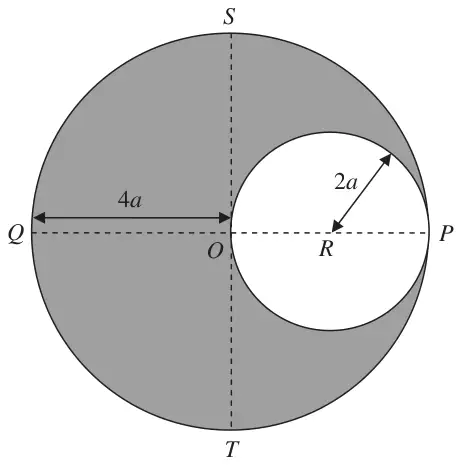
A uniform circular disc has centre \(O\) and radius \(4a\). The lines \(PQ\) and \(ST\) are perpendicular diameters of the disc. A circular hole of radius \(2a\) is made in the disc, with the centre of the hole at the point \(R\) on \(OP\) where \(OR = 2a\), to form the lamina \(L\), shown shaded in Figure 2.
The mass of \(L\) is \(m\) and a particle of mass \(km\) is now fixed to \(L\) at the point \(P\). The system is now suspended from the point \(S\) and hangs freely in equilibrium. The diameter \(ST\) makes an angle \(\alpha\) with the downward vertical through \(S\), where \(\tan\alpha = \dfrac{5}{6}\).
| Scheme | Marks | |||||||||
|---|---|---|---|---|---|---|---|---|---|---|
| B1 B1 | |||||||||
| \((4 \times 4a) - (1 \times 2a) = 3\bar{x}\) | M1 | |||||||||
| \(\dfrac{14a}{3} = \bar{x}\ \ *\) | A1 | |||||||||
| (4) |
Notes
B1 Correct mass ratios
B1 Distance of c of m from \(P\) (or from a point on \(QP\)).
M1 Moments about axis through \(P\), or about a parallel axis then convert the answer to distance from \(P\). Condone a sign slip.
A1 Answer given – check working carefully. Must reach positive answer legitimately.
| Scheme | Marks |
|---|---|
| \(OG = 4a\tan\alpha = \dfrac{10a}{3}\ \left(\Rightarrow PG = \dfrac{2a}{3}\right)\) | M1 A1 |
| \(M(P),\ (m + km)g.\dfrac{2a}{3}\cos\alpha = mg.\dfrac{14a}{3}\cos\alpha\) \(M(G):\ km \times \dfrac{2}{3}a = m \times \left(\dfrac{10}{3}a + \dfrac{2}{3}a\right) = 4ma\) \(M(O):\ m(1 + k) \times \dfrac{10}{3}a + m \times \dfrac{2}{3}a = km \times 4a\) \(M(C):\ \dfrac{12}{3}a \times (1 + k)m = \dfrac{14}{3}a \times km\) \(M(Q):\ \dfrac{22}{3}a \times m(1 + k) = \dfrac{10}{3}a \times m + 8a \times km\) | M1 A1 |
| \(k = 6\) | A1 |
| (5) | |
| (9 marks) |
Notes
M1 Vertical through \(S\) cuts \(OP\) at \(G\). Use trig to find the position of \(G\) on \(OP\).
A1 \(OG = \dfrac{10a}{3},\ QG = \dfrac{22a}{3}\) or \(PG = \dfrac{2a}{3}\) seen or implied
M1 Take moments about a point on \(QP\) – terms should be dimensionally consistent. Masses must be associated with the appropriate distances, which might be incorrectly evaluated or not yet found – e.g. accept with \(QG\). Must have the right terms but condone trig confusion. Also condone absence of trig.
A1 cso (\(C\) is the position of the original centre of mass.)
A1 cso
OR
| \((k + 1)m \times PG = m \times \dfrac{14}{3}a\) | M1 |
| \(PG = \dfrac{14a}{3(k + 1)}\) | A1 |
| \(\tan\alpha = \dfrac{OG}{4a} = \dfrac{4a - \dfrac{14a}{3(k + 1)}}{4a}\ \left(= 1 - \dfrac{7}{6(k + 1)}\right)\) | M1 |
| \(\dfrac{5}{6} = 1 - \dfrac{7}{6(k + 1)}\ \ \ \ k = 6\) | A1, A1 |
M1 Moments about P
A1 Correct expression for PG
M1 Use of \(\tan\alpha\) in the correct triangle.
A1, A1 Correct equation in \(k\), correct solution
OR
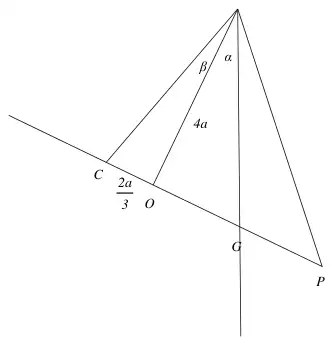 | |
| \(\tan(\angle CSO) = \tan\beta = \dfrac{\tfrac{2a}{3}}{4a} = \dfrac{1}{6}\) | M1 |
| \(km.\sqrt{32}a.\sin(45 - \alpha) = m.\sqrt{16\tfrac{4}{9}}a.\sin(\alpha + \beta)\) | M1A1 |
| \(k.\sqrt{32}.\left(\dfrac{6 - 5}{\sqrt{2}.\sqrt{61}}\right) = \dfrac{\sqrt{148}}{3}.\dfrac{6 \times 5 + 1 \times 6}{\sqrt{37}.\sqrt{61}}\) | A1 |
| \(4k = \dfrac{2}{3} \times 36,\ \ k = 6\) | A1 |
M1A1 Moments about S
A1 Do not expect accurate working
A1 Final answer 6.0