
M3 January 2012 Q7
7.
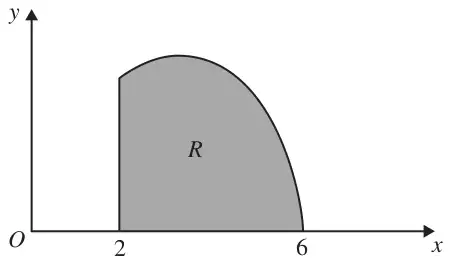
Diagram NOT accurately drawn
The shaded region \(R\) is bounded by the curve with equation \(y = \tfrac{1}{2}x(6 - x)\), the \(x\)-axis and the line \(x = 2\), as shown in Figure 1. The unit of length on both axes is 1 cm. A uniform solid \(P\) is formed by rotating \(R\) through 360\(^\circ\) about the \(x\)-axis.
(a) Show that the centre of mass of \(P\) is, to 3 significant figures, 1.42 cm from its plane face. (9)
The uniform solid \(P\) is placed with its plane face on an inclined plane which makes an angle \(\theta\) with the horizontal. Given that the plane is sufficiently rough to prevent \(P\) from sliding and that \(P\) is on the point of toppling when \(\theta = \alpha\),
(b) find the angle \(\alpha\). (4)
Given instead that \(P\) is on the point of sliding down the plane when \(\theta = \beta\) and that the coefficient of friction between \(P\) and the plane is 0.3,
(c) find the angle \(\beta\). (3)
| Scheme | Marks |
|---|---|
| \(\displaystyle\int \pi y^2\,\mathrm{d}x = \dfrac{\pi}{4}\int x^2(6 - x)^2\,\mathrm{d}x = \dfrac{\pi}{4}\int 36x^2 - 12x^3 + x^4\,\mathrm{d}x\) | M1 A1 |
| \(= \dfrac{\pi}{4}\left[12x^3 - 3x^4 + \dfrac{x^5}{5}\right]_2^6 = \dfrac{\pi}{4} \times \dfrac{1024}{5} \quad (160.8\ldots)\) | M1 |
| \(\displaystyle\int \pi y^2 x\,\mathrm{d}x = \dfrac{\pi}{4}\int x^3(6 - x)^2\,\mathrm{d}x = \dfrac{\pi}{4}\int 36x^3 - 12x^4 + x^5\,\mathrm{d}x\) | M1 A1 |
| \(= \dfrac{\pi}{4}\left[9x^4 - \dfrac{12}{5}x^5 + \dfrac{1}{6}x^6\right]_2^6 = \dfrac{\pi}{4}\dfrac{10496}{15} \quad (549.5\ldots)\) | M1 |
| \(\Rightarrow \bar{x} = \dfrac{10496}{15} \times \dfrac{5}{1024} = 3.416\ldots\) | M1 A1 |
| Required distance \(\approx 3.42 - 2 = 1.42\) (cm) * | A1 |
| (9) |
| Scheme | Marks |
|---|---|
| Base has radius \(\dfrac{1}{2} \times 2 \times 4 = 4\) cm | B1 |
| About to topple \(\Rightarrow \tan\alpha = \dfrac{4}{1.42}\) | M1 A1 |
| \(\alpha \approx 70.5^\circ\) | A1 |
| (4) |
| Scheme | Marks |
|---|---|
| Parallel to slope: \(F = mg\sin\beta\) Perpendicular to the slope: \(R = mg\cos\beta\) About to slip: \(F = \mu R\) | M1 A1 |
| \(\tan\beta = \mu = 0.3,\quad \beta \approx 16.7^\circ\) | A1 |
| (3) | |
| (16 marks) |