
C4 June 2014 Q3
3.
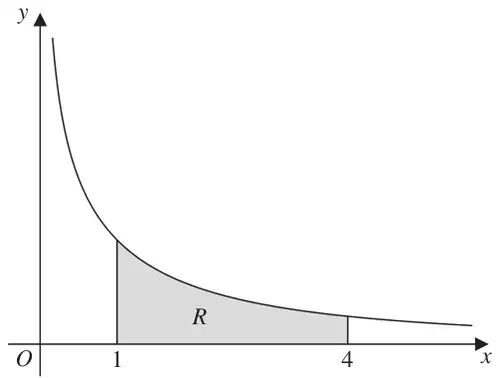
Figure 1 shows a sketch of part of the curve with equation \(y = \dfrac{10}{2x + 5\sqrt{x}}\), \(x > 0\)
The finite region \(R\), shown shaded in Figure 1, is bounded by the curve, the \(x\)-axis, and the lines with equations \(x = 1\) and \(x = 4\)
The table below shows corresponding values of \(x\) and \(y\) for \(y = \dfrac{10}{2x + 5\sqrt{x}}\)
| \(x\) | 1 | 2 | 3 | 4 |
|---|---|---|---|---|
| \(y\) | 1.42857 | 0.90326 | 0.55556 |
| Scheme | Marks | ||||||||||
|---|---|---|---|---|---|---|---|---|---|---|---|
| |||||||||||
| \(\{\text{At } x = 3,\}\ y = 0.68212\) (5 dp) 0.68212 | B1 cao | ||||||||||
| (1) |
Notes
B1: 0.68212 correct answer only. Look for this on the table or in the candidate’s working.
| Scheme | Marks |
|---|---|
| \(\dfrac{1}{2} \times 1 \times \underline{\left[1.42857 + 0.55556 + 2\left(0.90326 + \text{their } 0.68212\right)\right]}\) Outside brackets \(\tfrac{1}{2} \times 1\) or \(\tfrac{1}{2}\) For structure of \(\left[\ldots\ldots\ldots\ldots\ldots\right]\) | B1 aef M1 |
| \(\left\{= \tfrac{1}{2}(5.15489)\right\} = 2.577445 = 2.5774\) (4 dp) anything that rounds to 2.5774 | A1 |
| (3) |
Notes
B1: Outside brackets \(\dfrac{1}{2} \times 1\) or \(\dfrac{1}{2}\) or equivalent.
M1: For structure of trapezium rule \(\left[\ \ldots\ldots\ldots\ldots\ \right]\)
Note: No errors are allowed [eg. an omission of a \(y\)-ordinate or an extra \(y\)-ordinate or a repeated \(y\) ordinate].
A1: anything that rounds to 2.5774
Note: Working must be seen to demonstrate the use of the trapezium rule. (Actual area is 2.51314428…)
Note: Award B1M1A1 for \(\dfrac{1}{2}(1.42857 + 0.55556) + \left(0.90326 + \text{their } 0.68212\right) = 2.577445\)
Bracketing mistake: Unless the final answer implies that the calculation has been done correctly
award B1M0A0 for \(\dfrac{1}{2} \times 1 + 1.42857 + 2\left(0.90326 + \text{their } 0.68212\right) + 0.55556\) (nb: answer of 5.65489).
award B1M0A0 for \(\dfrac{1}{2} \times 1\ (1.42857 + 0.55556) + 2\left(0.90326 + \text{their } 0.68212\right)\) (nb: answer of 4.162825).
Alternative method: Adding individual trapezia
\(\text{Area} \approx 1 \times \left[\dfrac{1.42857 + 0.90326}{2} + \dfrac{0.90326 + \text{"}0.68212\text{"}}{2} + \dfrac{\text{"}0.68212\text{"} + 0.55556}{2}\right] = 2.577445\)
B1: 1 and a divisor of 2 on all terms inside brackets.
M1: First and last ordinates once and two of the middle ordinates twice inside brackets ignoring the 2.
A1: anything that rounds to 2.5774
| Scheme | Marks |
|---|---|
| B1 |
| (1) |
Notes
B1: Overestimate and either trapezia lie above curve or a diagram that gives reference to the extra area
eg. This diagram is sufficient. It must show the top of a trapezium lying above the curve.
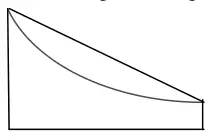
or concave or convex or \(\dfrac{\mathrm{d}^2y}{\mathrm{d}x^2} > 0\) (can be implied) or bends inwards or curves downwards.
Note: Reason of “gradient is negative” by itself is B0.
| Scheme | Marks |
|---|---|
| \(\left\{u = \sqrt{x} \Rightarrow\right\} \dfrac{\mathrm{d}u}{\mathrm{d}x} = \dfrac{1}{2}x^{-\frac{1}{2}}\) or \(\dfrac{\mathrm{d}x}{\mathrm{d}u} = 2u\) | B1 |
| \(\displaystyle\int \dfrac{10}{2u^2 + 5u}.\ 2u\,\mathrm{d}u\) Either \(\left\{\displaystyle\int\right\}\dfrac{\pm ku}{\alpha u^2 \pm \beta u}\{\mathrm{d}u\}\) or \(\left\{\displaystyle\int\right\}\dfrac{\pm k}{u\left(\alpha u^2 \pm \beta u\right)}\{\mathrm{d}u\}\) | M1 |
| \(\left\{= \displaystyle\int \dfrac{20}{2u + 5}\,\mathrm{d}u\right\} = \dfrac{20}{2}\ln(2u + 5)\) \(\pm\lambda\ln(2u + 5)\) or \(\pm\lambda\ln\left(u + \dfrac{5}{2}\right),\ \lambda \neq 0\) with no other terms. \(\dfrac{20}{2u + 5} \to \dfrac{20}{2}\ln(2u + 5)\) or \(10\ln\left(u + \dfrac{5}{2}\right)\) | M1 A1 cso |
| \(\left\{\left[\dfrac{20}{2}\ln(2u + 5)\right]_1^2\right\} = 10\ln\left(2(2) + 5\right) - 10\ln\left(2(1) + 5\right)\) Substitutes limits of 2 and 1 in \(u\) (or 4 and 1 in \(x\)) and subtracts the correct way round. | M1 |
| \(10\ln 9 - 10\ln 7\) or \(10\ln\left(\dfrac{9}{7}\right)\) or \(20\ln 3 - 10\ln 7\) | A1 oe cso |
| (6) | |
| (11 marks) |
Notes
B1: \(\dfrac{\mathrm{d}u}{\mathrm{d}x} = \dfrac{1}{2}x^{-\frac{1}{2}}\) or \(\mathrm{d}u = \dfrac{1}{2\sqrt{x}}\mathrm{d}x\) or \(2\sqrt{x}\,\mathrm{d}u = \mathrm{d}x\) or \(\mathrm{d}x = 2u\,\mathrm{d}u\) or \(\dfrac{\mathrm{d}x}{\mathrm{d}u} = 2u\) o.e.
M1: Applying the substitution and achieving \(\left\{\displaystyle\int\right\}\dfrac{\pm ku}{\alpha u^2 \pm \beta u}\{\mathrm{d}u\}\) or \(\left\{\displaystyle\int\right\}\dfrac{\pm k}{u\left(\alpha u^2 \pm \beta u\right)}\{\mathrm{d}u\}\),
\(k, \alpha, \beta \neq 0\). Integral sign and \(\mathrm{d}u\) not required for this mark.
M1: Cancelling \(u\) and integrates to achieve \(\pm\lambda\ln(2u + 5)\) or \(\pm\lambda\ln\left(u + \dfrac{5}{2}\right),\ \lambda \neq 0\) with no other terms.
A1: cso. Integrates \(\dfrac{20}{2u + 5}\) to give \(\dfrac{20}{2}\ln(2u + 5)\) or \(10\ln\left(u + \dfrac{5}{2}\right)\), un-simplified or simplified.
Note: BE CAREFUL! Candidates must be integrating \(\dfrac{20}{2u + 5}\) or equivalent.
So \(\displaystyle\int \dfrac{10}{2u + 5}\,\mathrm{d}u = 10\ln(2u + 5)\) WOULD BE A0 and final A0.
M1: Applies limits of 2 and 1 in \(u\) or 4 and 1 in \(x\) in their (i.e. any) changed function and subtracts the correct way round.
A1: Exact answers of either \(10\ln 9 - 10\ln 7\) or \(10\ln\left(\dfrac{9}{7}\right)\) or \(20\ln 3 - 10\ln 7\) or \(20\ln\left(\dfrac{3}{\sqrt{7}}\right)\) or \(\ln\left(\dfrac{9^{10}}{7^{10}}\right)\)
or equivalent. Correct solution only.
Note: You can ignore subsequent working which follows from a correct answer.
Note: A decimal answer of 2.513144283... (without a correct exact answer) is A0.