
M2 January 2007 Q5
5.
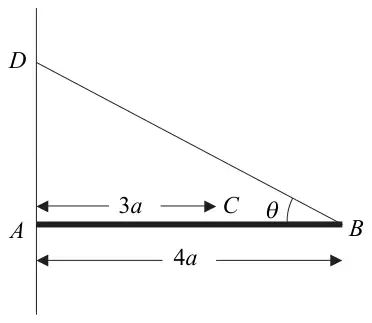
A horizontal uniform rod \(AB\) has mass \(m\) and length \(4a\). The end \(A\) rests against a rough vertical wall. A particle of mass \(2m\) is attached to the rod at the point \(C\), where \(AC = 3a\). One end of a light inextensible string \(BD\) is attached to the rod at \(B\) and the other end is attached to the wall at a point \(D\), where \(D\) is vertically above \(A\). The rod is in equilibrium in a vertical plane perpendicular to the wall. The string is inclined at an angle \(\theta\) to the horizontal, where \(\tan\theta = \tfrac{3}{4}\), as shown in Figure 2.
The coefficient of friction between the wall and the rod is \(\mu\). Given that the rod is in limiting equilibrium,
| Scheme | Marks |
|---|---|
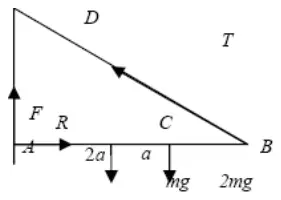
| M(\(A\)) \(T\sin\theta \times 4a = mg \times 2a + 2mg \times 3a\) | M1* A1=A1 |
| \(T = \dfrac{8mg}{4} \times \dfrac{5}{3} = \dfrac{10}{3}mg\) Accept 32.7m, 33m | DM1* A1 |
| (5) |
(a) Alternative approach:
\(\rightarrow\ \ R = T\cos\theta\)
\(\uparrow\ \ F + T\sin\theta = 3mg\)
M(B) \(F \times 4a = mg \times 2a + 2mg \times a\ (\Rightarrow F = mg)\)
\(\Rightarrow mg + T\sin\theta = 3mg \Rightarrow T = \dfrac{2mg}{\sin\theta} = \dfrac{10mg}{3}\)
If they use this method, watch out for F=mg just quoted in (c): M1A1
| Scheme | Marks |
|---|---|
| \(\rightarrow\) \(R = T\cos\theta = \dfrac{10}{3}mg \times \dfrac{4}{5};\ = \dfrac{8}{3}mg\ \ *\) cso ft their T | M1 A1ft; A1 |
| (3) |
| Scheme | Marks |
|---|---|
| \(\uparrow\) \(F + T\sin\theta = 3mg\ \ \Rightarrow\ \ F = mg\) ft their T | M1 A1ft |
| Or: M(B) \(F \times 4a = mg \times 2a + 2mg \times a \Rightarrow F = mg\) | |
| \(F = \mu R\ \ \Rightarrow\ \ \mu = \tfrac{3}{8}\) | M1 A1 |
| (4) | |
| (12 marks) |