
C4 June 2015 Q6
6.
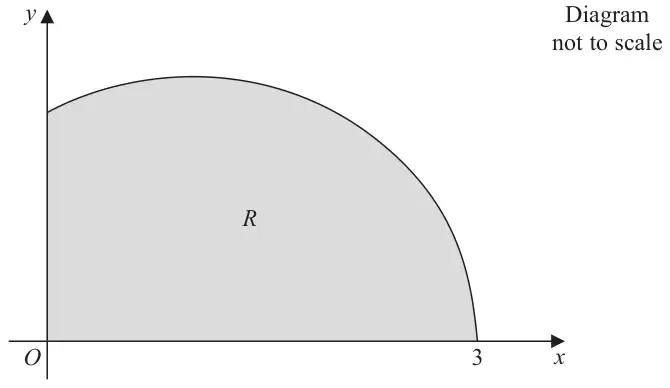
Figure 2 shows a sketch of the curve with equation \(y = \sqrt{(3 - x)(x + 1)},\ 0 \leqslant x \leqslant 3\)
The finite region \(R\), shown shaded in Figure 2, is bounded by the curve, the \(x\)-axis, and the \(y\)-axis.
| Scheme | Marks |
|---|---|
| \(A = \displaystyle\int_0^3 \sqrt{(3 - x)(x + 1)}\,\mathrm{d}x,\ x = 1 + 2\sin\theta\) | |
| \(\dfrac{\mathrm{d}x}{\mathrm{d}\theta} = 2\cos\theta\) \(\dfrac{\mathrm{d}x}{\mathrm{d}\theta} = 2\cos\theta\) or \(2\cos\theta\) used correctly in their working. Can be implied. | B1 |
| \(\left\{\displaystyle\int \sqrt{(3 - x)(x + 1)}\,\mathrm{d}x \text{ or } \displaystyle\int \sqrt{(3 + 2x - x^2)}\,\mathrm{d}x\right\}\) | |
| \(= \displaystyle\int \sqrt{\big(3 - (1 + 2\sin\theta)\big)\big((1 + 2\sin\theta) + 1\big)}\ 2\cos\theta\,\{\mathrm{d}\theta\}\) Substitutes for both \(x\) and \(\mathrm{d}x\), where \(\mathrm{d}x \neq \lambda\,\mathrm{d}\theta\). Ignore \(\mathrm{d}\theta\) | M1 |
| \(= \displaystyle\int \sqrt{(2 - 2\sin\theta)(2 + 2\sin\theta)}\ 2\cos\theta\,\{\mathrm{d}\theta\}\) | |
| \(= \displaystyle\int \sqrt{(4 - 4\sin^2\theta)}\ 2\cos\theta\,\{\mathrm{d}\theta\}\) | |
| \(= \displaystyle\int \sqrt{\big(4 - 4(1 - \cos^2\theta)\big)}\ 2\cos\theta\,\{\mathrm{d}\theta\}\) or \(\displaystyle\int \sqrt{4\cos^2\theta}\ 2\cos\theta\,\{\mathrm{d}\theta\}\) Applies \(\cos^2\theta = 1 - \sin^2\theta\) see notes | M1 |
| \(= 4\displaystyle\int \cos^2\theta\,\mathrm{d}\theta,\ \{k = 4\}\) \(4\displaystyle\int \cos^2\theta\,\mathrm{d}\theta\) or \(\displaystyle\int 4\cos^2\theta\,\mathrm{d}\theta\). Note: \(\mathrm{d}\theta\) is required here. | A1 |
| \(0 = 1 + 2\sin\theta\) or \(-1 = 2\sin\theta\) or \(\sin\theta = -\dfrac{1}{2} \Rightarrow \underline{\theta = -\dfrac{\pi}{6}}\) and \(3 = 1 + 2\sin\theta\) or \(2 = 2\sin\theta\) or \(\sin\theta = 1 \Rightarrow \underline{\theta = \dfrac{\pi}{2}}\) See notes | B1 |
| (5) |
Notes
B1: \(\dfrac{\mathrm{d}x}{\mathrm{d}\theta} = 2\cos\theta\). Also allow \(\mathrm{d}x = 2\cos\theta\,\mathrm{d}\theta\). This mark can be implied by later working.
Note: You can give B1 for \(2\cos\theta\) used correctly in their working.
M1: Substitutes \(x = 1 + 2\sin\theta\) and their \(\mathrm{d}x\) \(\left(\text{from their rearranged } \dfrac{\mathrm{d}x}{\mathrm{d}\theta}\right)\) into \(\sqrt{(3 - x)(x + 1)}\,\mathrm{d}x\).
Note: Condone bracketing errors here.
Note: \(\mathrm{d}x \neq \lambda\,\mathrm{d}\theta\). For example \(\mathrm{d}x \neq \mathrm{d}\theta\).
Note: Condone substituting \(\mathrm{d}x = \cos\theta\) for the 1st M1 after a correct \(\dfrac{\mathrm{d}x}{\mathrm{d}\theta} = 2\cos\theta\) or \(\mathrm{d}x = 2\cos\theta\,\mathrm{d}\theta\)
M1: Applies either
- \(1 - \sin^2\theta = \cos^2\theta\)
- \(\lambda - \lambda\sin^2\theta\) or \(\lambda(1 - \sin^2\theta) = \lambda\cos^2\theta\)
- \(4 - 4\sin^2\theta = 4 + 2\cos 2\theta - 2 = 2 + 2\cos 2\theta = 4\cos^2\theta\)
to their expression where \(\lambda\) is a numerical value.
A1: Correctly proves that \(\displaystyle\int \sqrt{(3 - x)(x + 1)}\,\mathrm{d}x\) is equal to \(4\displaystyle\int \cos^2\theta\,\mathrm{d}\theta\) or \(\displaystyle\int 4\cos^2\theta\,\mathrm{d}\theta\)
Note: All three previous marks must have been awarded before A1 can be awarded.
Note: Their final answer must include \(\mathrm{d}\theta\).
Note: You can ignore limits for the final A1 mark.
B1: Evidence of a correct equation in \(\sin\theta\) or \(\sin^{-1}\theta\) for both \(x\)-values leading to both \(\theta\) values. Eg:
- \(0 = 1 + 2\sin\theta\) or \(-1 = 2\sin\theta\) or \(\sin\theta = -\dfrac{1}{2}\) which then leads to \(\theta = -\dfrac{\pi}{6}\), and
- \(3 = 1 + 2\sin\theta\) or \(2 = 2\sin\theta\) or \(\sin\theta = 1\) which then leads to \(\theta = \dfrac{\pi}{2}\)
Note: Allow B1 for \(x = 1 + 2\sin\left(-\dfrac{\pi}{6}\right) = 0\) and \(x = 1 + 2\sin\left(\dfrac{\pi}{2}\right) = 3\)
Note: Allow B1 for \(\sin\theta = \left(\dfrac{x - 1}{2}\right)\) or \(\theta = \sin^{-1}\left(\dfrac{x - 1}{2}\right)\) followed by \(x = 0,\ \theta = -\dfrac{\pi}{6};\ x = 3,\ \theta = \dfrac{\pi}{2}\)
| Scheme | Marks |
|---|---|
| \(\left\{k\displaystyle\int \cos^2\theta\,\{\mathrm{d}\theta\}\right\} = \{k\}\displaystyle\int \left(\dfrac{1 + \cos 2\theta}{2}\right)\{\mathrm{d}\theta\}\) Applies \(\cos 2\theta = 2\cos^2\theta - 1\) to their integral | M1 |
| \(= \{k\}\left(\dfrac{1}{2}\theta + \dfrac{1}{4}\sin 2\theta\right)\) Integrates to give \(\pm\alpha\theta \pm \beta\sin 2\theta,\ \alpha \neq 0, \beta \neq 0\) or \(k(\pm\alpha\theta \pm \beta\sin 2\theta)\) | M1 (A1 on ePEN) |
| \(\left\{\text{So } 4\displaystyle\int_{-\frac{\pi}{6}}^{\frac{\pi}{2}} \cos^2\theta\,\mathrm{d}\theta = \big[2\theta + \sin 2\theta\big]_{-\frac{\pi}{6}}^{\frac{\pi}{2}}\right\}\) \(= \left(2\left(\dfrac{\pi}{2}\right) + \sin\left(\dfrac{2\pi}{2}\right)\right) - \left(2\left(-\dfrac{\pi}{6}\right) + \sin\left(-\dfrac{2\pi}{6}\right)\right)\) | |
| \(\left\{= (\pi) - \left(-\dfrac{\pi}{3} - \dfrac{\sqrt{3}}{2}\right)\right\} = \dfrac{4\pi}{3} + \dfrac{\sqrt{3}}{2}\) \(\dfrac{4\pi}{3} + \dfrac{\sqrt{3}}{2}\) or \(\dfrac{1}{6}\left(8\pi + 3\sqrt{3}\right)\) | A1 cao cso |
| (3) | |
| (8 marks) |
Notes
NOTE: Part (b) appears as M1A1A1 on ePEN, but is now marked as M1M1A1.
M1: Writes down a correct equation involving \(\cos 2\theta\) and \(\cos^2\theta\)
Eg: \(\cos 2\theta = 2\cos^2\theta - 1\) or \(\cos^2\theta = \dfrac{1 + \cos 2\theta}{2}\) or \(\lambda\cos^2\theta = \lambda\left(\dfrac{1 + \cos 2\theta}{2}\right)\)
and applies it to their integral. Note: Allow M1 for a correctly stated formula (via an incorrect rearrangement) being applied to their integral.
M1: Integrates to give an expression of the form \(\pm\alpha\theta \pm \beta\sin 2\theta\) or \(k(\pm\alpha\theta \pm \beta\sin 2\theta),\ \alpha \neq 0, \beta \neq 0\) (can be simplified or un-simplified).
A1: A correct solution in part (b) leading to a “two term” exact answer.
Eg: \(\dfrac{4\pi}{3} + \dfrac{\sqrt{3}}{2}\) or \(\dfrac{8\pi}{6} + \dfrac{\sqrt{3}}{2}\) or \(\dfrac{1}{6}\left(8\pi + 3\sqrt{3}\right)\)
Note: 5.054815… from no working is M0M0A0.
Note: Candidates can work in terms of \(k\) (note that \(k\) is not given in (a)) for the M1M1 marks in part (b).
Note: If they incorrectly obtain \(4\displaystyle\int_{-\frac{\pi}{6}}^{\frac{\pi}{2}} \cos^2\theta\,\mathrm{d}\theta\) in part (a) (or guess \(k = 4\)) then the final A1 is available for a correct solution in part (b) only.