
C3 June 2013 Q7
7. The function f has domain \(-2\leqslant x\leqslant 6\) and is linear from \((-2,10)\) to \((2,0)\) and from \((2,0)\) to \((6,4)\). A sketch of the graph of \(y=\mathrm{f}(x)\) is shown in Figure 1.
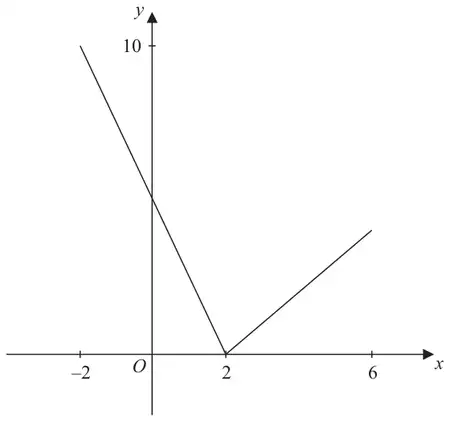
The function g is defined by\[\mathrm{g}:x\to\frac{4+3x}{5-x},\qquad x\in\mathbb{R},\quad x\neq 5\]
| Scheme | Marks |
|---|---|
| \(0\leqslant\mathrm{f}(x)\leqslant 10\) | B1 |
| (1) |
Notes
B1 Correct range. Allow \(0\leqslant\mathrm{f}(x)\leqslant 10\), \(0\leqslant\mathrm{f}\leqslant 10\), \(0\leqslant y\leqslant 10\), \(0\leqslant\text{range}\leqslant 10\), \([0,10]\)
Allow \(\mathrm{f}(x)\geqslant 0\) and \(\mathrm{f}(x)\leqslant 10\) but not \(\mathrm{f}(x)\geqslant 0\) or \(\mathrm{f}(x)\leqslant 10\)
Do Not Allow \(0\leqslant x\leqslant 10\). The inequality must include BOTH ends
| Scheme | Marks |
|---|---|
| \(\mathrm{ff}(0)=\mathrm{f}(5),\ =3\) | B1,B1 |
| (2) |
Notes
B1 For correct one application of the function at \(x=0\)
Possible ways to score this mark are \(\mathrm{f}(0)=5,\quad\mathrm{f}(5)\quad 0\to 5\to\ldots\)
B1: 3 (‘3’ can score both marks as long as no incorrect working is seen.)
| Scheme | Marks |
|---|---|
| \(y=\dfrac{4+3x}{5-x}\Rightarrow y(5-x)=4+3x\) | |
| \(\Rightarrow 5y-4=xy+3x\) | M1 |
| \(\Rightarrow 5y-4=x(y+3)\Rightarrow x=\dfrac{5y-4}{y+3}\) | dM1 |
| \(\mathrm{g}^{-1}(x)=\dfrac{5x-4}{3+x}\) | A1 |
| (3) |
Notes
M1 For an attempt to make \(x\) or a replaced \(y\) the subject of the formula. This can be scored for putting \(y=\mathrm{g}(x)\), multiplying across, expanding and collecting \(x\) terms on one side of the equation. Condone slips on the signs
dM1 Take out a common factor of \(x\) (or a replaced y) and divide, to make \(x\) subject of formula. Only allow one sign error for this mark
A1 Correct answer. No need to state the domain. Allow \(\mathrm{g}^{-1}(x)=\dfrac{5x-4}{3+x}\quad y=\dfrac{5x-4}{3+x}\)
Accept alternatives such as \(y=\dfrac{4-5x}{-3-x}\) and \(y=\dfrac{5-\frac{4}{x}}{1+\frac{3}{x}}\)
| Scheme | Marks |
|---|---|
| \(\mathrm{gf}(x)=16\Rightarrow\mathrm{f}(x)=\mathrm{g}^{-1}(16)=4\) oe | M1A1 |
| \(\mathrm{f}(x)=4\Rightarrow x=6\) | B1 |
| \(\mathrm{f}(x)=4\Rightarrow 5-2.5x=4\Rightarrow x=0.4\) oe | M1A1 |
| (5) | |
| (11 marks) |
Notes
M1 Stating or implying that \(\mathrm{f}(x)=\mathrm{g}^{-1}(16)\). For example accept \(\dfrac{4+3\mathrm{f}(x)}{5-\mathrm{f}(x)}=16\Rightarrow\mathrm{f}(x)=..\)
A1 Stating \(\mathrm{f}(x)=4\) or implying that solutions are where \(\mathrm{f}(x)=4\)
B1 \(x=6\) and may be given if there is no working
M1 Full method to obtain other value from line \(y=5-2.5x\)
\(5-2.5x=4\Rightarrow x=\ldots\).
Alternatively this could be done by similar triangles. Look for \(\dfrac{2}{5}=\dfrac{2-x}{4}\ (oe)\Rightarrow x=..\)
A1 0.4 or 2/5
Alt 1 to 7(d)
| Scheme | Marks |
|---|---|
| \(\mathrm{gf}(x)=16\Rightarrow\dfrac{4+3(ax+b)}{5-(ax+b)}=16\) | M1 |
| \(ax+b=x-2\quad or\quad 5-2.5x\) | A1 |
| \(\Rightarrow x=6\) | B1 |
| \(\dfrac{4+3(5-2.5x)}{5-(5-2.5x)}=16\Rightarrow x=\ldots\) | M1 |
| \(\Rightarrow x=0.4\) oe | A1 |
| (5) |
M1 Writes \(\mathrm{gf}(x)=16\) with a linear \(\mathrm{f}(x)\). The order of gf(\(x\)) must be correct
Condone invisible brackets. Even accept if there is a modulus sign.
A1 Uses \(\mathrm{f}(x)=x-2\) or \(\mathrm{f}(x)=5-2.5x\) in the equation \(\mathrm{gf}(x)=16\)
B1 \(x=6\) and may be given if there is no working
M1 Attempt at solving \(\dfrac{4+3(5-2.5x)}{5-(5-2.5x)}=16\Rightarrow x=\ldots\). The bracketing must be correct and there must be no more than one error in their calculation
A1 \(x=0.4,\ \dfrac{2}{5}\) or equivalent