
C3 June 2013 Q5
5. Given that\[x=\sec^2 3y,\qquad 0<y<\frac{\pi}{6}\]
| Scheme | Marks |
|---|---|
| \(\dfrac{\mathrm{d}x}{\mathrm{d}y}=2\times 3\sec 3y\sec 3y\tan 3y=\left(6\sec^2 3y\tan 3y\right)\) \(\left(\text{oe }\dfrac{6\sin 3y}{\cos^3 3y}\right)\) | M1A1 |
| (2) |
Notes
M1 Uses the chain rule to get \(A\sec 3y\sec 3y\tan 3y=\left(A\sec^2 3y\tan 3y\right)\).
There is no need to get the lhs of the expression. Alternatively could use the chain rule on \((\cos 3y)^{-2}\Rightarrow A(\cos 3y)^{-3}\sin 3y\)
or the quotient rule on \(\dfrac{1}{(\cos 3y)^2}\Rightarrow\dfrac{\pm A\cos 3y\sin 3y}{(\cos 3y)^4}\)
A1 \(\dfrac{\mathrm{d}x}{\mathrm{d}y}=2\times 3\sec 3y\sec 3y\tan 3y\) or equivalent. There is no need to simplify the rhs but both sides must be correct.
Alt 1 to 5(a)
| Scheme | Marks |
|---|---|
| \(x=(\cos 3y)^{-2}\Rightarrow\dfrac{\mathrm{d}x}{\mathrm{d}y}=-2(\cos 3y)^{-3}\times -3\sin 3y\) | M1A1 |
Alt 2 to 5(a)
| Scheme | Marks |
|---|---|
| \(x=\sec 3y\times\sec 3y\Rightarrow\dfrac{\mathrm{d}x}{\mathrm{d}y}=\sec 3y\times 3\sec 3y\tan 3y+\sec 3y\times 3\sec 3y\tan 3y\) | M1A1 |
| Scheme | Marks |
|---|---|
| Uses \(\dfrac{\mathrm{d}y}{\mathrm{d}x}=\dfrac{1}{\frac{\mathrm{d}x}{\mathrm{d}y}}\) to obtain \(\dfrac{\mathrm{d}y}{\mathrm{d}x}=\dfrac{1}{6\sec^2 3y\tan 3y}\) | M1 |
| \(\tan^2 3y=\sec^2 3y-1=x-1\) | B1 |
| Uses \(\sec^2 3y=x\) and \(\tan^2 3y=\sec^2 3y-1=x-1\) to get \(\dfrac{\mathrm{d}y}{\mathrm{d}x}\) or \(\dfrac{\mathrm{d}x}{\mathrm{d}y}\) in just \(x\). | M1 |
| \(\Rightarrow\dfrac{\mathrm{d}y}{\mathrm{d}x}=\dfrac{1}{6x(x-1)^{\frac{1}{2}}}\) CSO | A1* |
| (4) |
Notes
M1 Uses \(\dfrac{\mathrm{d}y}{\mathrm{d}x}=\dfrac{1}{\frac{\mathrm{d}x}{\mathrm{d}y}}\) to get an expression for \(\dfrac{\mathrm{d}y}{\mathrm{d}x}\). Follow through on their \(\dfrac{\mathrm{d}x}{\mathrm{d}y}\)
Allow slips on the coefficient but not trig expression.
B1 Writes \(\tan^2 3y=\sec^2 3y-1\) or an equivalent such as \(\tan 3y=\sqrt{\sec^2 3y-1}\) and uses \(x=\sec^2 3y\) to obtain either \(\tan^2 3y=x-1\) or \(\tan 3y=(x-1)^{\frac{1}{2}}\)
All elements must be present.
Accept
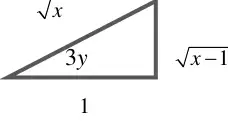
\(\cos 3y=\dfrac{1}{\sqrt{x}}\Rightarrow\tan 3y=\sqrt{x-1}\)
If the differential was in terms of \(\sin 3y,\cos 3y\) it is awarded for \(\sin 3y=\dfrac{\sqrt{x-1}}{\sqrt{x}}\)
M1 Uses \(\sec^2 3y=x\) and \(\tan^2 3y=\sec^2 3y-1=x-1\) or equivalent to get \(\dfrac{\mathrm{d}y}{\mathrm{d}x}\) in just \(x\). Allow slips on the signs in \(\tan^2 3y=\sec^2 3y-1\).
It may be implied- see below
A1* CSO. This is a given solution and you must be convinced that all steps are shown.
Note that the two method marks may occur the other way around
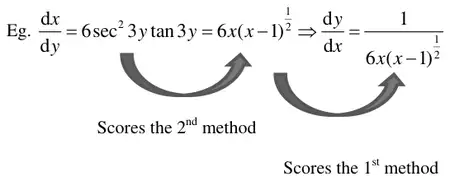
The above solution will score M1, B0, M1, A0
Example 1- Scores 0 marks in part (b)
\(\dfrac{\mathrm{d}x}{\mathrm{d}y}=6\sec^2 3y\tan 3y\Rightarrow\dfrac{\mathrm{d}y}{\mathrm{d}x}=\dfrac{1}{6\sec^2 3x\tan 3x}=\dfrac{1}{6\sec^2 3x\sqrt{\sec^2 3x-1}}=\dfrac{1}{6x(x-1)^{\frac{1}{2}}}\)
Example 2- Scores M1B1M1A0
\(\dfrac{\mathrm{d}x}{\mathrm{d}y}=2\sec^2 3y\tan 3y\Rightarrow\dfrac{\mathrm{d}y}{\mathrm{d}x}=\dfrac{1}{2\sec^2 3y\tan 3y}=\dfrac{1}{2\sec^2 3y\sqrt{\sec^2 3y-1}}=\dfrac{1}{2x(x-1)^{\frac{1}{2}}}\)
| Scheme | Marks |
|---|---|
| \(\dfrac{\mathrm{d}^2y}{\mathrm{d}x^2}=\dfrac{0-[6(x-1)^{\frac{1}{2}}+3x(x-1)^{-\frac{1}{2}}]}{36x^2(x-1)}\) | M1A1 |
| \(\dfrac{\mathrm{d}^2y}{\mathrm{d}x^2}=\dfrac{6-9x}{36x^2(x-1)^{\frac{3}{2}}}\quad=\dfrac{2-3x}{12x^2(x-1)^{\frac{3}{2}}}\) | dM1A1 |
| (4) | |
| (10 marks) |
Notes
(c) Using Quotient and Product Rules
M1 Uses the quotient rule \(\dfrac{vu'-uv'}{v^2}\) with \(u=1\) and \(v=6x(x-1)^{\frac{1}{2}}\) and achieving \(u'=0\) and \(v'=A(x-1)^{\frac{1}{2}}+Bx(x-1)^{-\frac{1}{2}}\).
If the formulae are quoted, both must be correct. If they are not quoted nor implied by their working allow expressions of the form
\(\xcancel{\left(\dfrac{\mathrm{d}^2y}{\mathrm{d}x^2}\right)}=\dfrac{0-[A(x-1)^{\frac{1}{2}}+Bx(x-1)^{-\frac{1}{2}}]}{\left(6x(x-1)^{\frac{1}{2}}\right)^2}\) or \(\xcancel{\left(\dfrac{\mathrm{d}^2y}{\mathrm{d}x^2}\right)}=\dfrac{0-A(x-1)^{\frac{1}{2}}\pm Bx(x-1)^{-\frac{1}{2}}}{Cx^2(x-1)}\)
A1 Correct un simplified expression \(\dfrac{\mathrm{d}^2y}{\mathrm{d}x^2}=\dfrac{0-[6(x-1)^{\frac{1}{2}}+3x(x-1)^{-\frac{1}{2}}]}{36x^2(x-1)}\) oe
dM1 Multiply numerator and denominator by \((x-1)^{\frac{1}{2}}\) producing a linear numerator which is then simplified by collecting like terms.
Alternatively take out a common factor of \((x-1)^{-\frac{1}{2}}\) from the numerator and collect like terms from the linear expression
This is dependent upon the 1st M1 being scored.
A1 Correct simplified expression \(\dfrac{\mathrm{d}^2y}{\mathrm{d}x^2}=\dfrac{2-3x}{12x^2(x-1)^{\frac{3}{2}}}\) oe
Alt 1 To 5 (c)
| Scheme | Marks |
|---|---|
| \(\dfrac{\mathrm{d}^2y}{\mathrm{d}x^2}=\tfrac{1}{6}[x^{-1}(-\tfrac{1}{2})(x-1)^{-\frac{3}{2}}+(-1)x^{-2}(x-1)^{-\frac{1}{2}}]\) | M1A1 |
| \(=\tfrac{1}{6}x^{-2}(x-1)^{-\frac{3}{2}}[x(-\tfrac{1}{2})+(-1)(x-1)]\) | dM1 |
| \(=\tfrac{1}{12}x^{-2}(x-1)^{-\frac{3}{2}}[2-3x]\) oe | A1 |
| (4) |
(c) Using Product and Chain Rules
M1 Writes \(\dfrac{\mathrm{d}y}{\mathrm{d}x}=\dfrac{1}{6x(x-1)^{\frac{1}{2}}}=Ax^{-1}(x-1)^{-\frac{1}{2}}\) and uses the product rule with \(u\) or \(v=Ax^{-1}\) and \(v\) or \(u=(x-1)^{-\frac{1}{2}}\). If any rule is quoted it must be correct.
If the rules are not quoted nor implied then award if you see an expression of the form \((x-1)^{-\frac{3}{2}}\times Bx^{-1}\pm C(x-1)^{-\frac{1}{2}}\times x^{-2}\)
A1 \(\xcancel{\dfrac{\mathrm{d}^2y}{\mathrm{d}x^2}}=\tfrac{1}{6}[x^{-1}(-\tfrac{1}{2})(x-1)^{-\frac{3}{2}}+(-1)x^{-2}(x-1)^{-\frac{1}{2}}]\)
dM1 Factorises out / uses a common denominator of \(x^{-2}(x-1)^{-\frac{3}{2}}\) producing a linear factor/numerator which must be simplified by collecting like terms. Need a single fraction.
A1 Correct simplified expression \(\dfrac{\mathrm{d}^2y}{\mathrm{d}x^2}==\tfrac{1}{12}x^{-2}(x-1)^{-\frac{3}{2}}[2-3x]\quad oe\)
(c) Using Quotient and Chain rules Rules
M1 Uses the quotient rule \(\dfrac{vu'-uv'}{v^2}\) with \(u=(x-1)^{-\frac{1}{2}}\) and \(v=6x\) and achieving \(u'=A(x-1)^{-\frac{3}{2}}\) and \(v'=B\).
If the formulae is quoted, it must be correct. If it is not quoted nor implied by their working allow an expression of the form
\(\xcancel{\left(\dfrac{\mathrm{d}^2y}{\mathrm{d}x^2}\right)}=\dfrac{Cx(x-1)^{-\frac{3}{2}}-D(x-1)^{-\frac{1}{2}}}{Ex^2}\)
A1 Correct un simplified expression \(\xcancel{\dfrac{\mathrm{d}^2y}{\mathrm{d}x^2}}=\dfrac{6x\times-\frac{1}{2}(x-1)^{-\frac{3}{2}}-(x-1)^{-\frac{1}{2}}\times 6}{(6x)^2}\)
dM1 Multiply numerator and denominator by \((x-1)^{\frac{3}{2}}\) producing a linear numerator which is then simplified by collecting like terms.
Alternatively take out a common factor of \((x-1)^{-\frac{3}{2}}\) from the numerator and collect like terms from the linear expression
This is dependent upon the 1st M1 being scored.
A1 Correct simplified expression \(\dfrac{\mathrm{d}^2y}{\mathrm{d}x^2}=\dfrac{2-3x}{12x^2(x-1)^{\frac{3}{2}}}\) oe \(\dfrac{\mathrm{d}^2y}{\mathrm{d}x^2}=\dfrac{(2-3x)x^{-2}(x-1)^{-\frac{3}{2}}}{12}\)
(c) Using just the chain rule
M1 Writes \(\dfrac{\mathrm{d}y}{\mathrm{d}x}=\dfrac{1}{6x(x-1)^{\frac{1}{2}}}=\dfrac{1}{(36x^3-36x^2)^{\frac{1}{2}}}=(36x^3-36x^2)^{-\frac{1}{2}}\) and proceeds by the chain rule to \(A(36x^3-36x^2)^{-\frac{3}{2}}(Bx^2-Cx)\).
M1 Would automatically follow under this method if the first M has been scored