
C4 June 2012 Q7
7.
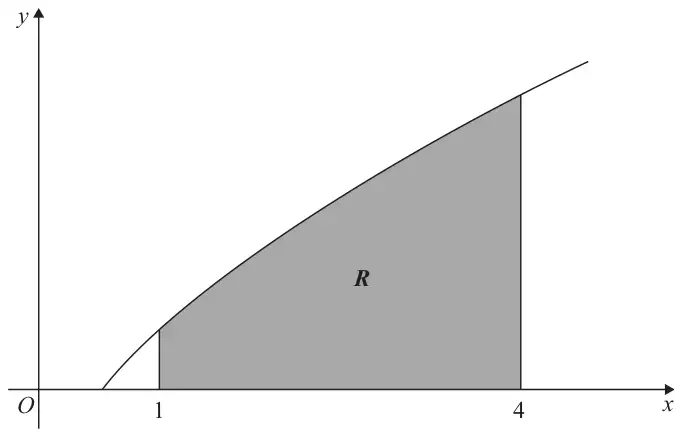
Figure 3 shows a sketch of part of the curve with equation \(y = x^{\frac{1}{2}}\ln 2x\).
The finite region \(R\), shown shaded in Figure 3, is bounded by the curve, the \(x\)-axis and the lines \(x = 1\) and \(x = 4\)
(a) Use the trapezium rule, with 3 strips of equal width, to find an estimate for the area of \(R\), giving your answer to 2 decimal places. (4)
(b) Find \(\displaystyle\int x^{\frac{1}{2}}\ln 2x\,\mathrm{d}x\). (4)
(c) Hence find the exact area of \(R\), giving your answer in the form \(a\ln 2 + b\), where \(a\) and \(b\) are exact constants. (3)
| Scheme | Marks | |||||||||||||||
|---|---|---|---|---|---|---|---|---|---|---|---|---|---|---|---|---|
| M1 | |||||||||||||||
| \(\text{Area} = \dfrac{1}{2} \times 1(\ \ldots\ )\) | B1 | |||||||||||||||
| \(\approx \ldots\ \left(0.6931 + 2(1.9605 + 3.1034) + 4.1589\right)\) | M1 | |||||||||||||||
| \(\approx \dfrac{1}{2} \times 14.97989\ldots \approx 7.49\) 7.49 cao | A1 | |||||||||||||||
| (4) |
| Scheme | Marks |
|---|---|
| \(\displaystyle\int x^{\frac{1}{2}}\ln 2x\,\mathrm{d}x = \frac{2}{3}x^{\frac{3}{2}}\ln 2x - \int \frac{2}{3}x^{\frac{3}{2}} \times \frac{1}{x}\,\mathrm{d}x\) | M1 A1 |
| \(= \dfrac{2}{3}x^{\frac{3}{2}}\ln 2x - \displaystyle\int \frac{2}{3}x^{\frac{1}{2}}\,\mathrm{d}x\) \(= \dfrac{2}{3}x^{\frac{3}{2}}\ln 2x - \dfrac{4}{9}x^{\frac{3}{2}} \quad (+C)\) | M1 A1 |
| (4) |
| Scheme | Marks |
|---|---|
| \(\left[\dfrac{2}{3}x^{\frac{3}{2}}\ln 2x - \dfrac{4}{9}x^{\frac{3}{2}}\right]_1^4 = \left(\dfrac{2}{3}4^{\frac{3}{2}}\ln 8 - \dfrac{4}{9}4^{\frac{3}{2}}\right) - \left(\dfrac{2}{3}\ln 2 - \dfrac{4}{9}\right)\) | M1 |
| \(= (16\ln 2 - \ldots) - \ldots\) Using or implying \(\ln 2^n = n\ln 2\) | M1 |
| \(= \dfrac{46}{3}\ln 2 - \dfrac{28}{9}\) | A1 |
| (3) | |
| (11 marks) |
Notes
In the printed scheme a bracket joins the two M1 marks: the second is dependent on the first.