
C4 January 2012 Q6
6.
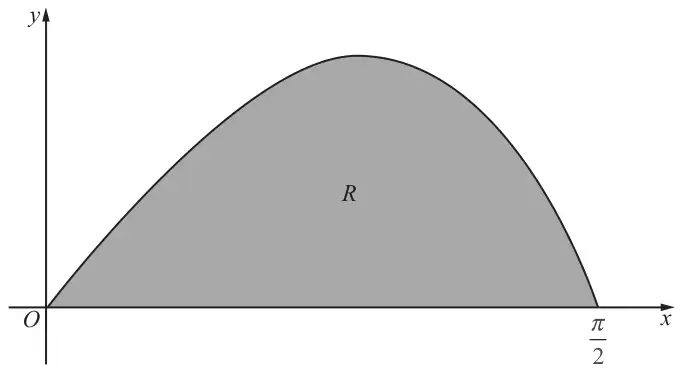
Figure 3 shows a sketch of the curve with equation \(y = \dfrac{2\sin 2x}{(1 + \cos x)},\ 0 \leqslant x \leqslant \dfrac{\pi}{2}\).
The finite region \(R\), shown shaded in Figure 3, is bounded by the curve and the \(x\)-axis.
The table below shows corresponding values of \(x\) and \(y\) for \(y = \dfrac{2\sin 2x}{(1 + \cos x)}\).
| \(x\) | 0 | \(\dfrac{\pi}{8}\) | \(\dfrac{\pi}{4}\) | \(\dfrac{3\pi}{8}\) | \(\dfrac{\pi}{2}\) |
|---|---|---|---|---|---|
| \(y\) | 0 | 1.17157 | 1.02280 | 0 |
| Scheme | Marks |
|---|---|
| 0.73508 | B1 cao |
| (1) |
Notes
B1: 0.73508 correct answer only. Look for this on the table or in the candidate’s working.
| Scheme | Marks |
|---|---|
| \(\text{Area} \approx \dfrac{1}{2} \times \dfrac{\pi}{8};\ \times \underline{\left[0 + 2(\text{their } 0.73508 + 1.17157 + 1.02280) + 0\right]}\) | B1 M1 |
| \(= \dfrac{\pi}{16} \times 5.8589\ldots = 1.150392325\ldots = 1.1504\ \text{(4 dp)}\) awrt 1.1504 | A1 |
| (3) |
Notes
B1: Outside brackets \(\dfrac{1}{2} \times \dfrac{\pi}{8}\) or \(\dfrac{\pi}{16}\) or awrt 0.196
M1: For structure of trapezium rule \(\left[\ \underline{\ldots\ldots\ldots\ldots}\ \right]\); (0 can be implied).
A1: anything that rounds to 1.1504
Bracketing mistake: Unless the final answer implies that the calculation has been done correctly
Award B1M0A0 for \(\dfrac{1}{2} \times \dfrac{\pi}{8} + 2(\text{their } 0.73508 + 1.17157 + 1.02280)\) (nb: answer of 6.0552).
Award B1M0A0 for \(\dfrac{1}{2} \times \dfrac{\pi}{8}\ (0 + 0) + 2(\text{their } 0.73508 + 1.17157 + 1.02280)\) (nb: answer of 5.8589).
Alternative method for part (b): Adding individual trapezia
| Scheme | Marks |
|---|---|
| \(\text{Area} \approx \dfrac{\pi}{8} \times \left[\dfrac{0 + 0.73508}{2} + \dfrac{0.73508 + 1.17157}{2} + \dfrac{1.17157 + 1.02280}{2} + \dfrac{1.02280 + 0}{2}\right] = 1.150392325\ldots\) |
B1: \(\dfrac{\pi}{8}\) and a divisor of 2 on all terms inside brackets.
M1: One of first and last ordinates, two of the middle ordinates inside brackets ignoring the 2.
A1: anything that rounds to 1.1504
| Scheme | Marks |
|---|---|
| \(\{u = 1 + \cos x\} \Rightarrow \underline{\dfrac{\mathrm{d}u}{\mathrm{d}x} = -\sin x}\) | B1 |
| \(\left\{\displaystyle\int \frac{2\sin 2x}{(1 + \cos x)}\,\mathrm{d}x =\right\} \displaystyle\int \frac{2(2\sin x\cos x)}{(1 + \cos x)}\,\mathrm{d}x\) \(\sin 2x = 2\sin x\cos x\) | B1 |
| \(= \displaystyle\int \frac{4(u - 1)}{u}.(-1)\,\mathrm{d}u \quad \left\{= 4\int \frac{(1 - u)}{u}\,\mathrm{d}u\right\}\) | M1 |
| \(= 4\displaystyle\int \left(\frac{1}{u} - 1\right)\mathrm{d}u = 4(\ln u - u) + c\) | dM1 |
| \(= 4\ln(1 + \cos x) - 4(1 + \cos x) + c \quad = 4\ln(1 + \cos x) - 4\cos x + k\) AG | A1 cso |
| (5) |
Notes
B1: \(\dfrac{\mathrm{d}u}{\mathrm{d}x} = -\sin x\) or \(\mathrm{d}u = -\sin x\,\mathrm{d}x\) or \(\dfrac{\mathrm{d}x}{\mathrm{d}u} = \dfrac{1}{-\sin x}\) oe.
B1: For seeing, applying or implying \(\sin 2x = 2\sin x\cos x\).
M1: After applying substitution candidate achieves \(\pm k\displaystyle\int \frac{(u - 1)}{u}(\mathrm{d}u)\) or \(\pm k\displaystyle\int \frac{(1 - u)}{u}(\mathrm{d}u)\).
Allow M1 for “invisible” brackets here, eg: \(\pm\displaystyle\int \frac{(\lambda u - 1)}{u}(\mathrm{d}u)\) or \(\pm\displaystyle\int \frac{(-\lambda + u)}{u}(\mathrm{d}u)\), where \(\lambda\) is a positive constant.
dM1: An attempt to divide through each term by \(u\) and \(\pm k\displaystyle\int \left(\frac{1}{u} - 1\right)\mathrm{d}u \to \pm k(\ln u - u)\) with/without \(+\,c\). Note that this mark is dependent on the previous M1 mark being awarded.
Alternative method: Candidate can also gain this mark for applying integration by parts followed by a correct method for integrating \(\ln u\). (See below).
A1: Correctly combines their \(+\,c\) and "\(-4\)" together to give \(\underline{4\ln(1 + \cos x) - 4\cos x + k}\)
As a minimum candidate must write either \(4\ln(1 + \cos x) - 4(1 + \cos x) + c \to 4\ln(1 + \cos x) - 4\cos x + k\)
or \(4\ln(1 + \cos x) - 4(1 + \cos x) + k \to 4\ln(1 + \cos x) - 4\cos x + k\)
Note: that this mark is also for a correct solution only.
Note: those candidates who attempt to find the value of \(k\) will usually achieve A0.
Alternative method for dM1 in part (c)
\(\displaystyle\int \frac{(1 - u)}{u}\,\mathrm{d}u = \left((1 - u)\ln u - \int -\ln u\,\mathrm{d}u\right) = \left((1 - u)\ln u + u\ln u - \int \frac{u}{u}\,\mathrm{d}u\right) = ((1 - u)\ln u + u\ln u - u)\)
or \(\displaystyle\int \frac{(u - 1)}{u}\,\mathrm{d}u = \left((u - 1)\ln u - \int \ln u\,\mathrm{d}u\right) = \left((u - 1)\ln u - \left(u\ln u - \int \frac{u}{u}\,\mathrm{d}u\right)\right) = ((u - 1)\ln u - u\ln u + u)\)
So dM1 is for \(\displaystyle\int \frac{(1 - u)}{u}\,\mathrm{d}u\) going to \(((1 - u)\ln u + u\ln u - u)\) or \(((u - 1)\ln u - u\ln u + u)\) oe.
| Scheme | Marks |
|---|---|
| \(= \left[4\ln\left(1 + \cos\dfrac{\pi}{2}\right) - 4\cos\dfrac{\pi}{2}\right] - \left[4\ln(1 + \cos 0) - 4\cos 0\right]\) Applying limits \(x = \dfrac{\pi}{2}\) and \(x = 0\) either way round. | M1 |
| \(= [4\ln 1 - 0] - [4\ln 2 - 4]\) \(= 4 - 4\ln 2\ \{= 1.227411278\ldots\}\) \(\pm 4(1 - \ln 2)\) or \(\pm(4 - 4\ln 2)\) or awrt \(\pm 1.2\), however found. | A1 |
| \(\text{Error} = \left|(4 - 4\ln 2) - 1.1504\ldots\right|\) \(= 0.0770112776\ldots = 0.077\ \text{(2 sf)}\) awrt \(\pm 0.077\) or awrt \(\pm 6.3(\%)\) | A1 cso |
| (3) | |
| (12 marks) |
Notes
M1: Substitutes limits of \(x = \dfrac{\pi}{2}\) and \(x = 0\) into \(\{4\ln(1 + \cos x) - 4\cos x\}\) or their answer from part (c) and subtracts the either way round. Note that: \(\left[4\ln\left(1 + \cos\dfrac{\pi}{2}\right) - 4\cos\dfrac{\pi}{2}\right] - [0]\) is M0.
A1: \(4(1 - \ln 2)\) or \(4 - 4\ln 2\) or awrt 1.2, however found.
This mark can be implied by the final answer of either awrt \(\pm 0.077\) or awrt \(\pm 6.3\)
A1: For either awrt \(\pm 0.077\) or awrt \(\pm 6.3\) (for percentage error). Note this mark is for a correct solution only. Therefore if there if a candidate substitutes limits the incorrect way round and final achieves (usually fudges) the final correct answer then this mark can be withheld. Note that awrt 6.7 (for percentage error) is A0.
Alternative method for part (d)
M1A1 for \(\left\{4\displaystyle\int_2^1 \left(\frac{1}{u} - 1\right)\mathrm{d}u =\right\} 4\left[\ln u - u\right]_2^1 = 4\left[(\ln 1 - 1) - (\ln 2 - 2)\right] = 4(1 - \ln 2)\)
Alternative method for part (d): Using an extra constant \(\lambda\) from their integration.
\(\left[4\ln\left(1 + \cos\dfrac{\pi}{2}\right) - 4\cos\dfrac{\pi}{2} + \lambda\right] - \left[4\ln(1 + \cos 0) - 4\cos 0 + \lambda\right]\)
\(\lambda\) is usually \(-4\), but can be a value of \(k\) that the candidate has found in part (d).
Note: The extra constant \(\lambda\) should cancel out and so the candidate can gain all three marks using this method, even the final A1 cso.