
C4 June 2006 Q7
7.
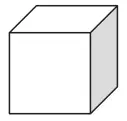
At time \(t\) seconds the length of the side of a cube is \(x\) cm, the surface area of the cube is \(S\ \text{cm}^2\), and the volume of the cube is \(V\ \text{cm}^3\).
The surface area of the cube is increasing at a constant rate of \(8\ \text{cm}^2\,\text{s}^{-1}\).
Show that
Given that \(V = 8\) when \(t = 0\),
| Scheme | Marks |
|---|---|
| From question, \(\dfrac{\mathrm{d}S}{\mathrm{d}t} = 8\) | B1 |
| \(S = 6x^2 \Rightarrow \dfrac{\mathrm{d}S}{\mathrm{d}x} = 12x\) | B1 |
| \(\dfrac{\mathrm{d}x}{\mathrm{d}t} = \dfrac{\mathrm{d}S}{\mathrm{d}t} \div \dfrac{\mathrm{d}S}{\mathrm{d}x} = \underline{\dfrac{8}{12x}};\ = \dfrac{\frac{2}{3}}{x} \quad \Rightarrow \left(k = \tfrac{2}{3}\right)\) | M1; A1oe |
| (4) |
Notes
B1 \(\dfrac{\mathrm{d}S}{\mathrm{d}t} = 8\)
B1 \(\dfrac{\mathrm{d}S}{\mathrm{d}x} = 12x\)
M1; A1 Candidate’s \(\dfrac{\mathrm{d}S}{\mathrm{d}t} \div \dfrac{\mathrm{d}S}{\mathrm{d}x}\); \(\dfrac{8}{12x}\)
| Scheme | Marks |
|---|---|
| \(V = x^3 \Rightarrow \dfrac{\mathrm{d}V}{\mathrm{d}x} = 3x^2\) | B1 |
| \(\dfrac{\mathrm{d}V}{\mathrm{d}t} = \dfrac{\mathrm{d}V}{\mathrm{d}x} \times \dfrac{\mathrm{d}x}{\mathrm{d}t} = 3x^2.\left(\dfrac{2}{3x}\right);\ = 2x\) | M1; A1ft |
| As \(x = V^{\frac{1}{3}}\), then \(\dfrac{\mathrm{d}V}{\mathrm{d}t} = 2V^{\frac{1}{3}}\) AG | A1 |
| (4) |
Notes
B1 \(\dfrac{\mathrm{d}V}{\mathrm{d}x} = 3x^2\)
M1; A1ft Candidate’s \(\dfrac{\mathrm{d}V}{\mathrm{d}x} \times \dfrac{\mathrm{d}x}{\mathrm{d}t}\); \(\lambda x\)
A1 Use of \(x = V^{\frac{1}{3}}\), to give \(\dfrac{\mathrm{d}V}{\mathrm{d}t} = 2V^{\frac{1}{3}}\)
Aliter (b) Way 2
| \(x = V^{\frac{1}{3}}\) & \(S = 6x^2 \Rightarrow S = 6V^{\frac{2}{3}}\) | B1ft |
| \(\dfrac{\mathrm{d}S}{\mathrm{d}V} = 4V^{-\frac{1}{3}}\) or \(\dfrac{\mathrm{d}V}{\mathrm{d}S} = \dfrac{1}{4}V^{\frac{1}{3}}\) | B1 |
| \(\dfrac{\mathrm{d}V}{\mathrm{d}t} = \dfrac{\mathrm{d}S}{\mathrm{d}t} \times \dfrac{\mathrm{d}V}{\mathrm{d}S} = 8.\left(\dfrac{1}{4V^{-\frac{1}{3}}}\right);\ = \dfrac{2}{V^{-\frac{1}{3}}} = 2V^{\frac{1}{3}}\) AG | M1; A1 |
| [4] |
B1ft \(S = 6V^{\frac{2}{3}}\)
B1 \(\dfrac{\mathrm{d}S}{\mathrm{d}V} = 4V^{-\frac{1}{3}}\) or \(\dfrac{\mathrm{d}V}{\mathrm{d}S} = \dfrac{1}{4}V^{\frac{1}{3}}\)
M1; A1 Candidate’s \(\dfrac{\mathrm{d}S}{\mathrm{d}t} \times \dfrac{\mathrm{d}V}{\mathrm{d}S}\); \(2V^{\frac{1}{3}}\)
Aliter (b) Way 3
similar to way 1.
| \(V = x^3 \Rightarrow \dfrac{\mathrm{d}V}{\mathrm{d}x} = 3x^2\) | B1 |
| \(\dfrac{\mathrm{d}V}{\mathrm{d}t} = \dfrac{\mathrm{d}V}{\mathrm{d}x} \times \dfrac{\mathrm{d}S}{\mathrm{d}t} \times \dfrac{\mathrm{d}x}{\mathrm{d}S} = 3x^2.8.\left(\dfrac{1}{12x}\right);\ = 2x\) | M1; A1ft |
| As \(x = V^{\frac{1}{3}}\), then \(\dfrac{\mathrm{d}V}{\mathrm{d}t} = 2V^{\frac{1}{3}}\) AG | A1 |
| [4] |
B1 \(\dfrac{\mathrm{d}V}{\mathrm{d}x} = 3x^2\)
M1; A1ft Candidate’s \(\dfrac{\mathrm{d}V}{\mathrm{d}x} \times \dfrac{\mathrm{d}S}{\mathrm{d}t} \times \dfrac{\mathrm{d}x}{\mathrm{d}S}\); \(\lambda x\)
A1 Use of \(x = V^{\frac{1}{3}}\), to give \(\dfrac{\mathrm{d}V}{\mathrm{d}t} = 2V^{\frac{1}{3}}\)
| Scheme | Marks |
|---|---|
| \(\displaystyle\int \frac{\mathrm{d}V}{V^{\frac{1}{3}}} = \int 2\,\mathrm{d}t\) | B1 |
| \(\displaystyle\int V^{-\frac{1}{3}}\,\mathrm{d}V = \int 2\,\mathrm{d}t\) \(\frac{3}{2}V^{\frac{2}{3}} = 2t\quad (+c)\) | M1; A1 |
| \(\frac{3}{2}(8)^{\frac{2}{3}} = 2(0) + c \Rightarrow c = 6\) | M1*; A1 |
| Hence: \(\frac{3}{2}V^{\frac{2}{3}} = 2t + 6\) \(\frac{3}{2}\left(16\sqrt{2}\right)^{\frac{2}{3}} = 2t + 6 \Rightarrow 12 = 2t + 6\) | depM1* |
| giving \(t = 3\). | A1 cao |
| (7) | |
| (15 marks) |
Notes
B1 Separates the variables with \(\int \frac{\mathrm{d}V}{V^{\frac{1}{3}}}\) or \(\int V^{-\frac{1}{3}}\,\mathrm{d}V\) on one side and \(\int 2\,\mathrm{d}t\) on the other side. integral signs not necessary.
M1; A1 Attempts to integrate and … … must see \(V^{\frac{2}{3}}\) and \(2t\); Correct equation with/without \(+\ c\).
M1*; A1 Use of \(V = 8\) and \(t = 0\) in a changed equation containing \(c\); \(c = 6\)
depM1* Having found their “\(c\)” candidate … … substitutes \(V = 16\sqrt{2}\) into an equation involving \(V\), \(t\) and “\(c\)”.
A1 cao \(t = 3\)
Aliter (c) Way 2
| \(\displaystyle\int \frac{\mathrm{d}V}{2V^{\frac{1}{3}}} = \int 1\,\mathrm{d}t\) | B1 |
| \(\dfrac{1}{2}\displaystyle\int V^{-\frac{1}{3}}\,\mathrm{d}V = \int 1\,\mathrm{d}t\) \(\left(\frac{1}{2}\right)\left(\frac{3}{2}\right)V^{\frac{2}{3}} = t\quad (+c)\) | M1; A1 |
| \(\frac{3}{4}(8)^{\frac{2}{3}} = (0) + c \Rightarrow c = 3\) | M1*; A1 |
| Hence: \(\frac{3}{4}V^{\frac{2}{3}} = t + 3\) \(\frac{3}{4}\left(16\sqrt{2}\right)^{\frac{2}{3}} = t + 3 \Rightarrow 6 = t + 3\) | depM1* |
| giving \(t = 3\). | A1 cao |
| [7] |
B1 Separates the variables with \(\int \frac{\mathrm{d}V}{2V^{\frac{1}{3}}}\) or \(\int \frac{1}{2}V^{-\frac{1}{3}}\,\mathrm{d}V\) oe on one side and \(\int 1\,\mathrm{d}t\) on the other side. integral signs not necessary.
M1; A1 Attempts to integrate and … … must see \(V^{\frac{2}{3}}\) and \(t\); Correct equation with/without \(+\ c\).
M1*; A1 Use of \(V = 8\) and \(t = 0\) in a changed equation containing \(c\); \(c = 3\)
depM1* Having found their “\(c\)” candidate … … substitutes \(V = 16\sqrt{2}\) into an equation involving \(V\), \(t\) and “\(c\)”.
A1 cao \(t = 3\)
Aliter (c) Way 3
| \(\displaystyle\int \frac{\mathrm{d}V}{V^{\frac{1}{3}}} = \int 2\,\mathrm{d}t\) | B1 |
| \(\displaystyle\int V^{-\frac{1}{3}}\,\mathrm{d}V = \int 2\,\mathrm{d}t\) \(V^{\frac{2}{3}} = \frac{4}{3}t\quad (+c)\) | M1; A1 |
| \((8)^{\frac{2}{3}} = \frac{4}{3}(0) + c \Rightarrow c = 4\) | M1*; A1 |
| Hence: \(V^{\frac{2}{3}} = \frac{4}{3}t + 4\) \(\left(16\sqrt{2}\right)^{\frac{2}{3}} = \frac{4}{3}t + 4 \Rightarrow 8 = \frac{4}{3}t + 4\) | depM1* |
| giving \(t = 3\). | A1 cao |
| [7] |
B1 Separates the variables with \(\int \frac{\mathrm{d}V}{V^{\frac{1}{3}}}\) or \(\int V^{-\frac{1}{3}}\,\mathrm{d}V\) on one side and \(\int 2\,\mathrm{d}t\) on the other side. integral signs not necessary.
M1; A1 Attempts to integrate and … … must see \(V^{\frac{2}{3}}\) and \(\frac{4}{3}t\); Correct equation with/without \(+\ c\).
M1*; A1 Use of \(V = 8\) and \(t = 0\) in a changed equation containing \(c\); \(c = 4\)
depM1* Having found their “\(c\)” candidate … … substitutes \(V = 16\sqrt{2}\) into an equation involving \(V\), \(t\) and “\(c\)”.
A1 cao \(t = 3\)
CHECK (corrected from the printed mark scheme: in Way 3 the line \(\left(16\sqrt{2}\right)^{\frac{2}{3}} = \frac{4}{3}t + 4\) is printed with \(+ 6\) on the right-hand side; with \(c = 4\) it is \(+ 4\).)
Beware when marking question 7(c). There are a variety of valid ways that a candidate can use to find the constant “\(c\)”.
Note: dM1 denotes a method mark which is dependent upon the award of the previous method mark. ddM1 denotes a method mark which is dependent upon the award of the previous two method marks. depM1* denotes a method mark which is dependent upon the award of M1*.