
C3 June 2010 Q5
5.
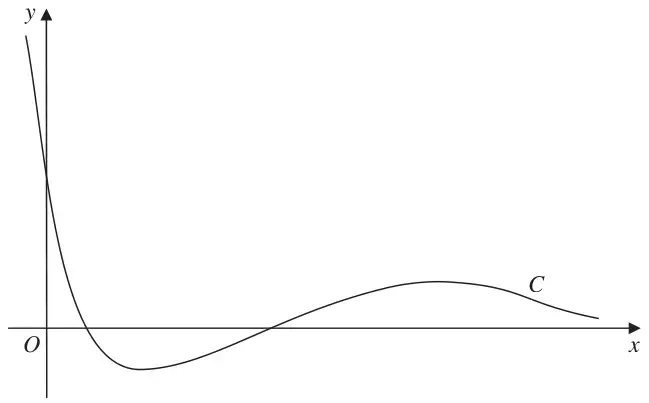
Figure 1 shows a sketch of the curve \(C\) with the equation \(y = (2x^2 - 5x + 2)\mathrm{e}^{-x}\).
| Scheme | Marks |
|---|---|
| Either \(y = 2\) or \((0, 2)\) | B1 |
| (1) |
| Scheme | Marks |
|---|---|
| When \(x = 2\), \(y = (8 - 10 + 2)\mathrm{e}^{-2} = 0\mathrm{e}^{-2} = 0\) | B1 |
| \((2x^2 - 5x + 2) = 0 \Rightarrow (x - 2)(2x - 1) = 0\) | M1 |
| Either \(x = 2\) (for possibly B1 above) or \(\underline{x = \tfrac{1}{2}}\). | A1 |
| (3) |
Notes
(b) If the candidate believes that \(\mathrm{e}^{-x} = 0\) solves to \(x = 0\) or gives an extra solution of \(x = 0\), then withhold the final accuracy mark.
| Scheme | Marks |
|---|---|
| \(\dfrac{\mathrm{d}y}{\mathrm{d}x} = (4x - 5)\mathrm{e}^{-x} - (2x^2 - 5x + 2)\mathrm{e}^{-x}\) | M1A1A1 |
| (3) |
Notes
(c) M1: (their \(u'\))\(\mathrm{e}^{-x} + (2x^2 - 5x + 2)\)(their \(v'\))
A1: Any one term correct.
A1: Both terms correct.
| Scheme | Marks |
|---|---|
| \((4x - 5)\mathrm{e}^{-x} - (2x^2 - 5x + 2)\mathrm{e}^{-x} = 0\) | M1 |
| \(2x^2 - 9x + 7 = 0 \Rightarrow (2x - 7)(x - 1) = 0\) | M1 |
| \(x = \tfrac{7}{2}, 1\) | A1 |
| When \(x = \tfrac{7}{2}\), \(y = 9\mathrm{e}^{-\frac{7}{2}}\), when \(x = 1\), \(y = -\mathrm{e}^{-1}\) | ddM1A1 |
| (5) | |
| (12 marks) |
Notes
(d) 1st M1: For setting their \(\frac{\mathrm{d}y}{\mathrm{d}x}\) found in part (c) equal to 0.
2nd M1: Factorise or eliminate out \(\mathrm{e}^{-x}\) correctly and an attempt to factorise a 3-term quadratic or apply the formula to candidate’s \(ax^2 + bx + c\). See rules for solving a three term quadratic equation on page 1 of this Appendix.
3rd ddM1: An attempt to use at least one \(x\)-coordinate on \(y = (2x^2 - 5x + 2)\mathrm{e}^{-x}\). Note that this method mark is dependent on the award of the two previous method marks in this part. Some candidates write down corresponding \(y\)-coordinates without any working. It may be necessary on some occasions to use your calculator to check that at least one of the two \(y\)-coordinates found is correct to awrt 2 sf.
Final A1: Both \(\{x = 1\}\), \(y = -\mathrm{e}^{-1}\) and \(\left\{x = \tfrac{7}{2}\right\}\), \(y = 9\mathrm{e}^{-\frac{7}{2}}\). cao
Note that both exact values of \(y\) are required.