
C3 June 2006 Q5
5.
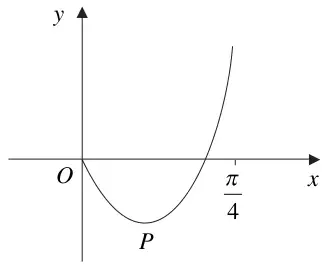
Figure 2 shows part of the curve with equation\[y = (2x - 1)\tan 2x, \quad 0 \leqslant x \lt \frac{\pi}{4}.\]
The curve has a minimum at the point \(P\). The \(x\)-coordinate of \(P\) is \(k\).
(a) Show that \(k\) satisfies the equation\[4k + \sin 4k - 2 = 0.\] (6)
The iterative formula\[x_{n+1} = \frac{1}{4}(2 - \sin 4x_n), \quad x_0 = 0.3,\]is used to find an approximate value for \(k\).
(b) Calculate the values of \(x_1\), \(x_2\), \(x_3\) and \(x_4\), giving your answers to 4 decimal places. (3)
(c) Show that \(k = 0.277\), correct to 3 significant figures. (2)
| Scheme | Marks |
|---|---|
| Using product rule: \(\dfrac{\mathrm{d}y}{\mathrm{d}x} = 2\tan 2x + 2(2x - 1)\sec^2 2x\) | M1 A1 A1 |
| Use of “\(\tan 2x = \dfrac{\sin 2x}{\cos 2x}\)” and “\(\sec 2x = \dfrac{1}{\cos 2x}\)” \(\left[= 2\dfrac{\sin 2x}{\cos 2x} + 2(2x - 1)\dfrac{1}{\cos^2 2x}\right]\) | M1 |
| Setting \(\dfrac{\mathrm{d}y}{\mathrm{d}x} = 0\) and multiplying through to eliminate fractions \([\Rightarrow 2\sin 2x\cos 2x + 2(2x - 1) = 0]\) | M1 |
| Completion: producing \(4k + \sin 4k - 2 = 0\) with no wrong working seen and at least previous line seen. AG | A1* |
| (6) |
| Scheme | Marks |
|---|---|
| \(x_1 = 0.2670,\quad x_2 = 0.2809,\quad x_3 = 0.2746,\quad x_4 = 0.2774\), | M1 A1 A1 |
| (3) |
Notes
M1 for first correct application, first A1 for two correct, second A1 for all four correct
Max \(-1\) deduction, if ALL correct to \(\gt 4\) d.p. M1 A0 A1
SC: degree mode: M1 \(x_1 = 0.4948\), A1 for \(x_2 = 0.4914\), then A0; max 2
| Scheme | Marks |
|---|---|
| Choose suitable interval for \(k\): e.g. \([0.2765, 0.2775]\) and evaluate \(\mathrm{f}(x)\) at these values | M1 |
| Show that \(4k + \sin 4k - 2\) changes sign and deduction \([\mathrm{f}(0.2765) = -0.000087\ldots,\ \mathrm{f}(0.2775) = +0.0057]\) | A1 |
| (2) | |
| (11 marks) |
Notes
Continued iteration: (no marks in degree mode)
Some evidence of further iterations leading to 0.2765 or better M1; Deduction A1