
C4 January 2011 Q6
6. The curve \(C\) has parametric equations \[x = \ln t, \qquad y = t^2 - 2, \qquad t > 0\]
Find
(a) an equation of the normal to \(C\) at the point where \(t = 3\), (6)
(b) a cartesian equation of \(C\). (3)
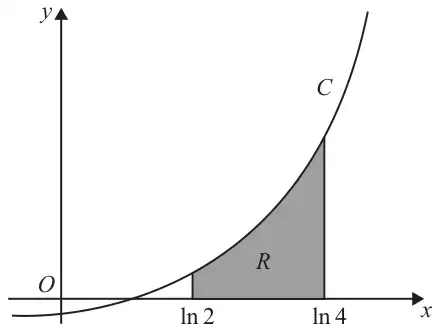
The finite area \(R\), shown in Figure 1, is bounded by \(C\), the \(x\)-axis, the line \(x = \ln 2\) and the line \(x = \ln 4\). The area \(R\) is rotated through \(360^\circ\) about the \(x\)-axis.
(c) Use calculus to find the exact volume of the solid generated. (6)
| Scheme | Marks |
|---|---|
| \(\dfrac{\mathrm{d}x}{\mathrm{d}t} = \dfrac{1}{t},\quad \dfrac{\mathrm{d}y}{\mathrm{d}t} = 2t\) | |
| \(\dfrac{\mathrm{d}y}{\mathrm{d}x} = 2t^2\) | M1 A1 |
| Using \(mm' = -1\), at \(t = 3\) \(m' = -\dfrac{1}{18}\) | M1 A1 |
| \(y - 7 = -\dfrac{1}{18}(x - \ln 3)\) | M1 A1 |
| (6) |
| Scheme | Marks |
|---|---|
| \(x = \ln t \Rightarrow t = \mathrm{e}^x\) | B1 |
| \(y = \mathrm{e}^{2x} - 2\) | M1 A1 |
| (3) |
| Scheme | Marks |
|---|---|
| \(V = \pi\displaystyle\int \left(\mathrm{e}^{2x} - 2\right)^2\mathrm{d}x\) | M1 |
| \(\displaystyle\int \left(\mathrm{e}^{2x} - 2\right)^2\mathrm{d}x = \int \left(\mathrm{e}^{4x} - 4\mathrm{e}^{2x} + 4\right)\mathrm{d}x\) | M1 |
| \(= \dfrac{\mathrm{e}^{4x}}{4} - \dfrac{4\mathrm{e}^{2x}}{2} + 4x\) | M1 A1 |
| \(\pi\left[\dfrac{\mathrm{e}^{4x}}{4} - \dfrac{4\mathrm{e}^{2x}}{2} + 4x\right]_{\ln 2}^{\ln 4} = \pi\big[(64 - 32 + 4\ln 4) - (4 - 8 + 4\ln 2)\big]\) | M1 |
| \(= \pi(36 + 4\ln 2)\) | A1 |
| (6) | |
| (15 marks) |
Alternative to (c) using parameters
| \(V = \pi\displaystyle\int \left(t^2 - 2\right)^2\frac{\mathrm{d}x}{\mathrm{d}t}\,\mathrm{d}t\) | M1 |
| \(\displaystyle\int \left(\left(t^2 - 2\right)^2 \times \frac{1}{t}\right)\mathrm{d}t = \int \left(t^3 - 4t + \frac{4}{t}\right)\mathrm{d}t\) | M1 |
| \(= \dfrac{t^4}{4} - 2t^2 + 4\ln t\) | M1 A1 |
| The limits are \(t = 2\) and \(t = 4\) \(\pi\left[\dfrac{t^4}{4} - 2t^2 + 4\ln t\right]_2^4 = \pi\big[(64 - 32 + 4\ln 4) - (4 - 8 + 4\ln 2)\big]\) | M1 |
| \(= \pi(36 + 4\ln 2)\) | A1 |
| (6) |