
C4 June 2010 Q1
1.
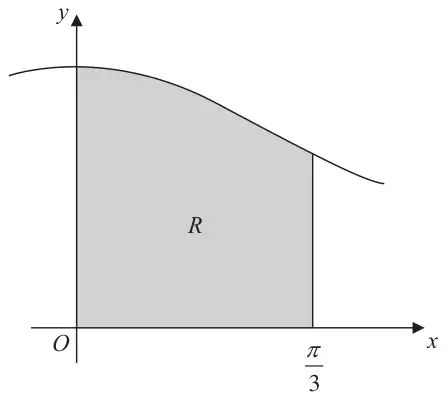
Figure 1 shows part of the curve with equation \(y = \sqrt{(0.75 + \cos^2 x)}\). The finite region \(R\), shown shaded in Figure 1, is bounded by the curve, the \(y\)-axis, the \(x\)-axis and the line with equation \(x = \dfrac{\pi}{3}\).
(a) Complete the table with values of \(y\) corresponding to \(x = \dfrac{\pi}{6}\) and \(x = \dfrac{\pi}{4}\).
(2)
| \(x\) | 0 | \(\dfrac{\pi}{12}\) | \(\dfrac{\pi}{6}\) | \(\dfrac{\pi}{4}\) | \(\dfrac{\pi}{3}\) |
|---|---|---|---|---|---|
| \(y\) | 1.3229 | 1.2973 | 1 |
(b) Use the trapezium rule
(i) with the values of \(y\) at \(x = 0\), \(x = \dfrac{\pi}{6}\) and \(x = \dfrac{\pi}{3}\) to find an estimate of the area of \(R\). Give your answer to 3 decimal places.
(ii) with the values of \(y\) at \(x = 0\), \(x = \dfrac{\pi}{12}\), \(x = \dfrac{\pi}{6}\), \(x = \dfrac{\pi}{4}\) and \(x = \dfrac{\pi}{3}\) to find a further estimate of the area of \(R\). Give your answer to 3 decimal places. (6)
| Scheme | Marks |
|---|---|
| \(y\left(\dfrac{\pi}{6}\right) \approx 1.2247,\ y\left(\dfrac{\pi}{4}\right) = 1.1180\) accept awrt 4 d.p. | B1 B1 |
| (2) |
| Scheme | Marks |
|---|---|
| (i) \(I \approx \left(\dfrac{\pi}{12}\right)\left(1.3229 + 2 \times 1.2247 + 1\right)\) B1 for \(\dfrac{\pi}{12}\) | B1 M1 |
| \(\approx 1.249\) cao | A1 |
| (ii) \(I \approx \left(\dfrac{\pi}{24}\right)\big(1.3229 + 2 \times (1.2973 + 1.2247 + 1.1180) + 1\big)\) B1 for \(\dfrac{\pi}{24}\) | B1 M1 |
| \(\approx 1.257\) cao | A1 |
| (6) | |
| (8 marks) |