
C3 June 2016 Q4
4.
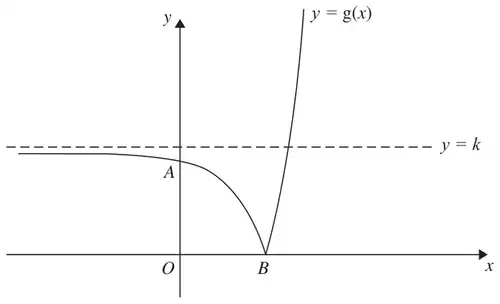
Figure 1 shows a sketch of part of the curve with equation \(y = \mathrm{g}(x)\), where\[\mathrm{g}(x) = \left|4\mathrm{e}^{2x} - 25\right|, \qquad x \in \mathbb{R}\]The curve cuts the \(y\)-axis at the point \(A\) and meets the \(x\)-axis at the point \(B\). The curve has an asymptote \(y = k\), where \(k\) is a constant, as shown in Figure 1
The equation \(\mathrm{g}(x) = 2x + 43\) has a positive root at \(x = \alpha\)
The iteration formula\[x_{n+1} = \frac{1}{2}\ln\left(\frac{1}{2}x_n + 17\right)\]can be used to find an approximation for \(\alpha\)
Give each answer to 4 decimal places. (2)
| Scheme | Marks |
|---|---|
| (i) 21 | B1 |
| (ii) \(4\mathrm{e}^{2x} - 25 = 0 \Rightarrow \mathrm{e}^{2x} = \dfrac{25}{4} \Rightarrow 2x = \ln\left(\dfrac{25}{4}\right) \Rightarrow x = \dfrac{1}{2}\ln\left(\dfrac{25}{4}\right), \Rightarrow x = \ln\left(\dfrac{5}{2}\right)\) | M1A1, A1 |
| (iii) 25 | B1 |
| (5) |
Notes
In part (a) accept points marked on the graph. If they appear on the graph and in the text, the text takes precedence. If they don't mark (a) as (i) (ii) and (iii) mark in the order given. If you feel unsure then please use the review system and your team leader will advise.
(a)(i)
B1: Sight of 21. Accept \((0, 21)\)
Do not accept just \(|4 - 25|\) or \((21, 0)\)
(a)(ii)
M1: Sets \(4\mathrm{e}^{2x} - 25 = 0\) and proceeds via \(\mathrm{e}^{2x} = \dfrac{25}{4}\) or \(\mathrm{e}^x = \dfrac{5}{2}\) to \(x = ..\)
Alternatively sets \(4\mathrm{e}^{2x} - 25 = 0\) and proceeds via \(\left(2\mathrm{e}^x - 5\right)\left(2\mathrm{e}^x + 5\right) = 0\) to \(\mathrm{e}^x = ..\)
A1: \(\dfrac{1}{2}\ln\left(\dfrac{25}{4}\right)\) or awrt 0.92
A1: cao \(\ln\left(\dfrac{5}{2}\right)\) or \(\ln 5 - \ln 2\). Accept \(\left(\ln\left(\dfrac{5}{2}\right), 0\right)\)
(a)(iii)
B1: \(k = 25\) Accept also 25 or \(y = 25\)
Do not accept just \(|-25|\) or \(x = 25\) or \(y = \pm 25\)
| Scheme | Marks |
|---|---|
| \(4\mathrm{e}^{2x} - 25 = 2x + 43 \Rightarrow \mathrm{e}^{2x} = \dfrac{1}{2}x + 17\) | M1 |
| \(\Rightarrow 2x = \ln\left(\dfrac{1}{2}x + 17\right) \Rightarrow x = \dfrac{1}{2}\ln\left(\dfrac{1}{2}x + 17\right)\) | A1* |
| (2) |
Notes
M1: Sets \(4\mathrm{e}^{2x} - 25 = 2x + 43\) and makes \(\mathrm{e}^{2x}\) the subject. Look for \(\mathrm{e}^{2x} = \dfrac{1}{4}(2x + 43 + 25)\) condoning sign slips. Condone \(\left|4\mathrm{e}^{2x} - 25\right| = 2x + 43\) and makes \(\left|\mathrm{e}^{2x}\right|\) the subject. Condone for both marks a solution with \(x = a/\alpha\)
An acceptable alternative is to proceed to \(2\mathrm{e}^{2x} = x + 34 \Rightarrow \ln 2 + 2x = \ln(x + 34)\) using ln laws
A1*: Proceeds correctly without errors to the correct solution. This is a given answer and the bracketing must be correct throughout. The solution must have come from \(4\mathrm{e}^{2x} - 25 = 2x + 43\) with the modulus having been taken correctly.
Allow \(\mathrm{e}^{2x} = \dfrac{1}{4}(2x + 43 + 25)\) going to \(x = \dfrac{1}{2}\ln\left(\dfrac{1}{2}x + 17\right)\) without explanation
Allow \(\dfrac{1}{2}\ln\left(\dfrac{1}{2}x + 17\right)\) appearing as \(\dfrac{1}{2}\log_{\mathrm{e}}\left(\dfrac{1}{2}x + 17\right)\) but not as \(\dfrac{1}{2}\log\left(\dfrac{1}{2}x + 17\right)\)
If a candidate attempts the solution backwards they must proceed from \(x = \dfrac{1}{2}\ln\left(\dfrac{1}{2}x + 17\right) \Rightarrow \mathrm{e}^{2x} = \dfrac{1}{2}x + 17 \Rightarrow 4\mathrm{e}^{2x} - 25 = 2x + 43\) for the M1
For the A1 it must be tied up with a minimal statement that this is \(g(x) = 2x + 43\)
| Scheme | Marks |
|---|---|
| \(x_1 = \dfrac{1}{2}\ln\left(\dfrac{1}{2} \times 1.4 + 17\right) = \textit{awrt } 1.44\) | M1 |
| awrt \(x_1 = 1.4368, x_2 = 1.4373\) | A1 |
| (2) |
Notes
M1: Subs 1.4 into the iterative formula in an attempt to find \(x_1\)
Score for \(x_1 = \dfrac{1}{2}\ln\left(\dfrac{1}{2} \times 1.4 + 17\right)\) \(x_1 = \dfrac{1}{2}\ln(17.7)\) or awrt 1.44
A1: awrt \(x_1 = 1.4368, x_2 = 1.4373\) Subscripts are not important, mark in the order given please.
| Scheme | Marks |
|---|---|
| Defines a suitable interval 1.4365 and 1.4375 | M1 |
| ...and substitutes into a suitable function Eg \(4\mathrm{e}^{2x} - 2x - 68\), obtains correct values with both a reason and conclusion | A1 |
| (2) | |
| (11 marks) |
Notes
M1: For a suitable interval. Accept 1.4365 and 1.4375 (or any two values of a smaller range spanning the root=1.4373) Continued iteration is M0
A1: Substitutes both values into a suitable function, which must be defined or implied by their working calculates both values correctly to 1 sig fig (rounded or truncated)
Suitable functions could be \(\pm\left(4\mathrm{e}^{2x} - 2x - 68\right), \pm\left(x - \dfrac{1}{2}\ln\left(\dfrac{1}{2}x + 17\right)\right), \pm\left(2x - \ln\left(\dfrac{1}{2}x + 17\right)\right)\).
Using \(4\mathrm{e}^{2x} - 2x - 68\) f (1.4365) = -0.1, f (1.4375) = +0.02 or +0.03
Using \(2\mathrm{e}^{2x} - x - 34\) f (1.4365) = -0.05/-0.06, f (1.4375) = +0.01
Using \(x - \dfrac{1}{2}\ln\left(\dfrac{1}{2}x + 17\right)\) f (1.4365) =-0.0007 or -0.0008, f (1.4375) =+ 0.0001 or +0.0002
Using \(2x - \ln\left(\dfrac{1}{2}x + 17\right)\) f (1.4365) = -0.001 or -0.002, f (1.4375) =+0.0003 or +0.0004
and states a reason (eg change of sign)
and a gives a minimal conclusion (eg root or tick)
It is valid to compare the two functions. Eg \(\begin{aligned} &g(1.4365) = 45.7(6) < 2 \times 1.4365 + 43 = 45.8(73) \\ &g(1.4375) = 45.90 > 2 \times 1.4375 + 43 = 45.8(75) \end{aligned}\)
but the conclusion should be \(g(x) = 2x + 43\) in between, hence root .
Similarly candidates can compare the functions \(x\) and \(\dfrac{1}{2}\ln\left(\dfrac{1}{2}x + 17\right)\)