
C3 June 2015 Q1
1. Given that\[\tan\theta^\circ = p, \text{ where } p \text{ is a constant, } p \neq \pm 1\]use standard trigonometric identities, to find in terms of \(p\),
Write each answer in its simplest form.
| Scheme | Marks |
|---|---|
| \(\tan 2\theta^\circ = \dfrac{2\tan\theta^\circ}{1 - \tan^2\theta^\circ} = \dfrac{2p}{1 - p^2}\) Final answer | M1A1 |
| (2) |
Notes
M1: Attempt to use the double angle formula for tangent followed by the substitution \(\tan\theta = p\).
For example accept \(\tan 2\theta^\circ = \dfrac{2\tan\theta^\circ}{1 \pm \tan^2\theta^\circ} = \dfrac{2p}{1 \pm p^2}\)
Condone unconventional notation such as \(\tan 2\theta^\circ = \dfrac{2\tan\theta^\circ}{1 \pm \tan\theta^{2\circ}}\) followed by an attempt to substitute \(\tan\theta = p\) for the M mark. Recovery from this notation is allowed for the A1.
Alternatively use \(\tan(A + B) = \dfrac{\tan A + \tan B}{1 \pm \tan A\tan B}\) with an attempt at substituting \(\tan A = \tan B = p\). The unsimplified answer \(\dfrac{p + p}{1 - p \times p}\) is evidence
It is possible to use \(\tan 2\theta^\circ = \dfrac{\sin 2\theta^\circ}{\cos 2\theta^\circ} = \dfrac{2\sin\theta^\circ\cos\theta^\circ}{2\cos^2\theta^\circ - 1} = \dfrac{2 \times \dfrac{p}{\sqrt{1 \pm p^2}} \times \dfrac{1}{\sqrt{1 \pm p^2}}}{2 \times \dfrac{1}{1 \pm p^2} - 1}\) but it is unlikely to succeed.
A1: Correct simplified answer of \(\tan 2\theta^\circ = \dfrac{2p}{1 - p^2}\) or \(\dfrac{2p}{(1 - p)(1 + p)}\).
Do not allow if they "simplify" to \(\dfrac{2}{1 - p}\)
Allow the correct answer for both marks as long as no incorrect working is seen.
| Scheme | Marks |
|---|---|
| \(\cos\theta^\circ = \dfrac{1}{\sec\theta^\circ} = \dfrac{1}{\sqrt{1 + \tan^2\theta^\circ}} = \dfrac{1}{\sqrt{1 + p^2}}\) Final answer | M1A1 |
| (2) |
Notes
M1: Attempt to use both \(\cos\theta = \dfrac{1}{\sec\theta}\) and \(1 + \tan^2\theta = \sec^2\theta\) with \(\tan\theta = p\) in an attempt to obtain an expression for \(\cos\theta\) in terms of \(p\). Condone a slip in the sign of the second identity.
Evidence would be \(\cos^2\theta = \dfrac{1}{\pm 1 \pm p^2}\)
Alternatively use a triangle method, attempt Pythagoras' theorem and use \(\cos\theta = \dfrac{adj}{hyp}\)
The attempt to use Pythagoras must attempt to use the squares of the lengths.
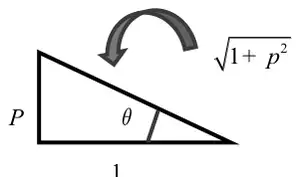
A1: \(\cos\theta^\circ = \dfrac{1}{\sqrt{1 + p^2}}\) Accept versions such as \(\cos\theta^\circ = \sqrt{\dfrac{1}{1 + p^2}}\), \(\cos\theta^\circ = \pm\dfrac{1}{\sqrt{1 + p^2}}\)
Withhold this mark if the candidate goes on to write \(\cos\theta^\circ = \dfrac{1}{1 + p}\)
| Scheme | Marks |
|---|---|
| \(\cot(\theta - 45)^\circ = \dfrac{1}{\tan(\theta - 45)^\circ} = \dfrac{1 + \tan\theta^\circ\tan 45^\circ}{\tan\theta^\circ - \tan 45^\circ} = \dfrac{1 + p}{p - 1}\) Final answer | M1A1 |
| (2) | |
| (6 marks) |
Notes
M1: Use the correct identity \(\cot(\theta - 45) = \dfrac{1}{\tan(\theta - 45)}\) and an attempt to use the \(\tan(A - B)\) formula with \(A = \theta\), \(B = 45\) and \(\tan\theta = p\).
For example accept an unsimplified answer such as \(\dfrac{1}{\dfrac{\tan\theta \pm \tan 45}{1 \pm \tan\theta\tan 45}} = \dfrac{1}{\dfrac{p \pm \tan 45}{1 \pm p\tan 45}}\)
It is possible to use \(\cot(\theta - 45) = \dfrac{\cos(\theta - 45)}{\sin(\theta - 45)}\) and an attempt to use the formulae for \(\sin(A - B)\) and \(\cos(A - B)\) with \(A = \theta\), \(B = 45\). \(\sin\theta = \dfrac{p}{\sqrt{1 \pm p^2}}\) and \(\cos\theta = \dfrac{1}{\sqrt{1 \pm p^2}}\)
Sight of an expression \(\dfrac{\dfrac{1}{\sqrt{1 \pm p^2}}\cos 45 \pm \dfrac{p}{\sqrt{1 \pm p^2}}\sin 45}{\dfrac{p}{\sqrt{1 \pm p^2}}\cos 45 \pm \dfrac{1}{\sqrt{1 \pm p^2}}\sin 45}\) is evidence.
A1: Uses \(\tan 45 = 1\) or \(\sin 45 = \cos 45 = \dfrac{\sqrt{2}}{2}\) oe and simplifies answer.
Accept \(-\dfrac{1 + p}{1 - p}\) or \(1 + \dfrac{2}{p - 1}\)
Note that there is no isw in any parts of this question.