
C2 June 2016 Q2
2. The curve \(C\) has equation\[y = 8 - 2^{x-1}, \qquad 0 \leqslant x \leqslant 4\]
| \(x\) | 0 | 1 | 2 | 3 | 4 |
|---|---|---|---|---|---|
| \(y\) | 7.5 | 6 | 4 | 0 |
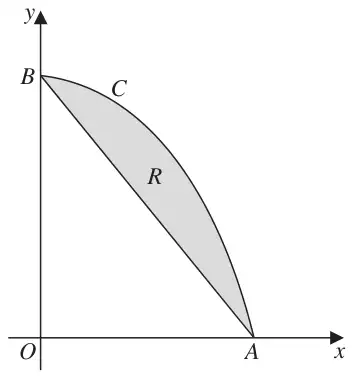
Figure 1 shows a sketch of the curve \(C\) with equation \(y = 8 - 2^{x-1}\), \(0 \leqslant x \leqslant 4\)
The curve \(C\) meets the \(x\)-axis at the point \(A\) and meets the \(y\)-axis at the point \(B\).
The region \(R\), shown shaded in Figure 1, is bounded by the curve \(C\) and the straight line through \(A\) and \(B\).
| Scheme | Marks |
|---|---|
| \(y = 8 - 2^{x-1},\ 0 \leqslant x \leqslant 4\) | |
| 7 | B1 cao |
| (1) |
Notes
B1 For 7 only
| Scheme | Marks |
|---|---|
| \(\left(\displaystyle\int_0^4 \left(8 - 2^{x-1}\right)\mathrm{d}x \approx\right)\ \dfrac{1}{2} \times 1; \times \underline{\left\{7.5 + 2\left(\text{"their 7"} + 6 + 4\right) + 0\right\}}\) | B1; M1 |
| \(\left\{= \dfrac{1}{2} \times 41.5\right\} = 20.75\) o.e. 20.75 | A1 cao |
| (3) |
Notes
B1 Outside brackets \(\dfrac{1}{2} \times 1\) or \(\dfrac{1}{2}\). For using \(\tfrac{1}{2} \times 1\) or \(\tfrac{1}{2}\) or equivalent.
M1 For structure of trapezium rule \(\{\ldots\ldots\ldots\ldots\}\) for a candidate’s \(y\)-ordinates.
Requires the correct \(\{\ldots\ldots\}\) bracket structure. It needs the 7.5 stated but the 0 may be omitted. The inner bracket needs to be multiplied by 2 and to be the summation of the remaining \(y\) values in the table with no additional values.
If the only mistake is a copying error or is to omit one value from 2nd bracket this may be regarded as a slip and the M mark can be allowed ( An extra repeated term forfeits the M mark however (unless it is 0)). M0 is awarded if values used in brackets are \(x\) values instead of \(y\) values
A1 For 20.75 or fraction equivalent e.g. \(20\tfrac{3}{4}\) or \(\tfrac{83}{4}\)
Note NB: Separate trapezia may be used : B1 for 0.5, M1 for 1/2 \(h(a + b)\) used 3 or 4 times Then A1 as before.
Special case: Bracketing mistake \(0.5 \times (7.5 + 0) + 2(\text{ their } 7 + 6 + 4)\) scores B1 M1 A0 unless the final answer implies that the calculation has been done correctly (then full marks can be given). An answer of 37.75 usually indicates this error.
Common error: Many candidates use \(\tfrac{1}{2} \times \dfrac{4}{5}\) and score B0 Then they proceed with \(\underline{\left\{7.5 + 2\left(\text{"their 7"} + 6 + 4\right) + 0\right\}}\) and score M1 This usually gives 16.6 for B0M1A0
| Scheme | Marks |
|---|---|
| Area\((R) = \text{"}20.75\text{"} - \dfrac{1}{2}(7.5)(4)\) | M1 |
| \(= 5.75\) 5.75 | A1 cao |
| (2) | |
| 6 |
Notes
M1 their answer to (b) \(-\) area of triangle with base 4 and height 7.5 or alternative correct method e.g. their answer to (b) \(- \displaystyle\int_0^4 \left(7.5 - \frac{7.5}{4}x\right)\mathrm{d}x\) (Even if this leads to a negative answer) This may be implied by a correct answer or by an answer where they have subtracted 15 from their answer to part (b). Must use answer to part (b).
A1 5.75 or fraction equivalent e.g. \(5\tfrac{3}{4}\) or \(\tfrac{23}{4}\)