
June 2018 Paper 1 Q18
18 \(D\), \(E\), \(F\) and \(S\) are points on a circle.
\(RST\) is a tangent.
The straight line \(EDT\) is parallel to \(FS\).
\(DS = DT\)
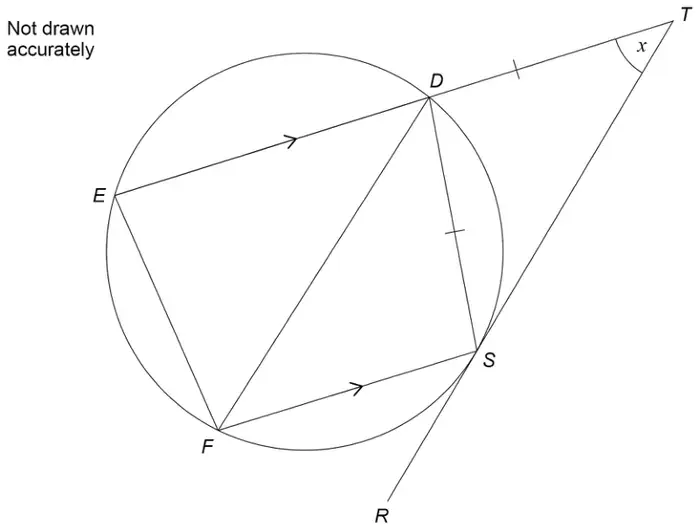
Prove that \(FD\) is parallel to \(RST\).
Use angle \(DTS\) as \(x\) to help you. [5 marks]
| Answer | Mark | Comments |
|---|---|---|
| Angle \(DST = x\) | M1 | ‘base angles of isosceles triangle \(DST\)’ but we do not require a reason for this mark |
| Angle \(DFS = x \quad\) angle in alternate segment or Angle \(RSF = x \quad\) corresponding | M1 | either of these angles with a correct reason scores this mark no reason or an incorrect reason is M0 |
| Further evaluation of angles, with correct reasons, to arrive at a stage where … either … it is possible to use the converse of a theorem or … which leads to the fact that \(DTSF\) is a parallelogram | M1dep | Here is a complete example … angle \(DST = x\) angle \(DSR = 180 - x \quad\) angles on a straight line angle \(RSF = x \quad\) corresponding angle \(FDS = x \quad\) \(FDS = RSF\), angle in alternate segment |
| A statement of the angles, or the values of the angles, that will complete the proof … the angles must be clearly identified | M1dep | angle \(DSR\) + angle \(FDS\) \(= 180 - x + x\) \(= 180\) |
| A statement of the correct reason to accompany these angles, thus completing the proof | A1 | \(FD\) is parallel to \(RST\) because these angles add to 180 … using the (converse) of the co-interior angles theorem |
Additional guidance
| Some methods are much shorter than others. Follow their reasoning to see if it is free from error. | |
| The 3rd mark is dependent on both of the previous two M marks. So, if they have not scored M1 M1 they cannot score any more marks | |
| For the 3rd M mark … when following their work, stop as soon as there is an error in the value of any angle or in the reason given for any particular angle. The proof breaks down at that point and they can only score a maximum of 2 marks. | |
| The 4th mark (M1dep) and the 5th mark (A1) are closely related. They can be thought of as a pair because the 4th mark is for identifying the two angles that make the completion of the proof possible and the 5th mark is for stating the correct reason. Condone the fact that you may not see the word ‘converse’. | |
| Any sign of them using the result (eg \(DST = FDS\), alternate angles) means they have compromised the proof immediately and they can only score a maximum of 2 marks. |