
June 2018 Paper 1 Q12
12 In the diagram,
\(A\) is the point \((15,\ 0)\) and \(B\) lies on the \(y\)-axis.
Angle \(ABC = 90^\circ\) and \(\tan\theta = \dfrac{5}{3}\)
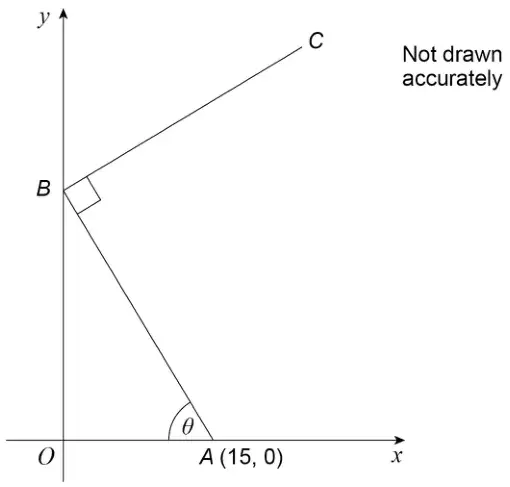
Work out the equation of the line \(BC\). [4 marks]
| Answer | Mark | Comments |
|---|---|---|
| \(\dfrac{5}{3} \times 15\) or 25 seen as the length of \(OB\) or the coordinates of \(B\) | M1 | |
| gradient \(AB = \dfrac{0 - \text{their } 25}{15 - 0}\) or \(-\dfrac{5}{3}\) | M1 | oe |
| gradient \(BC = -1 \div \left(\text{their } -\dfrac{5}{3}\right)\) or \(\dfrac{3}{5}\) | M1 | oe |
| \(y = \dfrac{3}{5}x + 25\) | A1 | oe eg \(y = \dfrac{15}{25}x + 25\) or \(5y = 3x + 125\) |
Additional guidance
| We must see \(y = \ldots\ldots\) for A1 (or any other correct equation) Look for this in their working if it isn’t written on the answer line. A sign error in their gradient \(AB\), after a correct expression, can be recovered. eg gradient \(AB = \dfrac{0 - 25}{15 - 0} = \dfrac{25}{15} = \dfrac{5}{3}\) gradient \(BC = \dfrac{3}{5}\) (positive gradient because they can see it from the diagram) equation \(BC\) is \(\ y = \dfrac{3}{5}x + 25\) … this scores 4 marks similarly, recovery can be from … gradient \(AB = \dfrac{25}{15} = \dfrac{5}{3}\) … without seeing \(\dfrac{0 - 25}{15 - 0}\) … and can still lead to 4 marks |