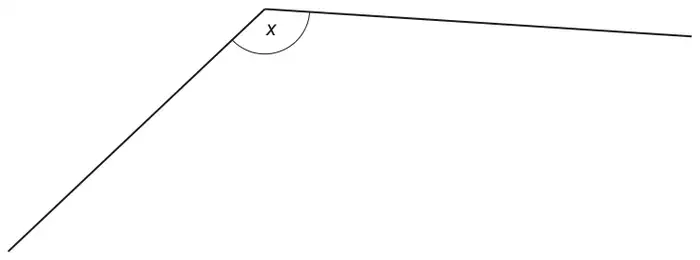
(b) The angles of a triangle are \(27^\circ\), \(126^\circ\) and \(27^\circ\).
Explain how you know the triangle is isosceles. [1]
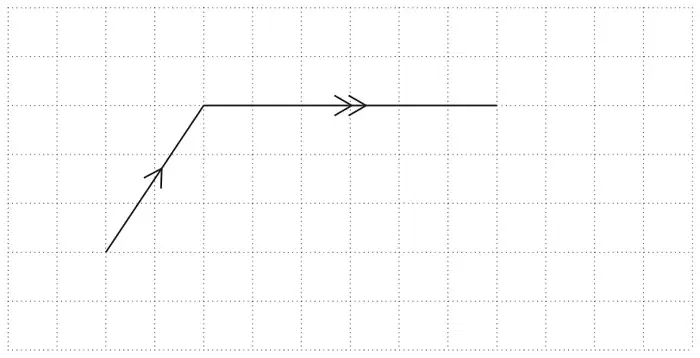
(c) The diagram shows two sides of a parallelogram drawn on a one-centimetre grid.
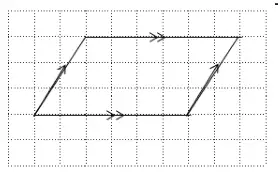
(i) Complete the drawing of the parallelogram. Include notation to show that the drawing is a parallelogram. [2]
(ii) Work out the area of the parallelogram. [2]
Mark scheme (a)
Answer
Marks
Part marks and guidance
133
1
Allow 131 to 135
Mark scheme (b)
Answer
Marks
Part marks and guidance
2 of the angles are equal oe
1
Must refer to angles not sides, statements must not be contradicted
Appendix
Exemplar responses for Q3b
Response
Mark
Two angles are identical and one is different.
1
Only two of the angles are the same so it cannot be equilateral.
1
Because two of the angles being the same means it is equal lines.
1
Two angles of an isosceles have to be the same.
1
27\(^\circ\) and 27\(^\circ\) are equal meaning it has two equal sides.
1
Only 2 numbers are the same and it's not all equal
1 bod
Because others don’t have same two angles
1 bod
Because others don’t have two angles the same/2 same angles
1 bod
Base angles in an isosceles triangle are always equal.
1 bod
Because isosceles triangles have equal sides and they are 27\(^\circ\).
0
Because 2 sides of the triangle are the same which is 27\(^\circ\) and the last side is different.
0
One angle is bigger than the others
0
Because they’re both 27 degree angles'
0
2 sides are the same
0
Both of isosceles have the same number
0
Mark scheme (c)
Answer
Marks
Part marks and guidance
(i)
1
Correct parallelogram drawn
Accept reasonable freehand, tolerance \(\pm\) 2mm by eye
1 dep
dep on parallelogram drawn Accept other, complete, standard notations that indicate a parallelogram eg two pairs of opposite sides have equal length or two pairs of opposite angles are equal or any combination of these properties that define a parallelogram
Mark intent
Arrows must be correct single/double and pointing in correct direction
(ii) 18 nfww
2
FTtheir parallelogram
M1 for their length \(\times\) their perpendicular height oe
e.g. \(6 + 3 + 6 + 3 = 18\) scores 0 M1 and 2 marks are dependent on a parallelogram being drawn in (i) Must be in cm\(^2\)
If not 6 and 3 their dimensions need to be verifiable eg shown on the diagram eg M0 for \(\sqrt{13}\) or 3.6… etc as their perpendicular height
oe includes two triangles + the \(4 \times 3\) rectangle or the \(8 \times 3\) rectangle – two triangles
Need to be certain that 3 is slant height to withhold the marks