
Foundation November 2021 Paper 3 Q22
22 In this question, all measurements are in centimetres.
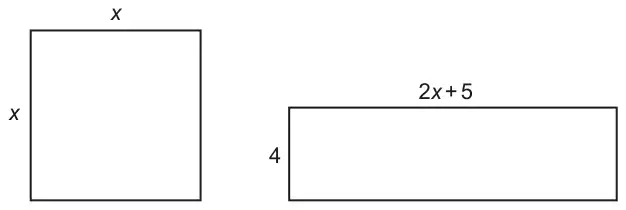
Not to scale
The square and the rectangle have the same area.
(a) Show that \(x^2 - 8x - 20 = 0\). [3]
(b) Solve \(x^2 - 8x - 20 = 0\). [3]
(c) Explain why one of the answers in part (b) is not possible in the context of the question. [1]
(d) Write down the following.
(i) The area of the square. [1]
(ii) The length of the rectangle. [1]
| Answer | Marks | Part marks and guidance | |
|---|---|---|---|
| \(x \times x\) or \(4(2x + 5)\) seen | M1 | Allow [area of] square \(= x^2\) or [area of] rectangle \(= 8x + 20\) | |
| \(x^2 = 8x + 20\) or \(x^2 = 4(2x + 5)\) | M1 | Dependent on first M1 and not from rearrangement of original equation | \(x^2\) and/or \(8x + 20\) may be written with correct shape(s) |
| Correctly rearranging to \(x^2 - 8x - 20 = 0\) without error | A1 | ||
| Answer | Marks | Part marks and guidance | |
|---|---|---|---|
| \(-2\) 10 nfww | 3 | B2 for one correct solution nfww OR M2 for \((x + 2)(x - 10) = 0\) or M1 for \((x + a)(x + b)\) where \(ab = -20\) or \(a + b = -8\) OR M2 for two correct trials using \(-4 \leqslant x \leqslant 0\) and two correct trials using \(8 \leqslant x \leqslant 12\) or M1 for two correct trials using \(-4 \leqslant x \leqslant 0\) or two correct trials using \(8 \leqslant x \leqslant 12\) If 0 scored SC1 for answers 2 and −10 | e.g. one trial is when \(x = 2\), \(2^2 - 8 \times 2 - 20 = -32\) Accept as trial \(x = 2\) and \(-32\) See trials table below |
Guidance
Trials for Q22(b)
| \(x\) | \(x^2\) | \(-8x\) | \(-20\) | total |
|---|---|---|---|---|
| −4 | 16 | 32 | −20 | 28 |
| −3 | 9 | 24 | −20 | 13 |
| −2 | 4 | 16 | −20 | 0 |
| −1 | 1 | 8 | −20 | −11 |
| 0 | 0 | 0 | −20 | −20 |
| 8 | 64 | −64 | −20 | −20 |
| 9 | 81 | −72 | −20 | −11 |
| 10 | 100 | −80 | −20 | 0 |
| 11 | 121 | −88 | −20 | 13 |
| 12 | 144 | −96 | −20 | 28 |
| Answer | Marks | Part marks and guidance | |
|---|---|---|---|
| Length [of square] cannot be negative | 1 | Dependent on negative answer in (b) | Do not accept \(x\) cannot be negative |
| Answer | Marks | Part marks and guidance | |
|---|---|---|---|
| (i) 100 | 1 | FT (their positive root from (b))\(^2\) | If two positive roots seen in (b) accept either or both used in (i) and in (ii) BUT, if one answer right and one wrong in any part, 0 marks |
| (ii) 25 | 1 | FT (their positive root from (b)) \(\times 2 + 5\) | |