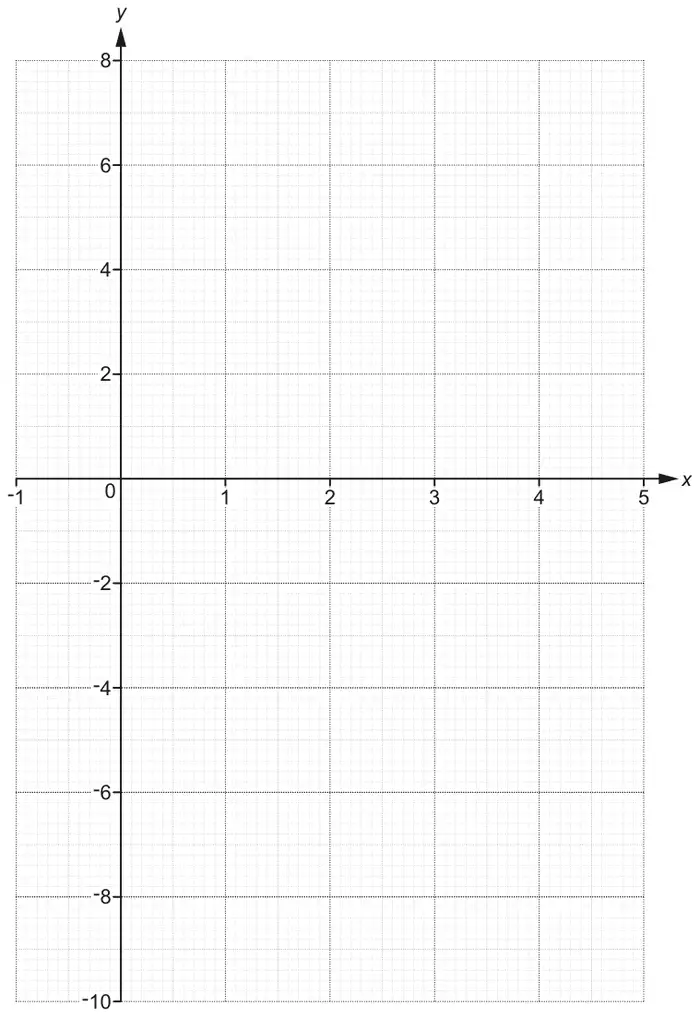
(b) Draw the graph of \(y = x^2 - 4x + 1\) for \(-1 \leqslant x \leqslant 5\).[3]
(c) On the same grid, draw the graph of \(y = 2x - 6\) for \(-1 \leqslant x \leqslant 5\). [3]
(d) Use your graphs to solve the equation \(x^2 - 4x + 1 = 2x - 6\).
Give your answers to 1 decimal place. [2]
Mark scheme (a)
Answer
Marks
Part marks and guidance
Completes table with
\(x\)
–1
0
1
2
3
4
5
\(y\)
6
1
–2
–3
–2
1
6
2
B1 for at least 2 correct values
Mark scheme (b)
Answer
Marks
Part marks and guidance
Correct curve
3
B2 for 6 or 7 points correctly plotted FT their table or B1 for 4 or 5 points correctly plotted FT their table
Tolerance ±2 mm for plotting and curve through the correct points. Strict marking of ‘smooth curve’ – must not be ruled or ‘feathered’
Mark scheme (c)
Answer
Marks
Part marks and guidance
Straight line passing through (0, –6) and (3, 0)
3
M2 for a correct unruled line or a straight line of gradient 2 or a straight line passing through (0, –6) or two correct points correctly stated or plotted or M1 for one correct point stated or plotted
\(x\)
–1
0
1
2
3
4
5
\(y\)
–8
–6
–4
–2
0
2
4
Mark scheme (d)
Answer
Marks
Part marks and guidance
1.6 and 4.4
2FT
B1 for each or both answers as decimals to a greater accuracy Correct answer or FT their straight line
Tolerance ±1 mm.
Do not allow exact answers \(3 + \sqrt{2}\) and \(3 - \sqrt{2}\)