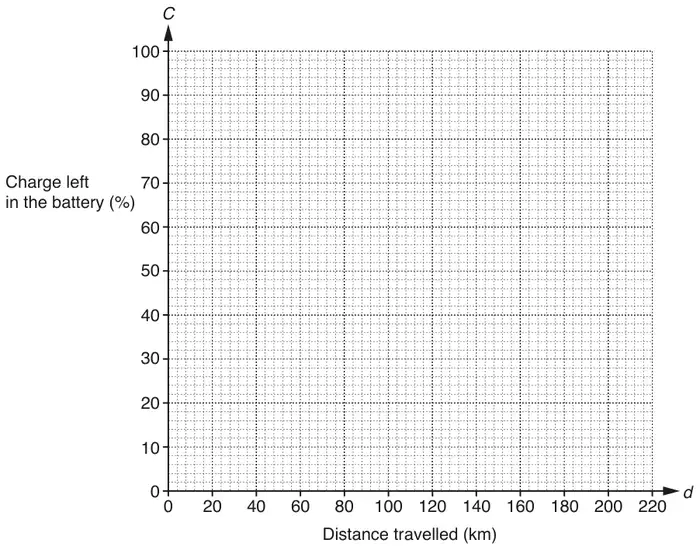
11 A company tests a new battery for an electric car. The distance the car travels, \(d\) km, and the charge left in the battery, \(C\) %, are measured.
Some measurements are shown in the table.
Distance travelled, \(d\) km.
0
50
100
150
Charge left in the battery, \(C\) %.
100
75
50
25
(a) Plot these values on the grid and use them to draw a straight line.
[2]
(b)
(i) Use your line to estimate the greatest distance the car will travel. [1]
(ii) What assumption is made when estimating the greatest distance? [1]
(c) For your line in part (a), find
(i) the gradient, [1]
(ii) the \(C\)-axis intercept. [1]
(d) Use your answers to part (c) to write down the equation of your graph.
Give your equation in the form \(C = ad + b\). [1]
(e)
(i) Use your equation to find the value of \(C\) when \(d = 210\). [2]
(ii) Comment on your answer. [1]
Mark scheme (a)
Answer
Marks
Part marks and guidance
4 points plotted and a ruled line joining
2
B1 for 3 points correctly plotted
Line at least between (0, 100) and (150, 25) Use overlay as guide. ½ square accuracy
Mark scheme (b)
Answer
Marks
Part marks and guidance
(i) 198 to 202
1
Do not FT their line
(ii) Battery usage remains the same or Battery can be used right to 0% or Trend or pattern continues
1
Accept For every 50 km it uses 25%
Mark scheme (c)
Answer
Marks
Part marks and guidance
(i) \(-\dfrac{1}{2}\) oe or \(-[0].5\)
1
Ignore units
(ii) 100
1
Accept 0, 100
Mark scheme (d)
Answer
Marks
Part marks and guidance
\(-\dfrac{1}{2}d + 100\)
1
FTtheir(c)(i)\(d\) + their(c)(ii)
Accept any letter for \(d\) (except \(c\))
Mark scheme (e)
Answer
Marks
Part marks and guidance
(i) \(-5\)
2
FTtheir(d) if linear in \(d\).
B1 for correct substitution of 210
Expect \(-\dfrac{1}{2} \times 210 + 100\) Accept any letter for \(d\) (except \(c\))
(ii) Impossible [as battery cannot have negative charge] oe
1
FTtheir(i) only if their equation gives negative outcome