
Higher November 2017 Paper 6 Q17
17 The diagram shows a circle, centre the origin.
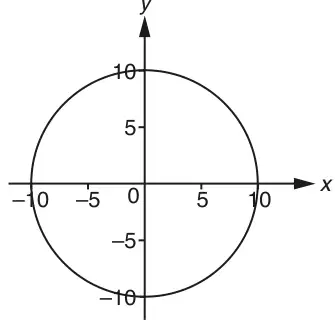
(a) Write down the equation of the circle. [1]
(b) Point P has coordinates (8, −6).
Show that point P lies on the circle. [2]
Show that point P lies on the circle. [2]
(c) Find the equation of the tangent to the circle at point P. [5]
| Answer | Marks | Part marks and guidance | |
|---|---|---|---|
| \(x^2 + y^2 = 100\) oe | 1 | ||
| Answer | Marks | Part marks and guidance | |
|---|---|---|---|
| \(8^2 + (-6)^2 = 100\), so it’s on the circle oe | 2 | M1 for \(8^2 + ([-]6)^2\) seen or for substituting \(x = 8\) and \(y = -6\) into their part (a) | Alternative using Pythagoras \(\sqrt{8^2 + 6^2} = 10\) their part (a) must be an equation in both \(x\) and \(y\). |
| Answer | Marks | Part marks and guidance | |
|---|---|---|---|
| \(3y - 4x + 50 = 0\) oe | 5 | B2 for [tangent gradient = ] \(\dfrac{4}{3}\) oe or M1 for \(\pm\dfrac{6}{8}\) or \(\pm\dfrac{8}{6}\) oe | Equivalents include: \(y = \dfrac{4}{3}x - \dfrac{50}{3}\) Condone decimals with at least 2 decimal places rot: Eg. \(y = 1.33x - 16.67\) |
| AND M2 for \(y + 6 = \textit{their } \dfrac{4}{3}(x - 8)\) oe or M1 for \(y = \textit{their } \dfrac{4}{3}x + \text{‘}c\text{’}\) | Equivalent for M2 includes \(y = \textit{their } \dfrac{4}{3}x + c\) and then attempt to find \(c\) by substituting in \(y = -6\) and \(x = 8\) | ||