11 Amelia buys a new car. The expected future value of this car, £\(V\), is given by
\[V = 16000 \times 0.75^t\]
where \(t\) is the age of the car in complete years.
(a)
(i) Write down the value of the car when new. [1]
(ii) Write down the annual percentage decrease in the expected value of the car. [1]
(iii) Show that the expected value of the car when 2 years old is £9000. [2]
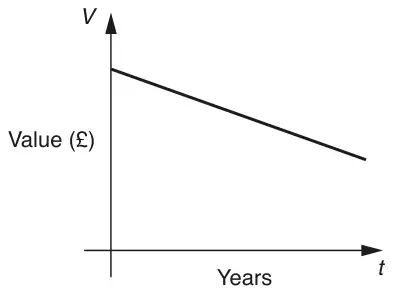
(b) Amelia sketches a graph to show the expected value of her car as it gets older.
Explain how you know that Amelia’s graph is incorrect. [1]
(c) Amelia assumes that her car will have no value at all after 20 years.
Explain why her assumption is mathematically incorrect. [1]
Mark scheme (a)
Answer
Marks
Part marks and guidance
(i) 16 000
1
(ii) 25
1
(iii) \(16\,000 \times 0.75^2\) oe with no subsequent error
M2
M1 for \(16\,000 \times 0.75^2\) with subsequent error or 16 000 × 0.75 oe or for their 12 000 × 0.75
M1 implied by 12000
Mark scheme (b)
Answer
Marks
Part marks and guidance
Equation does not give a straight line oe isw
1
Accept ‘There is not a constant decrease’ oe isw See AG
Appendix: exemplar responses for Q11(b)
Response
Mark
The graph should be a [decreasing] curve
1
It is 4000 for the first year and 3000 for the second year …
1
Because it would not be a steady decline
1
Mark scheme (c)
Answer
Marks
Part marks and guidance
If you calculate a value for a 20 year-old car it is greater than 0 oe
1
Accept ‘the graph will never reach the \(x\)-axis’ oe, It will have scrap value The answer is always positive etc Condone additional ‘opinion based’ information
We'd like to use Google Analytics cookies to count visits and see which pages help most. They're optional, and the site works exactly the same either way. Privacy policy