
Higher June 2018 Paper 6 Q5
5 The diagram shows a straight line that passes through points A and B, and a curve that passes through points P and Q.
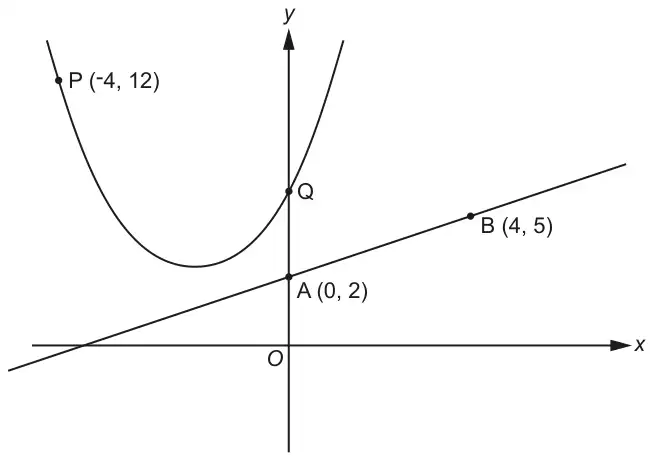
Not to scale
Find the value of \(k\). [3]
She says
Triangle ABQ is isosceles.
Is Diann correct?
You must show all your working. [4]
| Answer | Marks | Part marks and guidance | |
|---|---|---|---|
| \(y = 0.75x + 2\) oe | 3 | B2 for \(y = 0.75x\) [\(+ c\)] or answer \(0.75x + 2\) OR | ISW after a correct equation if attempting rearrangement Accept oe throughout eg B2 for \(4y = 3x\) |
| M1 for attempt at \(\dfrac{\text{change in } y}{\text{change in } x}\) soi by \(\dfrac{\pm(5 - 2)}{\pm(4 - 0)}\) or ±0.75 and B1 for \(y = kx + 2\) with \(k \ne 0\) | Examples: M1B1 for \(y = -0.75x + 2\) M1B0 for 0.75, \(0.75x\), −0.75, \(-0.75x\) If gradient inverted: M0B1 for \(y = 1.3x + 2\) M0B0 for \(1.3x + 2\), \(y = 1.3x\) Condone poorly written \(\frac{3}{4}x\) unless clearly 3 over \(4x\). | ||
| Answer | Marks | Part marks and guidance | |
|---|---|---|---|
| 3 nfww | 3 | M2 for \(12 = 16 - 4k + 8\) or better OR M1 for \(12 = -4^2 + -4 \times k + 8\) or sign errors in \(12 = 16 - 4k + 8\) or better or \(k = \dfrac{y - x^2 - 8}{x}\) | Condone −4 not in brackets but \(12 = -4^2 + k - 4 + 8\) with no times sign or dot between \(k\) and −4 scores 0 unless subsequently clarified. |
| Answer | Marks | Part marks and guidance | |
|---|---|---|---|
| Using symmetry: | |||
| Q is (0, 8) | 1 | dep mark is always dependent on 3 marks being achieved | For first mark in all methods, condone [Q =] 8 or [QA =] 8-2 or 6, seen in working or on diagram. |
| Midpoint, M, of AQ is at (0, 5) | 1 | Accept implied symmetry | eg 8 – 5 = 3 and 5 – 2 = 3 so B is in the middle of A and Q May see “midpoint” or any other letter for M |
| MB is perpendicular to QA | 1 | ||
| So isosceles/Diann is correct | 1dep | ||
| OR | |||
| Using Pythagoras: | |||
| Q is (0, 8) | 1 | ||
| \(\text{AB}^2 = 4^2 + 3^2\) oe or AB = 5 nfww or \(\text{QB}^2 = 4^2 + (\textit{their } 8 - 5)^2\) or QB = 5 nfww | 1 | ||
| AB = 5 and QB = 5 or \(\text{AB}^2 = 25\) and \(\text{QB}^2 = 25\) | 1 | ||
| AB = QB or “two sides are equal” oe so isosceles/Diann is correct | 1dep | ||
| OR | |||
| Using trig: | |||
| Q is (0, 8) | 1 | ||
| tan BAQ = 4/3 [=53.1] | 1 | ||
| tan BQA = 4/3 [= 53.1] | 1 | ||
| BAQ = BQA or “two angles are equal” oe so isosceles/Diann is correct | 1dep | ||
Alternative: using gradients, vectors or descriptions of translations
1 for Q is (0, 8)
1 for gradients/vectors/descriptions of translations for both AB and QB (must be seen together in part (c)): eg
gradients: AB = 3/4 and QB = −3/4 (may be implied from the equations of the two lines)
descriptions: AB is 4 along (treat as in positive sense) and 3 up and QB is 4 along and 3 down oe
To score more than 2 marks, the approach needs to be developed to justify isosceles, such as by switching to the 3rd and 4th marks of the Pythagoras or trig methods.
Condone poor notation, such as missing vector brackets or fraction lines in vectors if intention is clear.
eg gradient AB = ¾ and gradient QB = −3/4 scores a max of 1 1 0 0
eg gradient AB = ¾ and gradient QB = −3/4, so triangle is isosceles also scores a max of 1 1 0 0
Warnings:
dimensions of triangle shown as (8 – 2), 4, 4 and isosceles stated is B1 only;
blank answer space but BQ drawn on diagram is 0 not NR.