
Higher June 2018 Paper 2 Q12
12
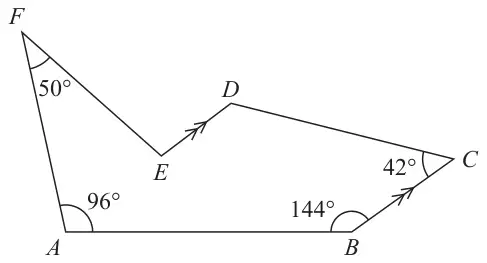
Diagram NOT accurately drawn
The diagram shows a hexagon \(ABCDEF\).
\(BC\) is parallel to \(ED\).
Work out the size of the obtuse angle \(DEF\).
(5)
| Scheme | Marks |
|---|---|
| \(\angle EDC\) = 180 − 42 (=138) | M1 |
| (2 × 6 – 4) × 90 (=720) | M1indep |
| eg “138” + 42 + 50 + 96 + 144 + \(E^{\prime}\) = “720” or “138” + 42 + 50 + 96 + 144 + (360 – \(E\)) = “720” or 42 + 144 + “138” + (50 + 96) + \(DEP\) = “540” (where \(P\) is on \(AB\) and \(FE\) extended) oe | M1 |
| \(E^{\prime}\) = “720” – “138” – 42 − 50 – 96 – 144 (= 720 – 470 = 250) and \(E\) = 360 – “250” or \(E\) = “138” + 42 + 50 + 96 + 144 + 360 – “720” (= 830 – 720) | M1 |
| 110 | A1 |
| (5) | |
| (5 marks) |
Notes
M1: May be marked on diagram.
M1indep: Method to find sum of interior angles of hexagon or the correct sums for the interior angles of shapes used (eg 540° & 180° if the line through \(FE\) to point on \(AB\) drawn or 720° and 180° if line drawn from \(E\) parallel to \(AB\) or 540° & 180° if line through \(FE\) extended and joined to line through \(CB\) extended) oe
M1: dep on previous M marks
Equation for \(E\) or \(E^{\prime}\) where \(E\) is the obtuse angle of the hexagon and \(E^{\prime}\) is the interior (reflex) angle
or for an answer of 250 from correct working
M1: A completely correct calculation for the correct angle \(E\)
A1: from no incorrect working
NB: splitting the shape incorrectly (\(FDC\) and \(DEA\) are not straight lines) gains no marks for angles calculated from false information. However angles calculated that follow the scheme, such as \(\angle EDC\) = 138° or interior angles of hexagon = 720° can be awarded. Other ways of correctly splitting the shape can be awarded full marks, eg \(FE\) to a point on \(AB\) or adding a parallel line eg from \(E\) parallel to \(AB\)
NB: some students show lots of lines but actually work with the angles correctly so please check carefully.