
Higher June 2018 Paper 1 Q17
17 The diagram shows parallelogram \(ABCD\).
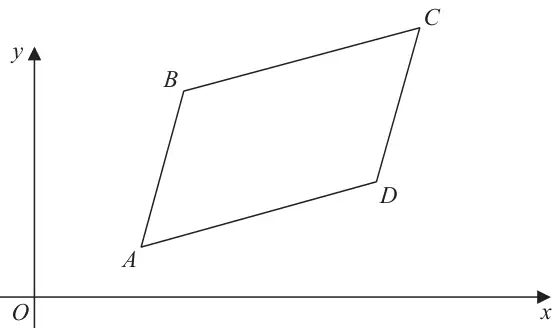
Diagram NOT accurately drawn
\(\overrightarrow{AB} = \begin{pmatrix}2\\7\end{pmatrix} \qquad \overrightarrow{AC} = \begin{pmatrix}10\\11\end{pmatrix}\)
The point \(B\) has coordinates (5, 8)
The point \(E\) has coordinates (63, 211)
| Scheme | Marks |
|---|---|
| \(\left(\overrightarrow{BC} =\right) \begin{pmatrix}-2\\-7\end{pmatrix} + \begin{pmatrix}10\\11\end{pmatrix} \left(= \begin{pmatrix}8\\4\end{pmatrix}\right)\) | M1 |
| \(\begin{pmatrix}5\\8\end{pmatrix} + \text{``}{\begin{pmatrix}8\\4\end{pmatrix}}\text{''}\) or \(\begin{pmatrix}10\\11\end{pmatrix} + \text{``}{\begin{pmatrix}3\\1\end{pmatrix}}\text{''}\) | M1 |
| (13, 12) | A1 |
| (3) |
Notes
M1: or coordinates (5 – 2, 8 – 7) (= (3, 1)) assigned to \(A\) (may be seen in vector form) or
(13, \(y\)) or (\(x\), 12) given as coordinates for \(C\)
M1: for coordinates (5 – 2 + 10, 8 – 7 + 11) assigned to \(C\)
| Scheme | Marks |
|---|---|
e.g. \(\begin{pmatrix}63\\211\end{pmatrix} - \begin{pmatrix}5\\8\end{pmatrix} \left(= \begin{pmatrix}58\\203\end{pmatrix}\right)\) with e.g. “58” ÷ 2 (=29) and “203” ÷ 7 (=29) OR e.g. \(\begin{pmatrix}63\\211\end{pmatrix} - \begin{pmatrix}3\\1\end{pmatrix} \left(= \begin{pmatrix}60\\210\end{pmatrix}\right)\) with e.g. “60” ÷ 2 (=30) and “210” ÷ 7 (=30) | M1 |
| Proof | A1 |
| (2) | |
| (5 marks) |
Notes
M1: may work with \(A\) and \(E\), in which case may need to ft for method mark from (a)
A1: proof with justification eg. \(\overrightarrow{BE} = 29\begin{pmatrix}2\\7\end{pmatrix}\) (or \(\overrightarrow{AE} = 30\begin{pmatrix}2\\7\end{pmatrix}\)) with \(ABE\) is a straight line or
210 ÷ 60 = 3.5 and 7 ÷ 2 = 3.5 so \(ABE\) is a straight line