
Higher January 2019 Paper 1R Q22
22 \(ABCDEF\) is a regular hexagon.
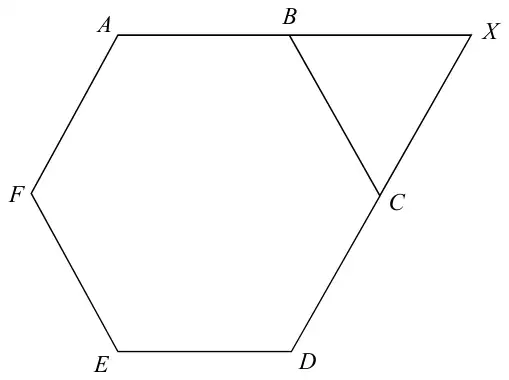
Diagram NOT accurately drawn
\(ABX\) and \(DCX\) are straight lines.
\(\overrightarrow{AB} = \mathbf{a} \qquad \overrightarrow{BC} = \mathbf{b}\)
Find \(\overrightarrow{EX}\) in terms of \(\mathbf{a}\) and \(\mathbf{b}\).
Give your answer in its simplest form.
(4)
| Scheme | Marks |
|---|---|
| eg \(\overrightarrow{EX} = \overrightarrow{ED} + \overrightarrow{DC} + \overrightarrow{CX}\) or \(\overrightarrow{EX} = \overrightarrow{EF} + \overrightarrow{FA} + \overrightarrow{AX}\) | M1 |
| \(\overrightarrow{DC} = -\mathbf{b} + \mathbf{a}\) or \(\overrightarrow{CX} = -\mathbf{b} + \mathbf{a}\) or \(\overrightarrow{FA} = -\mathbf{b} + \mathbf{a}\) | M1 |
| \(\overrightarrow{EX} = \mathbf{a} + 2(-\mathbf{b} + \mathbf{a})\) | M1 |
| \(3\mathbf{a} - 2\mathbf{b}\) | A1 |
| (4) | |
| (4 marks) |
Notes
M1: a correct statement for \(\overrightarrow{EX}\)
M1: for a complete method which gives a correct but unsimplified expression for \(\overrightarrow{EX}\)