
Higher January 2019 Paper 1R Q19
19
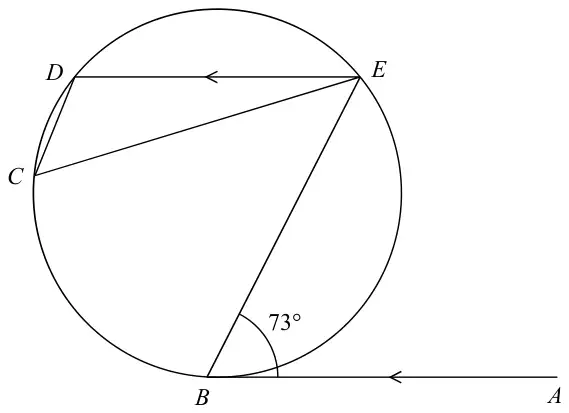
Diagram NOT accurately drawn
\(B\), \(C\), \(D\) and \(E\) are points on a circle.
\(AB\) is the tangent at \(B\) to the circle.
\(AB\) is parallel to \(ED\).
Angle \(ABE = 73^\circ\)
Work out the size of angle \(DCE\).
Give a reason for each stage of your working.
(5)
| Scheme | Marks |
|---|---|
| Angle \(BCE = 73^\circ\) or Angle \(BDE = 73^\circ\) | M1 |
| Angle \(DEB = 73^\circ\) and Angle \(DCB\) = 180−73 (=107°) or Angle \(DEB = 73^\circ\) and Angle \(DBE\) = 180−73×2 (=34°) | M1 |
| Angle \(DCE = 34^\circ\) Answer: 34 | A1 |
| eg Alternate segment theorem Opposite angles of a cyclic quadrilateral sum to 180° Alternate angles are equal Angles in the Same segment are equal Angles in a triangle sum to 180 | B2 |
| (5) | |
| (5 marks) |
Notes
M1: angles may be written on the diagram
B2: for a full set of reasons relevant to their method
(B1 for at least one relevant circle theorem)