
Higher June 2022 Paper 2 Q22
22 \(ABCD\) is a kite, with diagonals \(AC\) and \(BD\), drawn on a centimetre square grid, with a scale of 1 cm for 1 unit on each axis.
\(A\) is the point with coordinates \((-3, 4)\)
The diagonals of the kite intersect at the point \(M\) with coordinates \((0, 2)\)
Given that \(AB = AD = 6.5\) cm and the \(x\) coordinate of \(B\) is positive,
find the coordinates of the points \(B\) and \(D\).
(7)
| Scheme | Marks |
|---|---|
| (gradient \(AM\) =) \(\dfrac{4 - 2}{-3 - 0}\) oe \(\left(= -\dfrac{2}{3}\right)\) | M1 |
\(y = \dfrac{3}{2}x + 2\) or eg \(\dfrac{y - 2}{x} = \dfrac{3}{2}\) oe | M1 |
\((x - -3)^2 + (y - 4)^2 = 6.5^2\) or \((x - 0)^2 + (y - 2)^2 = 6.5^2 - \left[(-3 - 0)^2 + (4 - 2)^2\right]\) oe eg \(x^2 + (y - 2)^2 = 29.25\) | M1 |
| eg \(x^2 + 6x + 9 + y^2 - 8y + 16 - 42.25 = 0\) oe or \(x^2 + y^2 - 4y + 4 - 29.25 = 0\) oe | M1 |
eg \(x^2 + 6x + 9 + \left(\dfrac{3}{2}x + 2\right)^2 - 8\left(\dfrac{3}{2}x + 2\right) + 16 - 42.25 = 0\) \(\left(\dfrac{2y - 4}{3}\right)^2 + y^2 - 4y + 4 - 29.25 = 0\) oe | M1 |
eg \(\dfrac{13}{4}x^2 = \dfrac{117}{4}\) or oe \(13y^2 - 52y - 211.25 = 0\) | M1 |
| (3, 6.5) (−3, −2.5) | A1 |
| (7) | |
| (7 marks) |
Notes
M1: A correct method to find gradient of \(AM\)
M1: For the correct equation of the line passing through \(BD\) or for a correct expression involving the \(x\) and \(y\) coordinates of point \(B\) or point \(D\)
M1: A correct equation in \(x\) and \(y\) to find the coordinates of \(B\) and \(D\)
M1: Brackets expanded
M1: For a correct substitution into a correct equation to get an equation in either \(x\) only or \(y\) only
M1: A fully correct simplified equation in \(x\) or in \(y\) – all brackets expanded and like terms grouped.
A1: correct coordinates
SCB3 for one pair of correct coordinates or both \(x\) values correct or both \(y\) values correct
| Scheme | Marks |
|---|---|
| \((AM =)\;\sqrt{3^2 + 2^2}\;\left(= \sqrt{13} = 3.605\ldots\right)\) or \((AM^2 =)\;3^2 + 2^2\;(= 13)\) | M1 |
| \((BM =)\;\sqrt{6.5^2 - \text{``}{\sqrt{13}}\text{''}^2}\;\left(= \sqrt{29.25} = \dfrac{3\sqrt{13}}{2}\;5.4083\ldots\right)\) | M1 |
(SF =) \(\dfrac{\sqrt{29.25}}{\sqrt{13}} = \dfrac{3}{2}\) oe or \(MN = x\), \(BN = 1.5x\) (see diag) or \((LAM =)\;\sin^{-1}\dfrac{3}{\sqrt{13}}\;(= 56.3\ldots)\) oe or \((LMA =)\;\cos^{-1}\dfrac{3}{\sqrt{13}}\;(= 33.6\ldots)\) or | M1 |
eg \(\overrightarrow{MB}_x = \dfrac{3}{2} \times 2\) or \(\overrightarrow{MB}_y = \dfrac{3}{2} \times 3\) or \(\overrightarrow{MD}_x = -\dfrac{3}{2} \times 2\) or \(\overrightarrow{MD}_y = -\dfrac{3}{2} \times 3\) oe or \(x^2 + (1.5x)^2 = \sqrt{29.25}^2\) or \(MN = \sqrt{29.25}\cos 56.3\ldots\;(= 3)\) oe or \(BN = \sqrt{29.25}\sin 56.3\ldots\;(= 4.5)\) oe | M1 |
\(\overrightarrow{MB}_x = \dfrac{3}{2} \times 2\) and \(\overrightarrow{MB}_y = \dfrac{3}{2} \times 3\) or \(\overrightarrow{MD}_x = -\dfrac{3}{2} \times 2\) and \(\overrightarrow{MD}_y = -\dfrac{3}{2} \times 3\) oe or \(x^2 + 2.25x^2 = 29.25\) or \(MN = \dfrac{3\sqrt{13}}{2}\cos 56.309\ldots\;(= 3)\) and \(BN = \dfrac{3\sqrt{13}}{2}\sin 56.309\ldots\;(= 4.5)\) oe | M1 |
| eg (0, 2) is translated \(\begin{pmatrix} 3 \\ 4.5 \end{pmatrix}\) or \((0 + 3, 2 + 4.5)\;(= (3, 6.5))\) or (0, 2) is translated \(\begin{pmatrix} -3 \\ -4.5 \end{pmatrix}\) or \((0 - 3, 2 - 4.5)\;(= (-3, -2.5))\) oe or \(3.25x^2 = 29.25\) | M1 |
| (3, 6.5) (−3, −2.5) | A1 |
Notes
M1: Use of Pythagoras for point \(A\) to point \(M\)
M1: A correct method to find the length of \(BM\) or \(DM\)
M1: A correct method to find the SF of the enlargement of the sides \(AM\) to \(BM\) or angle \(LAM\)
OR \(LMA\)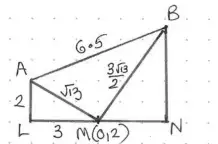
M1: A correct method to find the translation of at least one component of \(MB\) or \(MD\) (need not be written in vector form) OR correct Pythagoras statement using the SF to find \(x\) coordinates OR 1 correct trig statement to find translations from \(M\)
M1: A correct method to find the translation of both components of \(MB\) or \(MD\) (need not be written in vector form)
OR
correct Pythagoras statement with no brackets using the SF to find \(x\) coordinates
OR
2 correct trig statements to find translations from \(M\)
M1: correct method to find the coordinates of \(B\) or \(D\) or one pair of correct coordinates
or
a correct method to find both \(x\) coordinates or both \(y\) coordinates OR
a fully correct simplified equation in \(x\) all brackets expanded and like terms grouped.
A1: correct coordinates
SCB3 for one correct coordinate or both \(x\) values correct or both \(y\) values correct