
Foundation November 2024 Paper 2 Q22
22 In this question, all lengths are in centimetres.
The diagram shows an isosceles triangle ABC.
AB = AC.
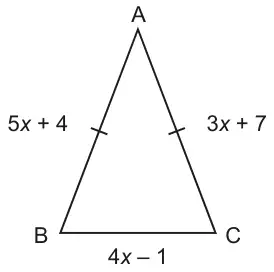
Not to scale
Find the perimeter of the triangle.
You must show your working. [6]
| Answer | Marks | Part marks and guidance | |
|---|---|---|---|
| 28[cm] with correct working | 6 | Correct working requires evidence of at least M1M1A1M1 or M1M1A1M2 | |
| M1 for \(5x + 4 = 3x + 7\) M1 for \(5x - 3x = 7 - 4\) oe | FT their equation if wrong sides equated Accept only: \(4x - 1 = 5x + 4\) or \(4x - 1 = 3x + 7\) | ||
| A1 for \(x = 1.5\) oe | After M1, \(x = 1.5\) implies M1M1A1 Do not penalise if their value of \(x\) is not subsequently used in their work leading to an algebraic final answer e.g. \(12x + 10\). | ||
| M1 for \(5x + 4 + 3x + 7 + 4x - 1\) soi | implied by \(12x + 10\) | ||
| M1 for substitution of their \(x\) into \(5x + 4\) or \(3x + 7\) or \(4x - 1\) or their \(12x + 10\) | their \(x\) must be > 0 and clearly stated as \(x =\)…. Substitution of their \(x\) into \(5x + 4\), \(3x + 7\) and \(4x - 1\) and then adding implies M1 M1. | ||
| If 0 or 1 scored, instead award SC2 for answer 28 If 0 scored, instead award SC1 for \(x = 1.5\) | Alternative method using trials: In all trials \(x\) must be > 0 M1M1A1 for both \(5x + 4\) and \(3x + 7\) correctly evaluated with \(x = 1.5\) or M1M1 for three correctly evaluated trials of both \(5x + 4\) and \(3x + 7\) with consistent value of \(x\) or M1 for two correctly evaluated trials of both \(5x + 4\) and \(3x + 7\) with consistent value of \(x\) AND M2 dep on at least M1 for their \(x\) substituted into their \(12x + 10\) oe or M1 dep on at least M1 for their \(x\) substituted into \(4x - 1\) M1 dep on previous M1 adding their three lengths | ||