
Higher June 2024 Paper 2 Q7
7 \(ABCD\) is a quadrilateral.
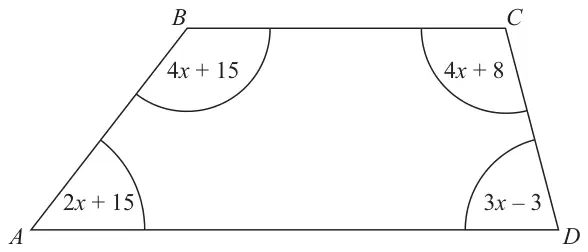
All angles are measured in degrees.
Show that \(ABCD\) is a trapezium. (4)
| Answer | Mark | Mark scheme |
|---|---|---|
| Shown | M1 | for deriving a suitable equation, eg \(4x + 15 + 2x + 15 + 4x + 8 + 3x - 3 = 360\ (13x + 35 = 360)\) or \(4x + 15 + 2x + 15 = 180\ (6x + 30 = 180)\) or \(4x + 8 + 3x - 3 = 180\ (7x + 5 = 180)\) |
| M1 | (dep) for a method to isolate terms in \(x\), eg \(4x + 2x + 4x + 3x = 360 - 15 - 15 - 8 + 3\) or \(4x + 2x = 180 - 15 - 15\) or \(4x + 3x = 180 - 8 + 3\) | |
| A1 | for solving equation to \(x = 25\) | |
| C1 | for substituting \(x = 25\) into \(A + B\) or \(C + D\) and showing = 180, and gives a suitable statement, eg co-interior/allied angles (sum to 180), or since \(A + B = 180\) the lines are parallel | |
| Alternative solution assuming it is a trapezium | ||
| M1 | for deriving a suitable equation, eg \(4x + 15 + 2x + 15 = 4x + 8 + 3x - 3\ (6x + 30 = 7x + 5)\) | |
| M1 | (dep) for a method to isolate terms in \(x\), eg \(15 + 15 - 8 + 3 = 4x + 3x - 4x - 2x\) | |
| A1 | for solving equation to \(x = 25\) | |
| C1 | for a fully correct statement, eg since \(A + B = 180\) the lines are parallel |
Additional guidance
If starting with an equation = 180 need to substitute into the opposite pair.