
Higher June 2019 Paper 1 Q9
9 A shaded semicircle is inside a circle as shown.
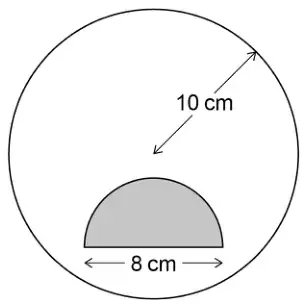
Not drawn accurately
The radius of the circle is 10 cm
The diameter of the semicircle is 8 cm
How many times bigger is the unshaded area than the shaded area? [4 marks]
| Answer | Mark | Comments |
|---|---|---|
| Alternative method 1: areas | ||
| \(\pi \times 10^2\) or \(100\pi\) | M1 | implied by [314, 314.2] |
| \(\pi \times (8 \div 2)^2\) or \(\pi \times 4^2\) or \(16\pi\) or \(\pi \times (8 \div 2)^2 \div 2\) or \(\pi \times 4^2 \div 2\) or \(16\pi \div 2\) or \(8\pi\) | M1 | implied by [50.2, 50.3] or [25.12, 25.14] \(92\pi\) or \(84\pi\) or 92 : 8 or 8 : 92 or 84 : 16 or 16 : 84 implies M1M1 |
| (their \(100(\pi)\) – their \(8(\pi)\)) \(\div\) their \(8(\pi)\) or \(92(\pi) \div 8(\pi)\) or their \(100(\pi) \div\) their \(8(\pi)\) (– 1) or \(12\dfrac{1}{2}\) (– 1) or 12.5 (– 1) | M1dep | dep on M2 absence of \(\pi\) must be consistent condone \(16(\pi)\) as their \(8(\pi)\) in first calculation only, ie condone (their \(100(\pi)\) – their \(16(\pi)\)) \(\div\) their \(16(\pi)\) or \(84(\pi) \div 16(\pi)\), but not their \(100(\pi) \div\) their \(16(\pi)\) (– 1) |
| \(11\dfrac{1}{2}\) or 11.5 | A1 | condone \(\dfrac{23}{2}\) |
| Alternative method 2: scale factor | ||
| \(\dfrac{10}{8 \div 2}\) or \(\dfrac{10}{4}\) or \(\dfrac{5}{2}\) or \(\dfrac{10 \times 2}{8}\) or \(\dfrac{20}{8}\) or 2.5 | M1 | oe scale factor of lengths eg \(\dfrac{2}{5}\) or 0.4 accept 2 : 5 or 5 : 2 oe ratio \(\pi\) may be present, but must be consistent in numerator and denominator |
| (their \(\dfrac{5}{2}\))\(^2\) or \(\dfrac{25}{4}\) | M1dep | oe scale factor of areas eg \(\dfrac{4}{25}\) accept 4 : 25 or 25 : 4 oe ratio |
| \(2 \times\) their \(\dfrac{25}{4}\) (– 1) or \(\dfrac{25}{2}\) (– 1) or \(12\dfrac{1}{2}\) (– 1) or 12.5 (– 1) | M1dep | oe eg \(2 \div\) their \(\dfrac{4}{25}\) (– 1) |
| \(11\dfrac{1}{2}\) or 11.5 | A1 | condone \(\dfrac{23}{2}\) |
Additional guidance
| Accept, for example, \(\pi 8\) or \(\pi \times 8\) or \(8 \times \pi\) for \(8\pi\) | |
| An answer of \(11.5\pi\) with no incorrect working | M1M1M1A0 |
| Consistent use of \(\pi d^2\) for the area of a circle gives the area of the circle as \(400\pi\), the area of the semicircle as \(32\pi\) and the area of the shaded part as \(368\pi\). This also gives the answer 11.5, but scores zero | M0M0M0A0 |
| Irrespective of where their answer comes from and the presence of other measures such as circumference, students can gain the first two marks of alternative method 1 if it is clear that the methods or values given are for area eg 1 Big area \(= 100\pi\), little area \(= 8\pi\), big circumference \(= 20\pi\), little circumference \(= 4\pi\), \(20 \div 4 = 5\) eg 2 \(100\pi\), \(8\pi\), \(20\pi\), \(4\pi\) | M1M1M0A0 M0M0 |
| Do not award the second mark if the value of \(8\pi\) comes from \(\pi d\) This is implied by, eg, ‘Area of circle \(= 20\pi\), area of semi-circle \(= 8\pi\)’ | M?M0 M0M0 |
| \(\dfrac{100(\pi) - 16(\pi)}{16(\pi)}\) (which may give an answer of 5.25) | M1M1M1A0 |
| \(\dfrac{100(\pi)}{16(\pi)}\) (which may give an answer of 6.25) | M1M1M0A0 |