
Higher November 2019 Paper 2 Q25
25 C, D and E are points on a circle.
CE = DE
The tangent at D is shown.
ACD and BCE are straight lines.
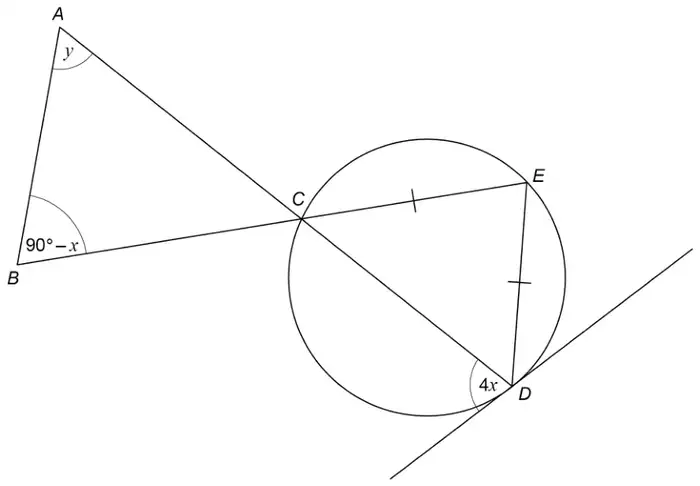
Not drawn accurately
Prove that \(\quad y = 3x\) [4 marks]
| Answer | Mark | Comments |
|---|---|---|
| CED \(= 4x\) or ACB = \(180 - y - (90 - x)\) | M1 | may be on diagram |
| CED \(= 4x\) and DCE \(= \dfrac{180 - 4x}{2}\) or ACB = \(180 - y - (90 - x)\) and DCE = \(180 - y - (90 - x)\) | M1dep | may be on diagram allow DCE = ACB for DCE = \(180 - y - (90 - x)\) |
| M2 seen and \(y + 90 - x + \dfrac{180 - 4x}{2} = 180\) and \(y = 3x\) or M2 seen and \(\dfrac{180 - 4x}{2} = 180 - y - (90 - x)\) and \(y = 3x\) | A1 | M2 seen and \(2(180 - y - (90 - x)) + 4x = 180\) and \(y = 3x\) |
| M2A1 seen and all reasons given | A1 | eg alt(ernate) seg(ment theorem) and (base angles of) isos(celes) triangle (are equal) and (vertically) opp(osite) angles (are equal) and angles in a triangle (sum to 180°) |
Additional guidance
| Allow CE = DE for the reason (base angles of) isos(celes) triangle (are equal) | |
| Allow \(90 - y + x\) or \(180 - y - 90 + x\) for \(180 - y - (90 - x)\) | |
| Allow \(90 - 2x\) for \(\dfrac{180 - 4x}{2}\) | |
| Allow clear indication of angles eg allow E for CED do not allow C for ACB unless seen on diagram | |
| Assuming \(y = 3x\) | Zero |
| For 1st A1, allow equivalent equations eg For \(2(180 - y - (90 - x)) + 4x = 180\) allow \(2(180 - y - (90 - x)) = 180 - 4x\) |