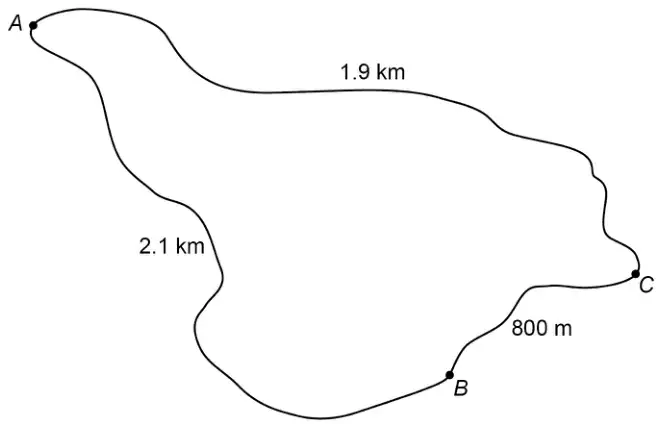
(a) \(A\), \(B\) and \(C\) are connected by paths.
The length of each path is shown.
Not drawn accurately
Nathan and Sue each walk from \(A\) to \(B\).
Nathan walks along the path \(\quad A \to B\) Sue walks along the paths \(\quad A \to C \to B\)
How much further does Sue walk than Nathan?
Give your answer in kilometres. [3 marks]
(b) A straight path between \(D\) and \(E\) passes through \(P\).
\(DE = 200\) metres \(P\) is 60 metres closer to \(E\) than to \(D\).
Not drawn accurately
Work out the ratio \(\quad DP : PE\)
Give your answer in its simplest form. [3 marks]
Mark scheme (a)
Answer
Mark
Comments
Any correct conversion using values given \(800 \div 1000\) or 0.8 or \(2.1 \times 1000\) or 2100 or \(1.9 \times 1000\) or 1900 or 2.7 (\(\times\) 1000) or 2700 or \(0.2 \times 1000\) or 200
M1
oe eg 0.800 may be seen in 2nd M1 2.7 or 4.8 or 2.9 implies 0.8 4800 implies 2100 and 1900 2900 implies 2100
\(1.9 +\) their \(0.8 - 2.1\) or their \(1900 + 800 -\) their 2100 or their \(0.8 - (2.1 - 1.9)\) or \(800 -\) (their \(2100 -\) their 1900) or 600
M1
oe allow their conversions allow mixed units eg \(1.9 + 800 - 2.1\)
0.6
A1
Additional guidance
Check diagram
600 (implies 2100 and 1900)
M1M1
Accept additional zeroes in the answer eg 0.600 or 00.6
M1M1A1
No correct unit changes or no changes attempted can score M0M1A0 but calculation must be seen eg \(190 + 800 - 210 = 780\)
M0M1A0
Up to M2 may be awarded for correct work, with no or incorrect answer, even if seen amongst multiple attempts
Mark scheme (b)
Answer
Mark
Comments
Alternative method 1
\(\dfrac{200 - 60}{2}\) or \(\dfrac{140}{2}\) or 70
M1
oe eg \(\dfrac{200}{2} - \dfrac{60}{2}\) may be seen or implied in a ratio eg n : 70 or 70 : n
130 : 70
A1
must be in correct order
13 : 7
B1ft
ft a correct and full simplification of any unsimplified ratio condone \(\dfrac{13}{7}\) : 1 or 1 : \(\dfrac{7}{13}\) SC2 7 : 13
Alternative method 2
\(\dfrac{200 + 60}{2}\) or \(\dfrac{260}{2}\) or 130
M1
oe eg \(\dfrac{200}{2} + \dfrac{60}{2}\) may be seen or implied in a ratio eg 130 : n or n : 130
130 : 70
A1
must be in correct order
13 : 7
B1ft
ft a correct and full simplification of any unsimplified ratio condone \(\dfrac{13}{7}\) : 1 or 1 : \(\dfrac{7}{13}\) SC2 7 : 13
Alternative method 3
\(200 + 60\) and \(200 - 60\) or 260 and 140
M1
260 : 140
A1
must be in correct order
13 : 7
B1ft
ft a correct and full simplification of any unsimplified ratio condone \(\dfrac{13}{7}\) : 1 or 1 : \(\dfrac{7}{13}\) SC2 7 : 13
Additional guidance
70 : 130 with answer 7 : 13
M1A0B1ft
Accept 0.53(846…) or 0.54 for \(\dfrac{7}{13}\) or 1.85(714…) or 1.86 for \(\dfrac{13}{7}\)
For the M1 in Alt1, 70 must come from working towards a ratio of 130 : 70 or 70 : 130, not from a simplification of 140 : 60 \(200 - 60 = 140\), 140 : 60, 70 : 30 \(200 - 60 = 140\), 140 : 60, 70 : 30, 7 : 3
M0A0B0ft M0A0B1ft
Ignore any units given in the answer
Algebraic approach may be seen but no marks scored until \(x = \dfrac{200 - 60}{2}\) reached oe
For any ratio, condone correct simplification to 1 : n or n : 1