
Higher June 2024 Paper 1 Q7
7 Here is a cone.
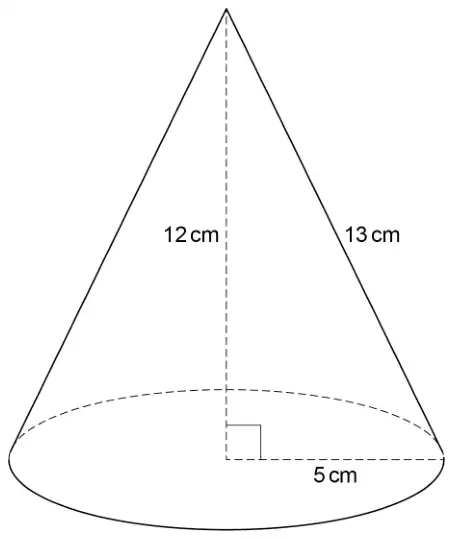
(a)
| Curved surface area of a cone \(= \pi r l\) where \(r\) is the radius and \(l\) is the slant height |
Beth tries to work out the curved surface area in terms of \(\pi\)
| Curved surface area of the cone \(= \pi \times 5 \times 12\) \(= 60\pi\ \text{cm}^2\) |
What mistake has she made? [1 mark]
(b) Adam uses \(\quad \pi = 3 \quad\) to estimate the area of the base of the cone.
Work out his estimate. [2 marks]
(c) Beth uses \(\quad \pi = 3.14 \quad\) to estimate the area of the base of the cone.
Is Beth’s estimate more than or less than Adam’s estimate?
Tick a box.
- More than
- Less than
Give a reason for your answer. [1 mark]
| Answer | Mark | Comments |
|---|---|---|
| Correct statement | B1 | eg she used the height instead of the slant height or she used the vertical height or she used 12 (instead of 13) |
Additional guidance
| Check diagram | |
| For ‘vertical’ accept anything that implies she has used the wrong height | |
| Condone ‘length’ to mean ‘height’ or ‘slant height’ | |
| 12 or 13 circled on the diagram must be accompanied by a supporting statement | |
| Indicates ‘12’ in the calculation | B1 |
| She should have done \(\pi \times 5 \times 13\) | B1 |
| It should be \(65\pi\) | B1 |
| She used the wrong height / the (value of) \(l\) is wrong | B1 |
| She hasn’t used the slant height (she used the (vertical) height) | B1 |
| She hasn’t used the 13 | B1 |
| She hasn’t used the 13 and should be \(5 \times 12 \times 13 \times \pi\) | B0 |
| The multiplication used the wrong number(s) | B0 |
| She hasn’t used a value for \(\pi\) | B0 |
| An incorrect statement with a correct statement eg she used 13 instead of 12 and didn’t square the radius | B0 |
| Answer | Mark | Comments |
|---|---|---|
| \(\pi \times 5 \times 5\) or \(25\pi\) or \(3 \times 5 \times 5\) | M1 | oe accept [3.14, 3.142] or \(\dfrac{22}{7}\) for \(\pi\) |
| 75 | A1 |
Additional guidance
| \(\pi 25\) | M1 |
| Answer | Mark | Comments |
|---|---|---|
| ‘More than’ indicated or implied by statement and valid reason | B1 | eg valid reasons 3.14 is greater (than 3) Beth’s number is bigger (than Adam’s) (the correct answer is) 78.5 (with their answer to (b) less than 78.5) |
Additional guidance
| If calculations are used, the outcomes must be correct | |
| Accept 78 or 79 for 78.5 unless from incorrect working | |
| ‘Less than’ indicated | B0 |
| Do not penalise use of the same incorrect formula in (b) and (c) eg \(3 \times 10 = 30\) in (b) and \(3.14 \times 10 = 31.4\) in (c) with ‘More than’ ticked | B1 |
| Ignore a non-contradictory reason with a correct reason eg 3.14 is bigger than 3 and nearer the true value of pi | B1 |
| Acceptable reasons | |
| Adam has rounded (pi) down / Adam only used 3 | B1 |
| There is an extra 0.14 to multiply by | B1 |
| Her number has decimal places | B1 |
| Her number is to more significant figures | B1 |
| Non-acceptable reasons | |
| 3.14 will give a bigger answer / 3.14 is more accurate | B0 |