
Foundation June 2017 Paper 3 Q8
8 Here is information about the goals scored in some hockey games.
Each game has four quarters.
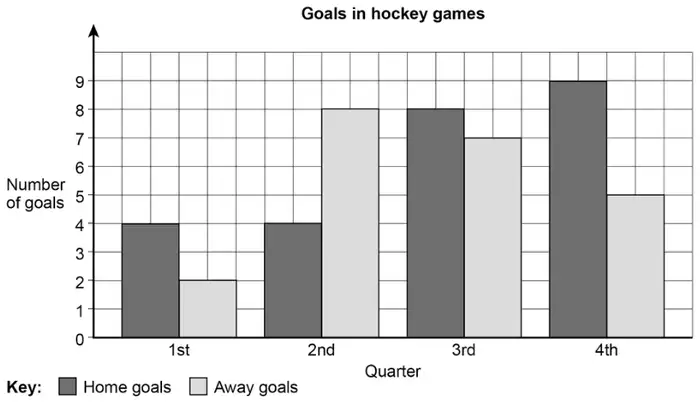
(a) Which quarter was the mode for away goals?
Circle your answer. [1 mark]
- 1st
- 2nd
- 3rd
- 4th
(b) There were 10 games.
Work out the mean number of goals per game. [2 marks]
(c) In total, how many more home goals were scored than away goals? [2 marks]
(d) Rob says,
“More home teams must have won because there were more home goals.”
Is he correct?
Give a reason for your answer. [1 mark]
| Answer | Mark | Comments |
|---|---|---|
| 2nd | B1 |
| Answer | Mark | Comments |
|---|---|---|
| \((4 + 2 + 4 + 8 + 8 + 7 + 9 + 5) \div 10\) or \((6 + 12 + 15 + 14) \div 10\) or \((25 + 22) \div 10\) or \(2.5 + 2.2\) or \(47 \div 10\) | M1 | Condone the omission of brackets Accept one error or omission in reading from diagram |
| 4.7 | A1 | oe |
Additional guidance
| 5 on answer line with 4.7 in working | M1A1 |
| 4 on answer line with 4.7 in working | M1A0 |
| \((4 + 2 + 4 + 8 + 8 + 7 + 9) \div 10\) is one omission \((4 + 2 + 4 + 8 + 8 + 7 + 9 + 6) \div 10\) is one error \((6 + 12 + 15 + 13) \div 10\) assume one error \((25 + 23) \div 10\) assume one error \(2.5 + 2.3\) assume one error | M1 |
| Do not accept further calculation after 4.7 seen \(47 \div 10 = 4.7\) \(4.7 \times 4 = 18.8\) | M1A0 |
| Use of away goals only, treat as misread from the words in part (a) \((2 + 8 + 7 + 5) \div 10\) or 2.2 condone the omission of brackets | M1A0 |
| 5 on answer line without working | M0A0 |
| \((6 + 12 + 15) \div 10\) assume two omissions | M0A0 |
| Answer | Mark | Comments |
|---|---|---|
| Alternative method 1 | ||
| \(4 + 4 + 8 + 9\) and \(2 + 8 + 7 + 5\) or 25 and 22 | M1 | Accept one error in reading from diagram |
| 3 | A1 | |
| Alternative method 2 | ||
| \(4 - 2\) or 2 and \(4 - 8\) or \(-4\) and \(8 - 7\) or 1 and \(9 - 5\) or 4 | M1 | Accept one error in reading from diagram Differences may be seen on the diagram |
| 3 | A1 | |
Additional guidance
| \(25 - 22 = 3\) | M1A1 |
| \(4 - 2 = 2\) and \(4 - 8 = -4\) and \(8 - 6 = 2\) and \(9 - 5 = 4\) is one reading error | M1 |
| \(4 - 2 = 2\) and \(4 - 8 = 4\) and \(8 - 7 = 1\) and \(9 - 5 = 4\) | M1 |
| \(4 + 4 + 8 + 9\) and \(2 + 7 + 7 + 5\) is one reading error \(24 - 21 = 3\) | M1 A0 |
| 1st 2 2nd 4 3rd 1 4th 4 is one error in calculation without working | M0A0 |
| 1st 2 3rd 1 4th 4 is one omission | M0A0 |
| \(24 - 21 = 3\) with no other working | M0A0 |
| \(4 + 4 + 8 + 8\) and \(2 + 8 + 6 + 5\) is two reading errors \(24 - 21 = 3\) | M0 A0 |
| Answer | Mark | Comments |
|---|---|---|
| No and valid reason eg Indicates that one or more home teams might have won a game or games by a lot of goals | B1 |
Additional guidance
| In numerical examples relating to results, the total home goals must be more than the total away goals and there cannot be more home wins than away wins eg | |
| No, the scores could have been 2-0 6-0 0-3 0-2 2-2 3-3 3-3 4-4 4-4 1-1 | B1 |
| No, the scores could have been 2-0 6-0 0-3 0-2 and then all draws | B1 |
| If scores are given, assume home team first | |
| Use of ‘they’ implies the home team in a statement relating to a team eg No, because they could score more just in one game | B1 |
| No, the home team scored 0 in 9 matches and 25 in the final game | B1 |
| No, the home team may have scored lots in one game | B1 |
| No, multiple goals could be scored by a home team in one game | B1 |
| No, the away team win a lot of games by one goal and lose by a lot of goals in one game | B1 |
| Yes with or without an explanation | B0 |
| No, the away team win a lot of games by one goal | B0 |
| No, multiple goals could be scored in one game | B0 |
| No, more goals scored at home but it doesn’t mean that they won more | B0 |
| No, we don't know how many goals were scored in each game | B0 |
| No, the home team scored more goals in some games than others | B0 |