
A2 June 2019 Paper 2 Q9
9 In this question you must show detailed reasoning.
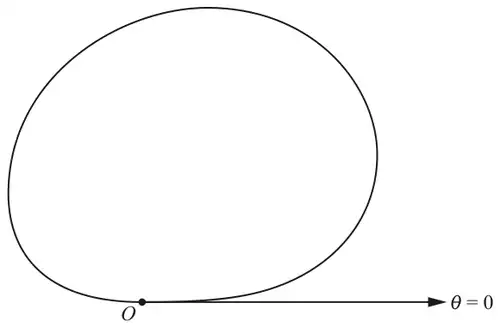
The diagram below shows the curve \(r = \sqrt{\sin\theta}\,\mathrm{e}^{\frac{1}{3}\cos\theta}\) for \(0 \leqslant \theta \leqslant \pi\).
| Scheme | Marks | AO |
|---|---|---|
| DR \(\displaystyle\frac{1}{2}\int \left(\sqrt{\sin\theta}\,\mathrm{e}^{\frac{1}{3}\cos\theta}\right)^2 \mathrm{d}\theta\) | M1 | 3.1a |
| \(\displaystyle A = \frac{1}{2}\int_{0}^{\pi} \sin\theta\,\mathrm{e}^{\frac{2}{3}\cos\theta}\,\mathrm{d}\theta\) | *A1 | 2.1 |
| \(= \dfrac{1}{2} \times -\dfrac{3}{2}\left[\mathrm{e}^{\frac{2}{3}\cos\theta}\right]_{0}^{\pi}\) | dep*M1 | 1.1a |
| \(\dfrac{3}{4}\left(\mathrm{e}^{\frac{2}{3}} - \mathrm{e}^{-\frac{2}{3}}\right)\) | A1 | 1.1 |
| [4] |
Notes
M1: Correct form, in terms of \(\theta\). M1 can be implied by 1.0757… BC
*A1: Integrand has been squared out. Must include limits (can be seen later)
dep*M1: Might be as result of substitution. Allow coefficient error for M1. eg \(\frac{3}{4}\left[\mathrm{e}^{u}\right]_{-\frac{2}{3}}^{\frac{2}{3}}\) or \(\frac{3}{4}\left[\mathrm{e}^{\frac{2}{3}u}\right]_{-1}^{1}\) oe
A1: isw
| Scheme | Marks | AO |
|---|---|---|
| DR \(\dfrac{\mathrm{d}r}{\mathrm{d}\theta} = \dfrac{1}{2}\cos\theta(\sin\theta)^{-\frac{1}{2}}\mathrm{e}^{\frac{1}{3}\cos\theta} + (\sin\theta)^{\frac{1}{2}}\left(-\dfrac{1}{3}\sin\theta\right)\mathrm{e}^{\frac{1}{3}\cos\theta}\) | *M1 A1 | 3.1a 1.1 |
| \(\dfrac{\mathrm{d}r}{\mathrm{d}\theta} = \dfrac{1}{6}(\sin\theta)^{-\frac{1}{2}}\mathrm{e}^{\frac{1}{3}\cos\theta}(3\cos\theta - 2\sin^2\theta)\) \(\dfrac{\mathrm{d}r}{\mathrm{d}\theta} = 0 \Rightarrow 3\cos\theta - 2\sin^2\theta = 0\) | dep*M1 | 2.2a |
| \(2\cos^2\theta + 3\cos\theta - 2 = 0\) | M1 | 2.1 |
| \(\cos\theta = \frac{1}{2}, -2\) \(\cos\theta \neq -2\) | *A1 dep*A1 | 1.1 2.3 |
| \(\Rightarrow \sin\theta = \dfrac{\sqrt{3}}{2} \Rightarrow r = \sqrt{\dfrac{\sqrt{3}}{2}}\,\mathrm{e}^{\frac{1}{3} \times \frac{1}{2}} = \sqrt{\dfrac{\sqrt{3}}{2}}\,\mathrm{e}^{\frac{1}{6}}\) | A1 | 2.2a |
| [7] |
Notes
*M1: Attempt to differentiate using product and chain rules. Must be in the form \(uv' + u'v\) with at most one of \(u, v, u'\) or \(v'\) incorrect or omitted
dep*M1: Setting \(r'\) to zero and factorising/cancelling to produce a quadratic equation in cos and/or sin
M1: Use of \(\cos^2 + \sin^2 = 1\) to find 3 term quadratic equation in \(\cos\theta\). Or could be in \(\sin^2\theta\): \(4\sin^4\theta + 9\sin^2\theta - 9 = 0\)
*A1: Solving quadratic correctly. \(\sin^2\theta = \frac{3}{4}, -3\)
dep*A1: Explicitly rejecting root. Rejects \(\sin^2\theta = -3\) and \(\sin\theta = -\frac{\sqrt{3}}{2}\)
A1: AG. At least one intermediate step must be seen. Can be awarded even if rejection of root(s) was implicit.