
A2 June 2019 Paper 1 Q5
5 The diagram shows part of the curve \(y = 5\cosh x + 3\sinh x\).
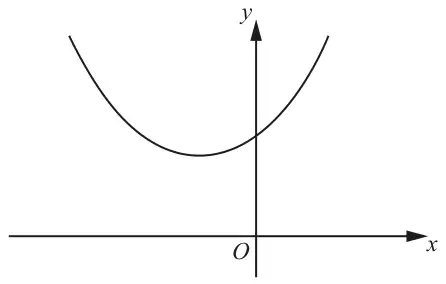
(a) Solve the equation \(5\cosh x + 3\sinh x = 4\) giving your solution in exact form. [4]
(b) In this question you must show detailed reasoning.
Find \(\displaystyle\int_{-1}^{1} (5\cosh x + 3\sinh x)\,\mathrm{d}x\) giving your answer in the form \(a\mathrm{e} + \dfrac{b}{\mathrm{e}}\) where \(a\) and \(b\) are integers to be determined. [3]
Find \(\displaystyle\int_{-1}^{1} (5\cosh x + 3\sinh x)\,\mathrm{d}x\) giving your answer in the form \(a\mathrm{e} + \dfrac{b}{\mathrm{e}}\) where \(a\) and \(b\) are integers to be determined. [3]
| Scheme | Marks | AO |
|---|---|---|
| \(5\cosh x + 3\sinh x = 4\) \(\Rightarrow 5\left(\dfrac{\mathrm{e}^x + \mathrm{e}^{-x}}{2}\right) + 3\left(\dfrac{\mathrm{e}^x - \mathrm{e}^{-x}}{2}\right) = 4\) | M1 | 3.1a |
| \(\Rightarrow 4\mathrm{e}^x + \mathrm{e}^{-x} = 4\) \(\Rightarrow 4\mathrm{e}^{2x} - 4\mathrm{e}^x + 1 = 0 \left(\Rightarrow (2\mathrm{e}^x - 1)^2 = 0\right)\) | M1 | 3.1a |
| \(\Rightarrow \mathrm{e}^x = \dfrac{1}{2}\) | A1 | 1.1 |
| \(\Rightarrow x = -\ln 2\) oe | A1 | 1.1 |
| [4] |
Notes
M1: Use of exponentials
M1: Multiply by \(\mathrm{e}^x\)
Alternatively make cosh the subject, square and use Pythagoras to give quadratic in cosh.
Alternatively use compound angle formula.
Alternative method
| Scheme | Marks |
|---|---|
| \(5\cosh x + 3\sinh x \equiv R\cosh(x + \alpha)\) where \(R = \sqrt{25 - 9} = 4\), | M1 |
| \(\tanh\alpha = \dfrac{3}{5} \Rightarrow \alpha = \tanh^{-1}\dfrac{3}{5} = \dfrac{1}{2}\ln\left(\dfrac{1 + \frac{3}{5}}{1 - \frac{3}{5}}\right) = \dfrac{1}{2}\ln 4 = \ln 2\) | M1 A1 |
| \(\Rightarrow 4\cosh(x + \alpha) = 4 \Rightarrow \cosh(x + \alpha) = 1\) \(\Rightarrow x = -\alpha = -\ln 2\) | A1 |
| [4] |
(corrected from the printed mark scheme: the printed alternative has \(\cosh(x + \alpha) = 0\); it should be \(\cosh(x + \alpha) = 1\), so \(x + \alpha = 0\).)
| Scheme | Marks | AO |
|---|---|---|
| DR \(\displaystyle\int_{-1}^{1} (5\cosh x + 3\sinh x)\,\mathrm{d}x = \big[5\sinh x + 3\cosh x\big]_{-1}^{1}\) | M1 | 1.1 |
| \(= \left(5\dfrac{\mathrm{e}^1 - \mathrm{e}^{-1}}{2} + 3\dfrac{\mathrm{e}^1 + \mathrm{e}^{-1}}{2}\right) - \left(5\dfrac{\mathrm{e}^{-1} - \mathrm{e}^1}{2} + 3\dfrac{\mathrm{e}^{-1} + \mathrm{e}^1}{2}\right)\) \(= (4\mathrm{e}^1 - \mathrm{e}^{-1}) - (4\mathrm{e}^{-1} - \mathrm{e}^1)\) | M1 | 1.1 |
| \(= 5\mathrm{e} - \dfrac{5}{\mathrm{e}}\) | A1 | 2.1 |
| [3] |
Notes
M1: Attempt at integral (i.e. one function changed)
M1: Convert \(\sinh x\) and \(\cosh x\) to exponential form in their integrated function and use limits correctly
Alternatively: M1 convert (including possibly using result from (a)); M1 integrate and use limits correctly
Alternative method
| Scheme | Marks |
|---|---|
| \(5\cosh x + 3\sinh x\) \(= 5\left(\dfrac{\mathrm{e}^x + \mathrm{e}^{-x}}{2}\right) + 3\left(\dfrac{\mathrm{e}^x - \mathrm{e}^{-x}}{2}\right) = \dfrac{1}{2}(8\mathrm{e}^x + 2\mathrm{e}^{-x})\) | M1 |
| \(\Rightarrow \displaystyle\int_{-1}^{1} \frac{1}{2}(8\mathrm{e}^x + 2\mathrm{e}^{-x})\,\mathrm{d}x = \big[4\mathrm{e}^x - \mathrm{e}^{-x}\big]_{-1}^{1}\) | M1 |
| \(= (4\mathrm{e} - \mathrm{e}^{-1}) - (4\mathrm{e}^{-1} - \mathrm{e}) = 5\mathrm{e} - \dfrac{5}{\mathrm{e}}\) | A1 |
| [3] |