
A2 June 2019 Q8
8.
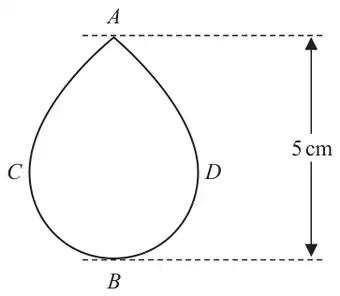
Figure 1 shows the vertical cross section of a child’s spinning top. The point \(A\) is vertically above the point \(B\) and the height of the spinning top is 5 cm.
The line \(CD\) is perpendicular to \(AB\) such that \(CD\) is the maximum width of the spinning top.
The spinning top is modelled as the solid of revolution created when part of the curve with polar equation
\[r^2 = 25\cos 2\theta\]is rotated through \(2\pi\) radians about the initial line.
| Scheme | Marks | AO |
|---|---|---|
| \(\displaystyle \mathrm{SA} = 2\pi\int r\sin\theta\sqrt{r^2 + \left(\frac{\mathrm{d}r}{\mathrm{d}\theta}\right)^2}\,\mathrm{d}\theta = 2\pi\int r\sin\theta\sqrt{25\cos 2\theta + \ldots}\,\mathrm{d}\theta\) Or \(\displaystyle \mathrm{SA} = 2\pi\int r\cos\theta\sqrt{r^2 + \left(\frac{\mathrm{d}r}{\mathrm{d}\theta}\right)^2}\,\mathrm{d}\theta = 2\pi\int r\cos\theta\sqrt{25\cos 2\theta + \ldots}\,\mathrm{d}\theta\) | M1 | 2.1 |
| \(\displaystyle \begin{aligned} &r^2 = 25\cos 2\theta \Rightarrow 2r\frac{\mathrm{d}r}{\mathrm{d}\theta} = k\sin 2\theta \\[6pt] &\text{Or } r = 5\cos^{\frac{1}{2}}2\theta \Rightarrow \frac{\mathrm{d}r}{\mathrm{d}\theta} = A\cos^{-\frac{1}{2}}2\theta \times B\sin 2\theta\ \text{(oe)} \end{aligned}\) | M1 | 2.1 |
| \(\displaystyle \begin{aligned} &2r\frac{\mathrm{d}r}{\mathrm{d}\theta} = -50\sin 2\theta \text{ or } \frac{\mathrm{d}r}{\mathrm{d}\theta} = \frac{-50\sin 2\theta}{2r} \\[6pt] &\text{Or } \frac{\mathrm{d}r}{\mathrm{d}\theta} = \frac{5}{2}\cos^{-\frac{1}{2}}2\theta \times -2\sin 2\theta\ \text{(oe)} \end{aligned}\) | A1 | 1.1b |
| \(\displaystyle \mathrm{SA} = 2\pi\int 5\sqrt{\cos 2\theta}\sin\theta\sqrt{25\cos 2\theta + \frac{25\sin^2 2\theta}{\cos 2\theta}}\,\mathrm{d}\theta\) \(\displaystyle = 2\pi\int 5\sqrt{\cos 2\theta}\sin\theta\frac{5}{\sqrt{\cos 2\theta}}\,\mathrm{d}\theta = k\pi\int\sin\theta\,\mathrm{d}\theta\) (may use \(\cos\theta\)) | M1 | 2.1 |
| \(\displaystyle = 50\pi\int\sin\theta\,\mathrm{d}\theta\) or \(\displaystyle 50\pi\int\cos\theta\,\mathrm{d}\theta\) | A1 | 1.1b |
| \(\displaystyle = 50\pi\int_0^{\frac{\pi}{4}}\sin\theta\,\mathrm{d}\theta = 50\pi\big[-\cos\theta\big]_0^{\frac{\pi}{4}}\) | M1 | 3.4 |
| \(= 25\pi\left(2 - \sqrt{2}\right)\) (cm2) | A1 | 2.2a |
| (7) |
Notes
M1: Applies the surface area formula about the \(x\) or \(y\) axis with substitution of at least the \(r^2\) and attempt at \(\left(\dfrac{\mathrm{d}r}{\mathrm{d}\theta}\right)^2\) as shown in scheme. May be completed in stages, so allow if correct formula quoted and the relevant “pieces” are found. The \(2\pi\) may be recovered later but must be present at some stage.
M1: Attempts to find an expression in \(\dfrac{\mathrm{d}r}{\mathrm{d}\theta}\) via implicit differentiation or first square rooting and then using the chain rule.
A1: Correct expression for or in \(\dfrac{\mathrm{d}r}{\mathrm{d}\theta}\) need not be simplified.
M1: Makes a complete substitution into the SA formula and applies appropriate trigonometric identities to simplify to the form \(k\pi\displaystyle\int\sin\theta\,\mathrm{d}\theta\) or \(k\pi\displaystyle\int\cos\theta\,\mathrm{d}\theta\) as appropriate for their method.
A1: Obtains a correct simplified integral.
M1: Uses the model with appropriate limits to determine the surface area of the top using their integral. Note that for rotation around the \(x\) axis appropriate limits will likely be 0 and \(\dfrac{\pi}{4}\) but may be \(-\dfrac{\pi}{4}\) and 0. For rotation about the \(y\) axis allow this mark for limits \(\dfrac{\pi}{4}\) and \(\dfrac{\pi}{2}\) (note that the curve is not strictly defined for these limits).
A1: Correct expression with no errors. Must come from a correct integral – so if rotation about the \(y\) axis is used they must have made clear reference to using \(r^2 = -25\cos 2\theta\) as the curve.
| Scheme | Marks | AO |
|---|---|---|
| Adopts the correct strategy by: Attempting \(\dfrac{\mathrm{d}y}{\mathrm{d}\theta}\), finding \(\theta\) when \(\dfrac{\mathrm{d}y}{\mathrm{d}\theta} = 0\) and using their value of \(\theta\) to find \(CD\) | M1 | 3.1a |
| \(\displaystyle y = r\sin\theta = 5\sqrt{\cos 2\theta}\sin\theta\) \(\displaystyle \Rightarrow \frac{\mathrm{d}y}{\mathrm{d}\theta} = -\frac{5\sin 2\theta\sin\theta}{\sqrt{\cos 2\theta}} + 5\sqrt{\cos 2\theta}\cos\theta\) | M1 | 1.1b |
| \(\displaystyle \frac{\mathrm{d}y}{\mathrm{d}\theta} = 0 \Rightarrow 5\cos\theta - 20\cos\theta\sin^2\theta = 0 \Rightarrow \theta = \ldots\) | M1 | 2.1 |
| E.g. \(\displaystyle \sin^2\theta = \frac{1}{4} \Rightarrow \theta = \frac{\pi}{6}\) or \(\displaystyle \cos 3\theta = 0 \Rightarrow 3\theta = \frac{\pi}{2} \Rightarrow \theta = \frac{\pi}{6}\) | A1 | 1.1b |
| \(\displaystyle CD = 2r\sin\frac{\pi}{6} = 2 \times 5 \times \sqrt{\cos\frac{\pi}{3}} \times \frac{1}{2}\ ;\ = \frac{5\sqrt{2}}{2}\) (cm) * | M1; A1* | 3.4 2.1 |
| (6) | ||
| (13 marks) |
Notes
M1: A complete method for finding \(CD\). Need to see the maximum identified and the length of \(CD\) calculated (watch out as \(r\) is the same value as \(CD\) so check they are finding \(CD\))
M1: Uses the product rule correctly to differentiate \(r\sin\theta\) – expect the correct form \(\alpha\sin 2\theta\sin\theta(\cos 2\theta)^{-\frac{1}{2}} + \beta\cos\theta(\cos 2\theta)^{\frac{1}{2}}\)
M1: Makes progress by setting their derivative (which may be \(\dfrac{\mathrm{d}y}{\mathrm{d}\theta}\) or \(\dfrac{\mathrm{d}x}{\mathrm{d}\theta}\)) equal to 0 and proceeding via correct trig work to reach a value for \(\theta\). Various routes are possible e.g.
\(\displaystyle \frac{\mathrm{d}y}{\mathrm{d}\theta} = 0 \Rightarrow 5\cos\theta - 20\cos\theta\sin^2\theta = 0 \Rightarrow \cos\theta\left(1 - 4\sin^2\theta\right) = 0 \Rightarrow \sin\theta = \ldots \Rightarrow \theta = \ldots\)
\(\displaystyle \frac{\mathrm{d}y}{\mathrm{d}\theta} = 0 \Rightarrow \cos 2\theta\cos\theta - \sin 2\theta\sin\theta = 0 \Rightarrow \cos 3\theta = 0 \Rightarrow 3\theta = \ldots \Rightarrow \theta = \ldots\)
\(\displaystyle \frac{\mathrm{d}y}{\mathrm{d}\theta} = 0 \Rightarrow \tan 2\theta = \frac{1}{\tan\theta} \Rightarrow \frac{2\tan\theta}{1 - \tan^2\theta} = \frac{1}{\tan\theta} \Rightarrow \tan^2\theta = \ldots \Rightarrow \theta = \ldots\)
A1: Correct value for \(\theta\) from correct working – derivative must have been correct. May be implied by correct sin and cosine values used in formulae. SC Award for \(\dfrac{\pi}{3}\) if using \(x = r\cos\theta\)
M1: Uses their value of \(\theta\) in the model to find CD, ie \(CD = 2 \times 5\sqrt{\cos\text{“}2\theta\text{”}} \times \sin\text{“}\theta\text{”}\)
Allow for use of \(2r\cos\theta\) for attempts stemming from \(\dfrac{\mathrm{d}x}{\mathrm{d}\theta} = 0\)
A1*: cso Correct proof
NB for \(x = r\cos\theta\) used, a maximum M0M0M1A1M1A0 can be gained unless \(r^2 = -25\cos 2\theta\) is used, in which case full marks is possible.
ALT for (b):
M1: for correct overall strategy of finding expression for width and maximising (via any valid method, e.g completion of square, calculus).
M1: \(CD = 2r\sin\theta = 10\sqrt{\cos 2\theta\sin^2\theta} = 10\sqrt{\sin^2\theta - 2\sin^4\theta}\) forms trig expression inside square root.
M1A1: \(\sin^2\theta - 2\sin^4\theta = -2\left(\sin^4\theta - \tfrac{1}{2}\sin^2\theta\right) = -2\left(\left(\sin^2\theta - \tfrac{1}{4}\right)^2 - \dfrac{1}{16}\right)\) completes the square.
Alternatively may optimise via calculus – score for full method leading to a value for \(\theta\)
M1: Hence max value for \(CD\) is \(10 \times \sqrt{\text{“}\tfrac{1}{8}\text{”}}\). Correct method to achieved \(CD\).
A1: Correct proof.