
A2 October 2020 Q2
2.
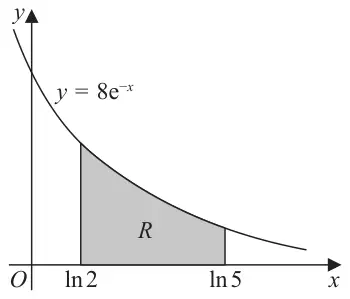
A uniform plane figure \(R\), shown shaded in Figure 1, is bounded by the \(x\)-axis, the line with equation \(x = \ln 5\), the curve with equation \(y = 8\mathrm{e}^{-x}\) and the line with equation \(x = \ln 2\). The unit of length on each axis is one metre.
The area of \(R\) is \(2.4\ \text{m}^2\)
The centre of mass of \(R\) is at the point with coordinates \((\bar{x}, \bar{y})\).
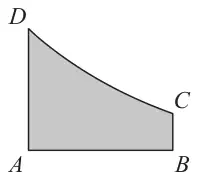
Figure 2 shows a uniform lamina \(ABCD\), which is the same size and shape as \(R\). The lamina is freely suspended from \(C\) and hangs in equilibrium with \(CB\) at an angle \(\theta^\circ\) to the downward vertical.
| Scheme | Marks | AO |
|---|---|---|
| \(2.4\bar{y} = \dfrac{1}{2}\displaystyle\int y^2\,\mathrm{d}x = \dfrac{1}{2}\int\left\{64\mathrm{e}^{-2x}\right\}\mathrm{d}x\) | M1 | 2.1 |
| \(= -16\left[\mathrm{e}^{-2x}\right]_{\ln 2}^{\ln 5}\) | A1 | 1.1b |
| Complete strategy to find \(\bar{y}\) | M1 | 3.1a |
| \(2.4\bar{y} = -16\mathrm{e}^{-\ln 25} + 16\mathrm{e}^{-\ln 4} = \dfrac{16}{4} - \dfrac{16}{25} = \dfrac{84}{25}\), \(\bar{y} = \dfrac{84}{25}\times\dfrac{10}{24}\ \left(= \dfrac{7}{5}\right) = 1.4\) * | A1* | 2.2a |
| (4) |
Notes
M1: Moments equation to obtain terms of the correct form (with or without limits)
Allow if area (2.4) not seen
A1: Correct unsimplified answer (with or without limits)
Allow if area (2.4) not seen
M1: Complete strategy for \(\bar{y}\): use of moments equation with correct use of limits and division by area
A1*: Use moments equation and given area to deduce given answer from correct working
| Scheme | Marks | AO |
|---|---|---|
| \(2.4\bar{x} = \displaystyle\int\left(8x\mathrm{e}^{-x}\right)\mathrm{d}x\) | M1 | 2.1 |
| \(\left(= \left[-8x\mathrm{e}^{-x} - 8\mathrm{e}^{-x}\right]_{\ln 2}^{\ln 5}\right)\) | ||
| \(= -\dfrac{8}{5}(\ln 5 + 1) + \dfrac{8}{2}(\ln 2 + 1)\ (= 2.5974\ldots)\) | M1 | 1.1b |
| \(\bar{x} = 1.08\) | A1 | 1.1b |
| Complete strategy to find \(\theta\) | M1 | 3.1a |
| \(\tan\theta^\circ = \dfrac{\ln 5 - \bar{x}}{8\mathrm{e}^{-\ln 5} - 1.4}\ (= 2.63\ldots)\) | A1ft | 3.4 |
| \(\theta = 69\) | A1 | 1.1b |
| (6) | ||
| (10 marks) |
Notes
M1: Use correct integral (with or without limits). Allow if area (2.4) not seen
M1: Correct use of correct limits in an integral of the correct form and 2.4
A1: Correct answer (1.0822….)
M1: Complete strategy to find \(\theta\) e.g find \(\bar{x}\) and then use trig to find appropriate angle
A1ft: Use the model to find a relevant angle. Follow their \(\bar{x}\)
A1: 2 s.f. or better 69.22...