
A2 June 2022 Paper 1 Q9
9 The cube roots of unity are represented on the Argand diagram below by the points \(A\), \(B\) and \(C\).
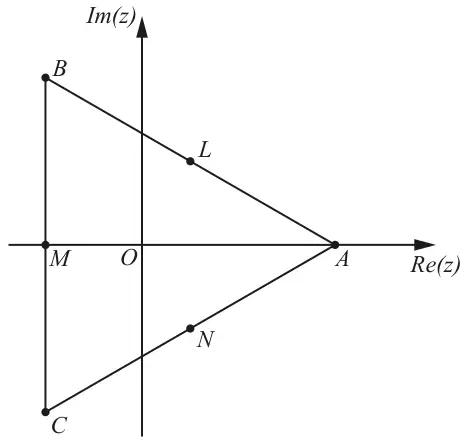
The points \(L\), \(M\) and \(N\) are the midpoints of the line segments \(AB\), \(BC\) and \(CA\) respectively.
Determine a degree 6 polynomial equation with integer coefficients whose roots are the complex numbers represented by the points \(A\), \(B\), \(C\), \(L\), \(M\) and \(N\). [5]
| Scheme | Marks | AO |
|---|---|---|
| Vertices of \(ABC\) satisfy \(z^3 - 1\ (= 0)\) | B1 | 1.1 |
| (Complex number represented by) \(M = -\frac{1}{2}\) | B1 | 3.1a |
| Vertices of \(LMN\) satisfy \(8z^3 + 1\ (= 0)\) | M1 | 3.1a |
| \(\left(z^3 - 1\right)\left(8z^3 + 1\right)\ (= 0)\) | M1 | 2.1 |
| \(8z^6 - 7z^3 - 1 = 0\) | A1 | 2.2a |
| [5] |
Notes
B1: Or \((z - 1)\left(z - \mathrm{e}^{\frac{2}{3}\pi\mathrm{i}}\right)\left(z - \mathrm{e}^{\frac{4}{3}\pi\mathrm{i}}\right)(= 0)\) Or all three values stated
B1: Or one of \(M = \frac{1}{2}\mathrm{e}^{\pi\mathrm{i}}, L = \frac{1}{2}\mathrm{e}^{\frac{1}{3}\pi\mathrm{i}}, N = \frac{1}{2}\mathrm{e}^{-\frac{1}{3}\pi\mathrm{i}}\)
M1: Attempt at polynomial relating to \(LMN\).
\(\left(z - \frac{1}{2}\mathrm{e}^{\pi\mathrm{i}}\right)\left(z - \frac{1}{2}\mathrm{e}^{\frac{1}{3}\pi\mathrm{i}}\right)\left(z - \frac{1}{2}\mathrm{e}^{-\frac{1}{3}\pi\mathrm{i}}\right)\) suffices for this mark.
M1: Attempt product of their two cubic factors.
A1: A0 without justification of \(8z^3 + 1 = 0\). Must see \(= 0\).
Alternative method
| Scheme | Marks |
|---|---|
| \(A(1)\), \(B\left(-\dfrac{1}{2} + \dfrac{\sqrt{3}}{2}\mathrm{i}\right)\), \(C\left(-\dfrac{1}{2} - \dfrac{\sqrt{3}}{2}\mathrm{i}\right)\) | B1 |
| \(L\left(\dfrac{1}{4} + \dfrac{\sqrt{3}}{4}\mathrm{i}\right)\), \(N\left(\dfrac{1}{4} - \dfrac{\sqrt{3}}{4}\mathrm{i}\right)\), \(M\left(-\dfrac{1}{2}\right)\) | B1 |
| Quadratic satisfying \(B\), \(C\): \(z^2 + z + 1 = 0\) Quadratic satisfying \(L\), \(N\): \(4z^2 - 2z + 1 = 0\) Quadratic satisfying \(A\), \(M\): \(2z^2 - z - 1 = 0\) | M1 |
| Eqn satisfying all 6 points \(\left(z^2 + z + 1\right)\left(4z^2 - 2z + 1\right)\left(2z^2 - z - 1\right) = 0\) | M1 |
| \(\Rightarrow 8z^6 - 7z^3 - 1 = 0\) | A1 |
B1: Finding A, B, C
B1: Finding L, M, N
M1: Combining to give a 6th degree polynomial
M1: Multiplying out some terms to give quadratics or cubics
A1: Must see = 0
Alternative methods
By rotational symmetry Because \(\left(\mathrm{e}^{\frac{2}{3}\pi\mathrm{i}}\right)^3 = 1\)
Calculation of vertices of \(L\), \(M\) and \(N\). Use of \(1 + \omega + \omega^2 = 0\) (and \(\omega^3 = 1\)) to simplify eg \((z - \frac{1}{2}(\omega + 1))(z - \frac{1}{2}(\omega^2 + 1))\ ))(z - \frac{1}{2}(\omega + \omega^2))\) \(= (z + \frac{1}{2}\omega^2))(z + \frac{1}{2}\omega)\ ))(z + \frac{1}{2})\) etc or to find sum/product of roots.