
A2 June 2022 Paper 1 Q5
5 The diagram below shows the curve \(C\) with polar equation \(r = 3(1 - \sin 2\theta)\) for \(0 \leqslant \theta \leqslant 2\pi\).
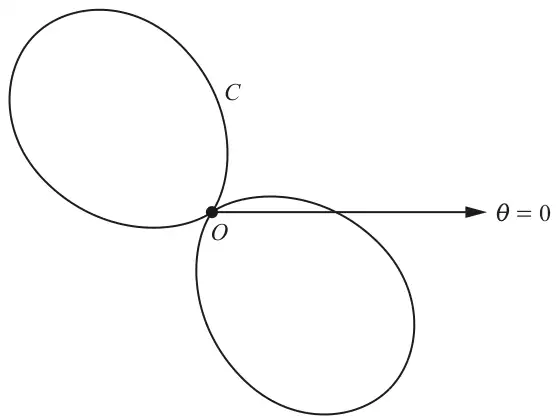
Find the exact area of each of the loops of \(C\). [6]
| Scheme | Marks | AO |
|---|---|---|
| AG \(r = 3\left(1 - \dfrac{2xy}{r^2}\right)\) | M1 | 1.1 |
| \(\Rightarrow r^3 = 3\left(r^2 - 2xy\right) = 3(x - y)^2\) | A1 | 1.1 |
| \(\Rightarrow r^6 = 9(x - y)^4\) \(\Rightarrow \left(x^2 + y^2\right)^3 = 9(x - y)^4\) | A1 | |
| [3] |
Notes
M1: Fully shown (AG). Use of double angle formula and \(y = r\sin\theta,\ x = r\cos\theta\) oe
A1: Any correct form of the equation with \(\theta\) eliminated.
A1: Fully shown
| Scheme | Marks | AO |
|---|---|---|
| \(\Rightarrow \left(y^2 + x^2\right)^3 = 9(y - x)^4\) | M1 | 3.1a |
| \(\Rightarrow \left(x^2 + y^2\right)^3 = 9\left(-(x - y)\right)^4\) \(= 9(-1)^4(x - y)^4\) \(\Rightarrow \left(x^2 + y^2\right)^3 = 9(x - y)^4\) | A1 | 2.4 |
| [2] |
Notes
M1: Interchange of \(x\) and \(y\)
A1: Showing/explaining clearly that interchange of \(x\) and \(y\) leaves the equation unchanged.
(corrected from the printed mark scheme: the printed line reads \(9\left(-1^4\right)(x - y)^4\); the factor is \((-1)^4\))
Alternative method
| Scheme | Marks |
|---|---|
| \(\sin 2\left(\dfrac{1}{4}\pi + \alpha\right) = \sin 2\left(\dfrac{1}{4}\pi - \alpha\right)\) or \(\sin 2\left(\dfrac{5}{4}\pi + \alpha\right) = \sin 2\left(\dfrac{5}{4}\pi - \alpha\right)\) | M1 |
| So \(\theta = \frac{1}{4}\pi\) (and \(\theta = \frac{5}{4}\pi\) are lines of symmetry). So \(y = x\) is a line of symmetry. | A1 |
| [2] |
M1: Showing that \(\sin 2\theta\) is symmetrical about \(\theta = \frac{1}{4}\pi\) (or \(\theta = \frac{5}{4}\pi\)). May be done graphically or using trig identities.
A1: so \(r = 3(1 - \sin 2\theta)\) has lines of symmetry at \(\theta = \frac{1}{4}\pi\) and \(\theta = \frac{5}{4}\pi\) and the line \(y = x\) has polar equation \(\theta = \frac{1}{4}\pi\) and \(\theta = \frac{5}{4}\pi\).
Any mention of \(\theta = \frac{5}{4}\pi\) is unnecessary since it is implied by the \(\theta = \frac{1}{4}\pi\) case.
| Scheme | Marks | AO |
|---|---|---|
| DR \(\displaystyle A = \frac{1}{2}\int_{\pi/4}^{5\pi/4} 9(1 - \sin 2\theta)^2\,\mathrm{d}\theta\) | B1 M1 | 2.2a 1.1 |
| \(\displaystyle = \frac{1}{2}\int_{\pi/4}^{5\pi/4} 9\left(1 - 2\sin 2\theta + \sin^2 2\theta\right)\mathrm{d}\theta\) \(\displaystyle = \frac{1}{2}\int_{\pi/4}^{5\pi/4} 9\left(1 - 2\sin 2\theta + \frac{1}{2}(1 - \cos 4\theta)\right)\mathrm{d}\theta\) | M1* | 1.1 |
| \(\displaystyle = \frac{9}{2}\left[\frac{3}{2}\theta + \cos 2\theta - \frac{1}{8}\sin 4\theta\right]_{\pi/4}^{5\pi/4}\) | M1dep | 1.1 |
| \(= \dfrac{9}{2}\left(\dfrac{3}{2}\left(\dfrac{5\pi}{4} - \dfrac{\pi}{4}\right) + 0 + 0\right) = \dfrac{27\pi}{4}\) | M1 | 3.1a |
| Other loop is the same | A1 | 2.2a |
| [6] |
Notes
B1: For identifying appropriate limits correctly
M1: Use of \(A = \dfrac{1}{2}\displaystyle\int r^2\,\mathrm{d}\theta\)
M1*: Expand correctly and use of \(\sin^2 2\theta = \dfrac{1}{2}(1 - \cos 4\theta)\) Ignore limits
M1dep: Integrate
M1: Substituting correct limits and subtracting
A1: Answer for each loop which must be stated
Alternative method for last 2 marks
| Scheme | Marks |
|---|---|
| Using limits 0 to \(2\pi\) \(\displaystyle = \frac{9}{2}\left[\frac{3}{2}\theta + \cos 2\theta - \frac{1}{8}\sin 4\theta\right]_0^{2\pi}\) | M1 |
| \(= \dfrac{9}{2}(3\pi + 0 + 0) = \dfrac{27\pi}{2}\) for both loops \(\Rightarrow \dfrac{27\pi}{4}\) for one loop by symmetry in \(y = x\) | A1 |
M1: Substituting correct limits and subtracting
A1: Answer for each loop which must be stated