
A2 June 2025 Q4
4.
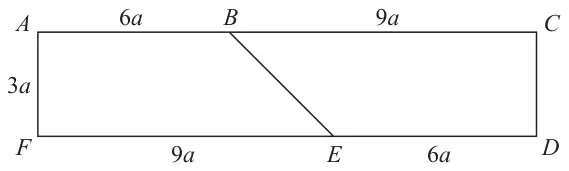
The uniform rectangular lamina \(ACDF\) shown in Figure 5 has \(AC = FD = 15a\) and \(AF = CD = 3a\). The point \(B\) on \(AC\) is such that \(AB = 6a\). The point \(E\) on \(FD\) is such that \(ED = 6a\).
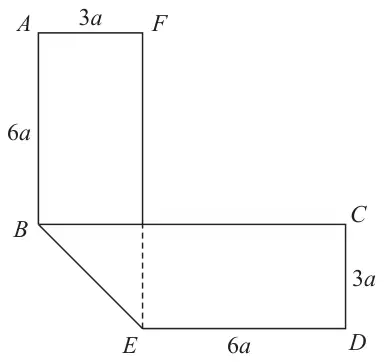
The rectangular lamina is folded along \(BE\) to form the folded lamina shown in Figure 6.
The folded lamina has \(AB\) perpendicular to \(BC\) and the two sections, \(ABEF\) and \(BEDC\), of the lamina lie in the same plane.
The folded lamina is freely suspended from \(F\) and hangs in equilibrium.
| Scheme | Marks | AO | |||||||||||||||
|---|---|---|---|---|---|---|---|---|---|---|---|---|---|---|---|---|---|
| B1 B1 | 1.1b 1.1b | |||||||||||||||
| Moments about \(EF\) | M1 | 2.1 | |||||||||||||||
| \(2 \times -1.5a + 1 \times -a + 2 \times 3a = 5d\) | A1 | 1.1b | |||||||||||||||
| Distance \(= \dfrac{2}{5}a\) * | A1* | 2.2a | |||||||||||||||
| (5) |
Notes
B1: Correct mass ratios
B1: Correct distances from \(EF\) or a parallel axis
M1: Moments about \(EF\) or a parallel axis. Need all terms. Dimensionally correct. Condone sign errors.
A1: Correct unsimplified moments equation (E.g. \(45d = 18 \times 1.5a + 9 \times 2a + 18 \times 6a\))
A1*: Obtain given answer from correct working.
| Scheme | Marks | AO |
|---|---|---|
| The perpendicular bisector of \(BE\) is a line of symmetry | B1 | 2.4 |
| (1) |
Notes
B1: Or equivalent reasoning mentioning symmetry with no incorrect statements.
| Scheme | Marks | AO |
|---|---|---|
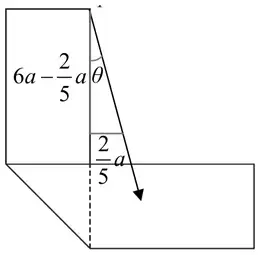 | ||
| Vertical distance of c of m from \(F = \dfrac{28a}{5}\) | B1 | 3.1a |
| \(\tan\theta = \dfrac{2}{28}\) | M1 | 1.1b |
| \(\theta = \tan^{-1}\left(\dfrac{1}{14}\right) = 4.09^\circ \quad (4.1^\circ) \quad (0.071 \text{ rads})\) | A1 | 1.1b |
| (3) | ||
| (9 marks) |
Notes
B1: Correct vertical distance using symmetry or a second moments equation
M1: Use of trig to find a relevant angle. Must be dimensionally correct.
Award if using an incorrectly evaluated vertical distance of the form \(6a \pm \bar{y}\), where \(\bar{y} = \dfrac{2a}{5}\) or is calculated from a moments equation.
A1: Correct only. \(4.1^\circ\) or better (4.08561678…)